Mortgage Note Investing Questions From New Investors
Answers to common mortgage note investing questions from new investors: due diligence timing, pricing models, loan acceleration and starting capital.
Where Do the Questions Come From?
Every investor who has researched mortgage notes has hit the same wall. The basics make sense -- you buy debt secured by real estate, collect payments or work out a resolution, and earn a return. But the moment you start evaluating an actual loan, the questions multiply. What research do you do before committing money? How do you price a non-performing loan? What happens when a bank accelerates the balance? How do you systematize a process that seems to have dozens of moving parts?
These are not hypothetical questions. They came directly from investors during a live Q&A session, and the answers reflect the operational reality of buying and managing mortgage notes in the secondary mortgage market. If you are new to the asset class, start with What Is Mortgage Note Investing? for the foundational framework and the complete guide to investing in mortgage notes for the full process, then come back here for the practical details that surface once you start doing the work.
What Parts of Due Diligence Should You Do Before vs. After the Letter of Intent?
This is one of the most important workflow questions in the business, and getting it wrong costs you either money or deal flow.
The letter of intent (LOI) is the dividing line between free research and paid research. Before you submit an LOI, your goal is to confirm the basic facts the seller has represented to you on the data tape -- and to develop a defensible pricing position -- without spending money on third-party reports.
Before the LOI (free research):
- Confirm secured vs. unsecured. Use county records or a property data tool to verify that the property owner matches the borrower name on the data tape. If the collateral address does not tie to the borrower, you may be looking at an unsecured debt -- which changes the entire valuation.
- Check the assignment chain. Go to the county public records and confirm that the seller appears on a recorded assignment of mortgage. If the seller is not in the chain of title, that is a red flag worth addressing before you spend another minute on the loan.
- Run free property valuations. Check Zillow for the Zestimate and recently sold comps in the area. Pull up Google Street View to assess the property condition -- and check the date stamp in the corner to confirm the imagery is recent. A Street View image from five years ago tells you very little about current condition.
- Price the loan. For performing loans, run your yield calculations (cash-on-cash return, internal rate of return). For non-performing loans, develop your bid based on a percentage of fair market value (for first liens) or a percentage of unpaid principal balance (for junior liens). You need to be confident in your number before the LOI goes out.
After the LOI (paid research):
- Order a BPO or property valuation to confirm the fair market value you estimated during desktop underwriting.
- Pull a title report to verify lien position, check for outstanding taxes, municipal liens, judgments, or other encumbrances.
- Run a credit report on the borrower to assess their current financial profile and payment behavior.
- Skip trace the borrower to verify current contact information and occupancy status.
The reason for this split is both financial and strategic. You do not want to spend a few hundred dollars on due diligence reports for a loan that another buyer snaps up before you can submit an offer. But you also do not want to submit an LOI at a price you cannot defend -- because if your paid due diligence reveals problems and you significantly fade your offer, you burn the relationship with that seller. In this business, your reputation as a reliable closer is one of your most valuable assets.
The LOI gives the seller confidence that you are a serious buyer, and it gives you exclusivity (or at least priority) on the loan while you spend money to verify the data. Both sides benefit from that structure.
How Do You Price Non-Performing Notes?
Pricing is where most new investors feel the least confident, and it is also where a systematic approach pays the biggest dividends.
The pricing methodology depends entirely on whether the loan is producing cash flow.
Performing and re-performing loans are priced on yield. You are buying a known payment stream, so the question is: at what purchase price does this cash flow produce an acceptable return? Junior liens carry more risk, so buyers demand higher yields on them than on senior liens. Lower yields mean higher prices -- a loan yielding 8% costs more than one yielding 12%.
Non-performing first liens are priced as a percentage of fair market value. The investor's downside protection is the property itself, so FMV is the anchor. Where a given loan lands depends on the borrower's situation, property condition, state foreclosure timelines, and occupancy status.
Non-performing junior liens are priced as a percentage of unpaid principal balance. Because the equity position behind a senior lien is uncertain, the UPB becomes the pricing reference, and the specific price is driven by equity coverage, senior lien status, and bankruptcy exposure. For recent prices by lien position on our marketplace, see the FIXnotes Market Index.
For where supply stands now, our NPL Explorer tracks noncurrent loans at every U.S. bank from their quarterly Call Reports.
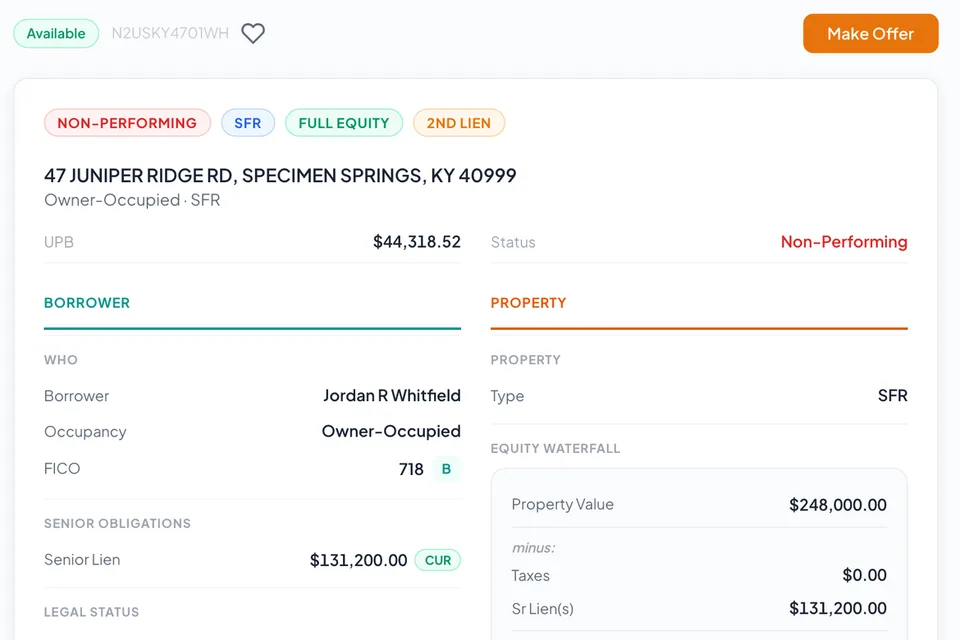
This is why confirming property value and senior lien status during your free research phase matters so much. For a non-performing second mortgage, the three variables that most affect pricing are: (1) whether the senior lien is current, delinquent, or unknown; (2) whether the borrower has equity above the senior lien balance; and (3) whether the borrower is in bankruptcy. Every permutation of those three factors lands in a different pricing bucket.
Can Letter of Intent Bids Be Purely Mathematical?
Yes -- and eventually they should be. But you need to build the model manually first so you understand the logic behind it.
The approach that works at scale is to create a pricing matrix. Define every permutation of the key variables for your asset class, assign a price to each permutation, and then use a lookup formula to automatically apply the right price to each loan in a portfolio.
For non-performing junior liens, the key variables are:
- Senior lien status -- current, delinquent, or in foreclosure
- Equity position -- positive equity, partial equity, or underwater
- Bankruptcy status -- active, dismissed, or none
Each combination produces a distinct risk profile, and each risk profile commands a distinct price. A senior-current, positive-equity, no-bankruptcy loan sits in the top pricing tier. A senior-delinquent, underwater, active-bankruptcy loan sits at the bottom. Everything else falls somewhere in between, and you set the percentage for each cell from your own target returns and recent trades.
Once your matrix is built, you can price a portfolio of hundreds of loans in minutes by running a VLOOKUP against the asset categories. And because the pricing inputs are adjustable, you can quickly model aggressive vs. conservative scenarios by tweaking the percentages in the matrix without recalculating each loan individually.
The important caveat: this model gives you indicative pricing for your LOI. It does not replace the detailed due diligence you conduct after the LOI is accepted. The model gets you to a defensible bid quickly. The paid research confirms whether that bid should hold, adjust, or walk.
What Is Loan Acceleration and How Does It Impact Note Investors?
When a borrower defaults, the lender can invoke the acceleration clause in the note and mortgage, usually after a notice of default and a chance to cure: the full balance becomes due and payable immediately, and the loan is no longer amortizing on its original schedule. (Acceleration and charge-off are separate events. A charge-off is an accounting write-down on the lender's books.)
Acceleration does not always end the borrower's right to reinstate. The Fannie Mae/Freddie Mac uniform security instruments, for example, let a borrower reinstate after acceleration by paying "all sums which then would be due ... as if no acceleration had occurred," plus costs, up to shortly before the sale (Section 19), and many state laws provide a similar right.
For note investors, this distinction matters in two ways.
First, it changes the conversation with the borrower. Once a loan is accelerated, the demand is for the full balance. Even where the borrower keeps a right to reinstate, a long-delinquent borrower often cannot afford years of arrears either -- which is exactly why loan modifications are the primary workout tool for charged-off debt. You use the accelerated balance as a starting point for negotiation, then work toward a modification agreement that includes a down payment (to demonstrate borrower commitment) and a new monthly payment plan the borrower can sustain.
Second, it affects how you account for interest accrual. When you acquire a charged-off loan, the most conservative and defensible approach is to use the unpaid principal balance at the time of charge-off as your baseline -- not a balance that includes years of retroactively calculated interest accrual. Once the loan is boarded onto your servicer's platform and actively receiving statements again, you can begin accruing interest going forward. But retroactively applying accruals from the period when the loan was sitting on a bank's books unserviced is legally risky: under Regulation Z, a servicer that stops sending periodic statements on a charged-off loan may not later assess interest or fees for that period (12 CFR 1026.41(e)(6)).
Your attorney and your servicer will guide you on the specifics for each state. Different servicers handle accelerated balances differently, and state law varies on what accruals are enforceable. The safe default is to pursue the UPB and let your legal counsel advise on anything beyond that.
What Automation Can You Use in Due Diligence?
The answer depends on your portfolio size. At scale (50+ loans), bulk data services and API integrations can automate large portions of the due diligence workflow. At smaller volumes, the opportunities are narrower but still meaningful.
Bankruptcy monitoring. Bankruptcy data services search PACER (Public Access to Court Electronic Records) for your borrowers and return case data -- filing date, chapter (7, 11, or 13), disposition status, and case number. This works for single loans and bulk portfolios alike, and it doubles as a portfolio monitoring tool: instead of manually checking PACER for each borrower, you get an alert when a borrower's bankruptcy status changes.
Credit reporting. For larger portfolios, credit bureaus and resellers offer batch processing: you upload a formatted data file and receive credit data on every borrower in the pool. On a handful of loans, you pull reports one at a time.
Property data. Data vendors that serve mortgage lenders sell bundled data -- credit, AVMs (automated valuation models), bankruptcy status, and ownership history -- in bulk. This is powerful for large-tape analysis but usually requires a specific file format and a credentialing process to access.
Workflow automation. Tools like Zapier allow you to connect web services without writing code. You can build workflows that pull data from email, route it into a Google Sheet or CRM, and trigger follow-up actions automatically. For example, an investor could scrape property data from Zillow email alerts into a Google Sheet using Zapier, creating a lightweight pipeline that feeds their research process.
The principle behind all of this is the same: complete the process manually first so you understand every step, document it, and then identify which steps are high-volume and repeatable enough to justify automation. Automating a process you do not fully understand just means you will make mistakes faster.
How Do You Turn a Non-Performing Loan Into a Performing Asset?
This is the core mechanic of NPL investing, and a worked example shows it better than theory.
Consider a non-performing second lien secured by a single-family property. Fair market value: $190,200. Senior lien balance: $115,950. That leaves roughly $74,000 in equity -- but the junior lien's unpaid principal balance is $56,950, so the equity only partially covers the debt. The combined loan-to-value from the borrower's perspective exceeds 100%. From the investor's perspective, though, the invested capital is well below the available equity.
The investor purchased this loan for $12,520 -- about 22% of UPB. Total expenses (due diligence, servicing setup, collections, modification processing) came to $450.
Suppose the workout follows a common path. A medical hardship put the borrowers behind, but they still live in the property, have brought the senior lien current, and can afford about $550 per month.
The modification terms: $250 modification fee, $568/month, 15-year term, 8.75% interest rate. Two months from acquisition to signed modification agreement.
The result: a re-performing loan. If a buyer pays about $35,000 for it, they earn roughly 18.8% net cash-on-cash after servicing fees, and the NPL investor who sells after about eight months of seasoning earns an internal rate of return in the hundreds of percent.
That is the Fix and Flip model applied to debt instead of property. Buy a broken loan at a steep discount, fix the payment situation through a modification, and either hold for cash flow or sell to a yield-seeking investor at a premium to your basis.
What Should You Look for When Buying Re-Performing Loans?
If the NPL investor is the flipper, the re-performing loan buyer is the long-term holder. And long-term holders need to underwrite differently than workout specialists.
The key risk factors on a re-performing second lien are:
- Senior lien status. A current senior lien is the baseline expectation. A rolling delinquency on the senior (consistently 30-60 days late) is a warning sign that the borrower is financially stretched. It does not disqualify the deal, but it should command a higher yield to compensate for the added risk.
- Occupancy. Owner-occupied properties tend to keep performing better than vacant or tenant-occupied properties. The borrower has a personal stake in keeping the home.
- Modification seasoning. How long has the borrower been making payments under the new terms? Many buyers want to see six to twelve months of consistent payments before they treat a loan as re-performing. Longer seasoning means lower risk.
- Equity coverage. Calculate not just whether equity exists, but the ratio of equity to your invested capital. A 2-3x equity coverage ratio gives you a meaningful cushion if property values decline or if you ultimately need to pursue foreclosure.
Re-performing second liens in bulk sales can price at higher yields than one-off purchases when the seller is liquidating quickly, so a package buyer may earn returns on individual loans that retail pricing would not offer.
How Much Capital Do You Actually Need to Get Started?
This question comes up in every conversation with new investors. The full breakdown is covered in How Much Money Do You Need to Start Investing in Mortgage Notes?, but the short version from this Q&A: our rule of thumb is $30,000 to $50,000 in available capital for your first deal if you are buying a first-position note.
That number is not just the purchase price. It covers due diligence costs, servicing setup, legal reserves, back property taxes, insurance, and the carrying costs you will incur while the loan resolves. Non-performing loans do not resolve on your schedule. A modification might take a few months. A foreclosure in a judicial state can take years (each state's process and typical timeline is on our state market pages). During that time, you are funding expenses with no income from the asset.
If $30,000-$50,000 is out of reach, there are lower entry points. Non-performing junior liens and partial interests in performing loans cost far less; browse the mortgage notes for sale on our marketplace to see current asking prices. And if you have retirement funds in a traditional 401(k) or IRA, rolling them into a self-directed IRA (SDIRA) lets you deploy that capital into mortgage notes with tax-deferred (or, in a Roth, tax-free) growth.
You can also participate with no capital at all. Brokering -- connecting note buyers and sellers for a fee -- costs nothing to start and teaches you every step of the acquisition process. Joint ventures pair your deal-sourcing and operational skills with a capital partner's money. Many successful note investors built their early track records through one or both of these paths before ever purchasing a loan with their own funds.
What Matters More Than the Dollar Amount?
Capital gets you into a deal. Three things determine whether the deal succeeds:
Education. Understanding how loans are priced, what a collateral file contains, how state foreclosure timelines affect your resolution strategy, and how to read a title report is the difference between informed investing and guessing. The Mortgage Notes 101 course covers the foundational concepts, and the How NPL Investing Works lesson walks through the workout process step by step.
Deal flow. Access to quality loan offerings determines the deals available to you. Building relationships with sellers, brokers, and other investors takes time and costs nothing. The investors with the best deal flow are not the ones with the most capital -- they are the ones with the strongest networks.
Systems. The note business is operational. It involves tracking due diligence deadlines, monitoring servicer reports, managing legal timelines, and communicating with multiple counterparties on every deal. Even a simple spreadsheet-based workflow -- a pricing matrix, a due diligence checklist, an amortization template -- puts you ahead of investors who manage by memory. Build the process manually, document it, and systematize it over time. That infrastructure compounds in value with every deal you close.
Frequently asked questions
- What due diligence should you do before vs. after a Letter of Intent?
- Before the LOI, do free research: confirm secured vs. unsecured status, check the assignment chain in county records, run free property valuations, and price the loan. After the LOI, order paid reports: BPO, title search, credit report, and skip trace.
- How do you price non-performing mortgage notes?
- Performing loans are priced on yield: what purchase price makes the payment stream return what you need. Non-performing first liens are priced as a percentage of the property's fair market value. Non-performing junior liens are priced as a percentage of unpaid principal balance, driven by senior lien status, equity and bankruptcy.
- What is loan acceleration and how does it impact note investors?
- When a borrower defaults, the lender can invoke the acceleration clause, making the full balance due immediately. Many mortgages and state laws still let the borrower reinstate by paying the arrears and costs before the sale. For note investors, acceleration shapes workout negotiations and how interest is calculated after acquisition.
- How much capital do you need to start investing in mortgage notes?
- Our rule of thumb for a first-position note is $30,000-$50,000 of available capital, covering the purchase price, due diligence, servicing setup, legal reserves and carrying costs. Junior liens and partial interests cost far less to enter.
 Free Note Investor Workshop
Learn notes by pricing one.
Analyze a training loan modeled on a real deal, then submit practice offers on loans that actually sold.
- No credit card
- No email needed to start
- 7 steps · about 70 min