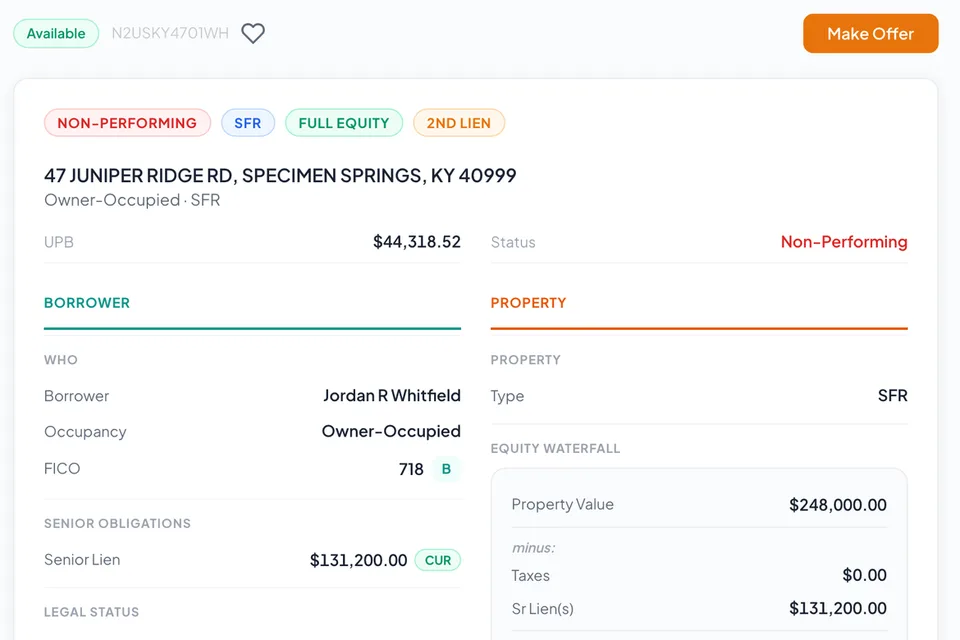
Property Value
Also known as: collateral value, property valuation, home value
Property value is the estimated worth of the real property that serves as collateral for a mortgage note. It is arguably the single most important variable in note investing because it determines the loan-to-value (LTV) ratio, which in turn drives pricing, resolution strategy, and downside protection. A note backed by a property worth significantly more than the debt has a fundamentally different risk profile than one where the property is worth less than what is owed. Getting the value right — or at least within a reasonable range — is the foundation of every investment decision.
Compare alternatives: Fix-and-flip vs note investing →
Methods of Determining Property Value
Note investors use three primary tools to estimate property value, each with different cost, speed, and reliability trade-offs:
| Method | Description | Cost | Accuracy | Best For |
|---|---|---|---|---|
| AVM (Automated Valuation Model) | Algorithm-generated estimate based on public records, comparable sales, and statistical modeling | Free–$20 | Low to moderate; unreliable for rural, unique, or distressed properties | Initial screening and bulk portfolio analysis |
| BPO (Broker Price Opinion) | Valuation prepared by a local real estate agent based on comparable sales and an exterior (drive-by) or interior inspection | $50–$150 | Moderate to high; depends on agent quality and local market knowledge | Pre-bid due diligence on individual loans |
| Appraisal | Formal valuation by a licensed appraiser following USPAP standards, including interior inspection | $300–$600+ | Highest; legally defensible | Post-acquisition, pre-foreclosure, or when precision is critical |
Most note investors use AVMs for initial filtering, BPOs for bid-level due diligence, and appraisals only when a high-stakes decision requires maximum confidence in the number.
As-Is Value vs. After-Repaired Value
Two distinct value concepts apply to note investing:
| Value Type | Definition | When It Matters |
|---|---|---|
| As-is value | What the property would sell for today, in its current condition | Used for LTV calculations, bid pricing, and determining whether the borrower has equity |
| After-repaired value (ARV) | What the property would sell for after necessary repairs and renovations are completed | Used when the exit strategy involves taking the property through foreclosure or deed-in-lieu and rehabbing before sale |
Note investors should always price acquisitions based on as-is value, not ARV. The ARV introduces execution risk — rehab costs, contractor delays, market changes — that should not be baked into the purchase price. If the deal only works at ARV, the margin of safety is too thin.
Property Value and LTV
The LTV ratio is calculated by dividing the unpaid principal balance (UPB) by the property value:
LTV = UPB / Property Value
A $40,000 UPB on a property worth $100,000 produces a 40% LTV — strong collateral coverage. The same UPB on a property worth $30,000 produces a 133% LTV — the loan is underwater and the borrower has no equity. LTV is the primary metric that determines how much a note investor should pay and which resolution strategies are viable.
| LTV Range | Investor Implication |
|---|---|
| Below 60% | Strong equity position; borrower is motivated to protect their home; loan modification and reinstatement are likely |
| 60%–80% | Moderate equity; most resolution strategies remain viable |
| 80%–100% | Thin equity; short sale or discounted payoff may be needed |
| Above 100% | Underwater; borrower may have little motivation to pay; foreclosure economics are weak |
Common Valuation Pitfalls
Property valuation errors are among the most expensive mistakes in note investing:
- Relying solely on AVMs. Automated models fail on properties that are unique, rural, heavily damaged, or in micro-markets with limited comparable sales data. Always supplement with a BPO for any loan you are seriously considering.
- Using stale valuations. A BPO or appraisal from two years ago may not reflect current market conditions. Order a fresh valuation during your due diligence window.
- Ignoring condition. A property that looks good on comparable sales analysis may be in severe disrepair. Vacant and abandoned properties — common in NPL portfolios — deteriorate quickly. Factor estimated repair costs into your as-is value assessment.
- Overweighting the seller's BPO. Sellers sometimes provide valuations with the data tape. Use these as a reference point, not gospel. Order your own independent BPO from an agent with local market expertise.
- Confusing assessed value with market value. The assessed value used for property tax purposes is often significantly different from fair market value. Some jurisdictions assess at a fraction of market value; others reassess infrequently. Never use assessed value as a proxy for what the property would sell for.
 Free Note Investor Workshop
Learn notes by pricing one.
Analyze a training loan modeled on a real deal, then submit practice offers on loans that actually sold.
- No credit card
- No email needed to start
- 7 steps · about 70 min