Property Taxes
Also known as: real estate taxes, ad valorem taxes
Property taxes are annual taxes levied by counties, municipalities, school districts, and other local taxing authorities on real property based on its assessed value. For mortgage note investors, property taxes are not just a data point — they represent one of the most dangerous risks in the business. Unpaid property taxes create tax liens that hold super-priority status, sitting ahead of every private lien on the property, including first-position mortgages. A small delinquent tax bill — sometimes just a few hundred dollars — can wipe out a note investor's entire position through a tax foreclosure sale.
How Property Taxes Work
Property taxes are calculated by multiplying the property's assessed value by the local mill rate (tax rate), which is set annually by the taxing jurisdiction. A property assessed at $100,000 in a jurisdiction with a 2.5% effective tax rate owes $2,500 per year.
| Component | Description |
|---|---|
| Assessed value | The taxable value assigned to the property by the local assessor — often a percentage of fair market value |
| Mill rate / tax rate | The rate set by the taxing authority, expressed as a percentage or per-$1,000 of assessed value |
| Payment schedule | Varies by jurisdiction — annual, semi-annual, or quarterly installments |
| Penalty for non-payment | Interest, penalties, and ultimately a tax lien or tax sale |
Tax rates vary enormously by location. Some counties levy effective rates below 0.5%, while others exceed 3%. When evaluating a note backed by property in a high-tax jurisdiction, the annual tax obligation directly affects the borrower's ability to pay and the property's net value to an investor.
Why Property Taxes Are Critical for Note Investors
The super-priority nature of property tax liens makes them uniquely dangerous. Unlike virtually every other risk in note investing, a tax lien can completely eliminate your investment with no recourse:
- Super-priority status. Tax liens sit ahead of all private liens regardless of recording date. A first mortgage recorded 20 years ago is still subordinate to a tax lien filed last year.
- Tax foreclosure wipes all liens. When a taxing authority (or a tax lien certificate holder) forecloses for unpaid taxes, the resulting tax deed transfers the property free and clear of all prior encumbrances. Your promissory note becomes unsecured debt — the collateral is gone.
- Small amounts, catastrophic consequences. Tax delinquencies are often a fraction of the property's value or the note investor's basis. A $600 unpaid tax bill can destroy a $15,000 note investment backed by a $50,000 property.
Due Diligence on Property Taxes
Checking property tax status is one of the most important steps in the due diligence process — and one of the easiest. Every county maintains a tax portal or treasurer's office where you can look up the current tax status for any parcel:
| What to Check | Where to Find It | Red Flags |
|---|---|---|
| Current-year taxes | County tax portal by parcel number or property address | Delinquent balance, penalties accruing |
| Prior-year delinquencies | Same portal — look for multiple years outstanding | Multi-year delinquency indicates abandonment risk |
| Tax lien certificates sold | County records or tax sale database | A third party owns the right to foreclose for the taxes |
| Redemption deadline | Tax sale records | If the deadline is approaching, act immediately |
| Escrow status | Servicer records or data tape | If escrow is not collecting for taxes, no one may be paying |
Managing Property Tax Risk After Acquisition
Once you own the note, monitoring and managing property taxes is an ongoing responsibility:
- Verify servicer tax monitoring. Confirm your loan servicer is tracking tax status on every loan in your portfolio. Many servicers offer automated tax monitoring, but verify the coverage — some only monitor escrowed loans.
- Advance delinquent taxes. On non-performing loans where no escrow payments are being collected, the borrower is not paying property taxes. You may need to advance the delinquent amount yourself and add it to the borrower's outstanding balance. The cost of advancing a few hundred dollars is negligible compared to losing the entire investment.
- Prioritize tax-delinquent assets. Within your portfolio, any loan with a tax delinquency should move to the top of your resolution priority list. The clock is ticking on a potential tax sale.
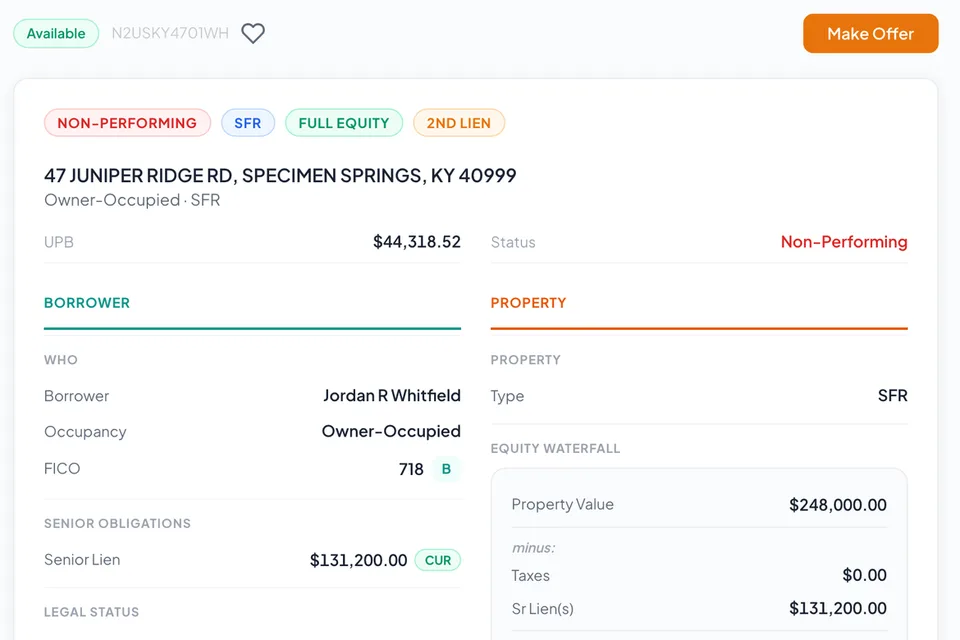
- Factor taxes into pricing. When bidding on a non-performing loan, always check the tax status and subtract any delinquent balance from your bid. If the seller represented taxes as current and they are not, that is a breach of representations and warranties under the LPSA.
Escrow and Property Taxes
On a performing loan with an escrow account, the borrower's monthly payment includes a prorated amount for property taxes. The servicer collects these funds and pays the tax bill on the borrower's behalf when it comes due. This system works well on performing loans but breaks down completely on non-performing ones — if the borrower is not making payments, no escrow funds are being collected, and no one is paying the taxes. This is precisely why non-performing note investors must independently monitor tax status on every asset.
 Free Note Investor Workshop
Learn notes by pricing one.
Analyze a training loan modeled on a real deal, then submit practice offers on loans that actually sold.
- No credit card
- No email needed to start
- 7 steps · about 70 min