Charge-Off
Also known as: charged off, charged-off loan, loan charge-off, charge off, written off
A charge-off is an accounting action — not a legal one — where a lender writes down a delinquent loan to its estimated recoverable value. The bank acknowledges the loss on its books, but the borrower still owes the debt and the lien remains on the property. A charge-off does not forgive anything.
What Happens at Charge-Off
Federal banking regulations generally require lenders to charge off residential mortgage loans after they have been delinquent for 180 days. When a loan is charged off:
- The bank writes down the asset — the loan's book value drops from the UPB to the bank's estimate of what it can recover
- The loan goes to non-accrual status — the bank stops accruing interest on the balance. No new interest is added.
- The debt survives — the borrower's obligation under the promissory note remains legally enforceable
- The lien survives — the mortgage or deed of trust remains recorded against the property
The charge-off hits the bank's income statement as a loss provision. It signals to regulators that the bank has acknowledged the impairment. But the borrower's legal obligations are unchanged.
Non-Accrual Status
After charge-off, the loan is classified as non-accrual. This means the bank stops adding interest to the balance. The UPB freezes at its charge-off amount.
Non-accrual is the bank's accounting. What the borrower can still be charged is a separate question, and Regulation Z answers it. A servicer may stop sending monthly statements on a charged-off mortgage only if it charges no further interest or fees and sends a final statement labeled "Suspension of Statements & Notice of Charge Off" (12 CFR 1026.41(e)(6)). Interest and fees can never be charged retroactively for the months that exemption applied — not when you buy the loan, and not at payoff. A servicer that later resumes charging interest must resume the statements too, and can charge interest only from then on. Interest from the months when statements did go out, before the charge-off, is still owed.
This matters for note investors. When you buy a post-charge-off loan, start from the UPB at charge-off, never a balance inflated with years of interest from the months nobody billed. Read the statement history before you quote a payoff: it tells you which months carry interest. Getting this right is one reason workouts succeed — borrowers engage when the numbers are fair.
Why It Matters for Note Investors
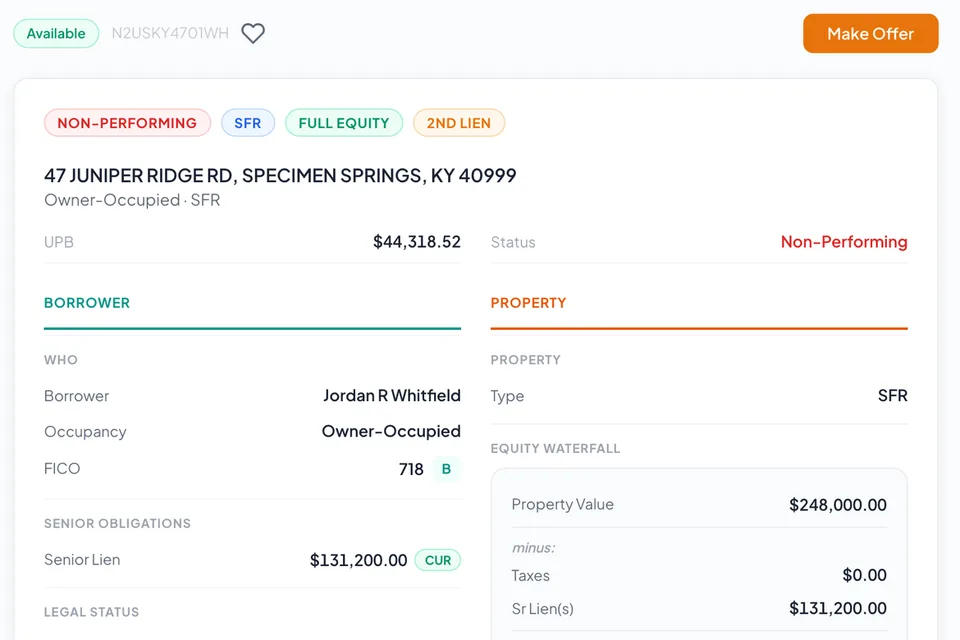
Most non-performing loans that reach the secondary market are post-charge-off. The bank has already taken the loss, classified the loan as non-accrual, and decided to sell rather than hold or foreclose. This is the point in the loan's life cycle where it becomes available to note investors.
Understanding the charge-off timeline explains the pricing:
| Stage | What Happens | Who Holds the Loan |
|---|---|---|
| Delinquency (1–89 days) | Borrower misses payments. Servicer sends notices and attempts contact. | Original lender |
| Default (90+ days) | Loan classified as non-performing. Loss mitigation begins. | Original lender |
| Charge-off (~180 days) | Bank writes down the asset. Loan goes non-accrual. | Original lender |
| Sale | Bank sells the charged-off loan at a discount to recover capital. | Transfers to note investor |
By the time a loan reaches sale, the bank has exhausted its own loss mitigation efforts and decided the loan is not worth the operational cost of holding. The discount reflects this — you are buying an asset the bank has given up on, at a price that accounts for the work required to resolve it.
"Zombie Debt" and Fair Lending
Media sometimes labels post-charge-off debt as "zombie debt" — old obligations that resurface when a new creditor buys them. That framing assumes bad faith. When the new lender treats the borrower fairly — works with the non-accrual balance, offers reasonable modification terms, and follows all FDCPA and state regulations — the workout benefits everyone. The borrower resolves a lien on their home. The investor earns a return. The loan exits limbo.
The key is fairness: start from the charged-off UPB, charge nothing for the months statements were suspended, and offer workout terms the borrower can actually meet.
Charged-off mortgages vs. unsecured charge-offs
Most charged-off debt that trades in the secondary market is unsecured — credit card, medical, auto deficiency, student loan, telecom. Recovery rates on unsecured charge-offs typically run 5–15%, and buyers price portfolios at $0.03–$0.07 per $1 of face value. Resolution relies on collection efforts under FDCPA and state debt-collection law.
Charged-off mortgages are different. When a bank charges off a delinquent first or second lien, the loan remains secured by the underlying real property. Recovery paths include reinstatement, modification, discounted payoff, deed-in-lieu, short sale, or foreclosure → REO sale. Pricing typically runs 30–65¢ per $1 of unpaid principal balance, and the regulatory framework (RESPA, Regulation X, state foreclosure law) is materially different from FDCPA.
FIXnotes is a marketplace for real-estate-secured charged-off debt — non-performing mortgage notes from verified sellers. See Charged-Off Debt Portfolios For Sale for current inventory and comparison details.
 Free Note Investor Workshop
Learn notes by pricing one.
Analyze a training loan modeled on a real deal, then submit practice offers on loans that actually sold.
- No credit card
- No email needed to start
- 7 steps · about 70 min