Charged-Off Mortgages vs. Unsecured Charge-Offs: Pricing, Recovery, and Risk
How charged-off mortgages and unsecured charge-offs differ on pricing, recovery rates, and regulatory exposure — a side-by-side comparison for note buyers.
Search "charged-off debt portfolios for sale" and most of what surfaces is unsecured consumer debt — credit card receivables, medical balances, auto deficiency judgments, telecom write-offs. The listings run into the thousands, the face values are huge, and the prices look like a bargain: three to seven cents on the dollar.
Real-estate-secured charge-offs exist in a parallel market. It is smaller, quieter, and far less understood by investors who learned their trades in the unsecured world. The economics are materially different: buyers price charged-off mortgage non-performing loans at thirty to sixty-five cents on the dollar against unpaid principal balance. Recovery rates run 40–95% of UPB versus the 5–15% common in unsecured collections. The regulatory exposure is different in kind, not just degree.
If you are evaluating either market — or being pitched on one while comparing it to the other — the two asset classes require separate frameworks. This is that comparison.
What "Charged-Off" Actually Means
A charge-off is an accounting event, not a legal one. Banks follow regulatory guidance from the Federal Financial Institutions Examination Council (FFIEC) — specifically the Uniform Retail Credit Classification and Account Management Policy — which establishes timelines for when consumer loans must be written off the balance sheet. For most consumer credit products, that threshold is 120 days past due. For secured mortgage loans, servicers typically reach charge-off status between 120 and 180 days of non-performance, though the specific timeline varies by investor and servicer guidelines.
When a loan is charged off, the bank removes the asset from its accrual books and recognizes a loss. The Federal Reserve's Charge-Off and Delinquency Rates series tracks these events across all major loan categories — the data shows charge-off rates on credit cards and consumer loans consistently running multiples higher than on 1-4 family residential mortgages, reflecting both the volume of unsecured issuance and the faster delinquency-to-charge-off timelines.
What charge-off does not do is extinguish the debt. The borrower still owes every dollar. The obligation survives the accounting write-off; only the bank's balance sheet treatment changes. The bank has simply acknowledged it does not expect to recover the loan internally, which is why the asset becomes available for sale to secondary market buyers. This distinction matters because buyers who treat charge-off as synonymous with "uncollectible" systematically underestimate recovery potential — especially on the secured side.
The transition path is: performing → non-accrual (typically at 90 days past due) → charge-off → disposition (internal workout, sale to a debt buyer, or referral to a collection agency). At each stage, the holder is deciding whether the expected recovery justifies the continued cost of carrying the asset.
Secured vs. Unsecured: The Core Comparison
The table below summarizes the structural differences between the two markets. Each row is explained in the sections that follow.
| Dimension | Unsecured charge-offs | Real-estate-secured charge-offs (NPLs) |
|---|---|---|
| Typical asset types | Credit card, medical, auto deficiency, student, telecom | First-lien NPL, second-lien NPL, contract for deed |
| Typical pricing (per $1 of face / UPB) | $0.03–$0.07 | $0.30–$0.65 |
| Typical recovery rate | 5–15% of face | 40–95% of UPB |
| Time to resolution | 6–36 months (collections) | 6–24 months (workout) or 12–36 months (foreclosure) |
| Primary exit strategies | Collection, resale, charge-off litigation | Reinstatement, modification, DPO, deed-in-lieu, short sale, foreclosure → REO |
| Regulatory framework | FDCPA, state debt-collection law, CFPB | RESPA, Reg X, state foreclosure law, CFPB |
| Data tape complexity | Account-level (debtor, balance) | Loan-level (UPB, lien position, payment history, BPO, property data) |
| Buyer qualification | Debt buyer license per state | Note buyer entity + state licensing varies |
Typical asset types. Unsecured charge-off portfolios aggregate heterogeneous consumer obligations — credit cards from multiple issuers, hospital and physician balances, remaining auto loan balances after repossession, defaulted telecom contracts. The individual balances are small; the pools are large. Secured NPL portfolios contain mortgage instruments tied to specific parcels of real property. Each asset has a lien position, a collateral file, and a chain of title that must be verified before the trade closes.
Pricing convention. Unsecured portfolios are priced in cents per dollar of face balance. A $10 million face credit card portfolio at five cents trades for $500,000. Secured NPLs are priced as a percentage of UPB — the current outstanding principal balance of the loan, which may differ from original face value after years of partial payments, capitalized advances, and fees. A $200,000 UPB first-lien NPL at 50 cents trades for $100,000. The denominators are different, and conflating them when comparing pricing across asset classes is a common error.
Recovery rates. The driver of the recovery gap is covered in the next section.
Time to resolution. Unsecured collections run through phone contact, letters, skip tracing, and, when the balance is large enough to justify it, litigation. Resolution timelines depend almost entirely on debtor behavior. Secured workouts add property-dependent paths — a motivated borrower can reinstate or modify quickly; foreclosure timelines vary from a few months in non-judicial states to several years in judicial foreclosure states. Neither market guarantees speed, but secured assets have a hard floor under recovery time because the property can be liquidated even without borrower cooperation.
Exit strategies. Unsecured exits are narrow: collect from the debtor, resell the paper to another buyer at a further discount, or litigate a judgment. Secured exits are wide: reinstatement (borrower catches up on arrears), loan modification (restructured terms), discounted payoff (DPO — borrower pays an agreed lump sum less than full UPB), deed-in-lieu of foreclosure (borrower conveys title voluntarily), short sale (property sold for less than UPB with lender approval), or foreclosure through to REO (real estate owned) disposition.
Data tape complexity. Unsecured tapes are account-level files: debtor name, balance, last payment date, charge-off date, state. Secured NPL tapes require loan-level data: UPB, lien position, payment history, property address, BPO (broker price opinion — an estimated market value from a licensed real estate professional), senior lien balances for second-lien positions, property tax status, occupancy status, and collateral file inventory. The due diligence workload per loan is substantially higher for secured assets.
Buyer qualification. Most states require a debt buyer license to purchase and collect on consumer debt, with annual renewals and bonding requirements that vary by state. Secured NPL buyers operate through an LLC or other entity and may face state-specific licensing depending on whether they self-service. The compliance surface is different rather than clearly lighter on either side.
Why Recovery Rates Differ
The recovery rate gap between secured and unsecured charge-offs is not incidental — it is structural. Unsecured recovery depends entirely on the debtor's ability and willingness to pay. If a borrower has no income, no assets, and no motivation to engage, the recovery floor on an unsecured balance is zero. Collection agencies, litigation, and payment plans are all predicated on the debtor eventually cooperating or having garnishable wages. When neither condition exists, the note is unrecoverable regardless of how much time and capital the buyer commits.
Secured real estate debt has a floor built into the asset itself. The mortgage lien attaches to a parcel of property. Even if the borrower has gone completely silent and the collateral file has deficiencies, the property exists, can be appraised, and can be foreclosed if the lien is valid and senior enough to produce a recovery. Recovery does not require the borrower's cooperation — it requires the buyer's willingness to pursue the legal process.
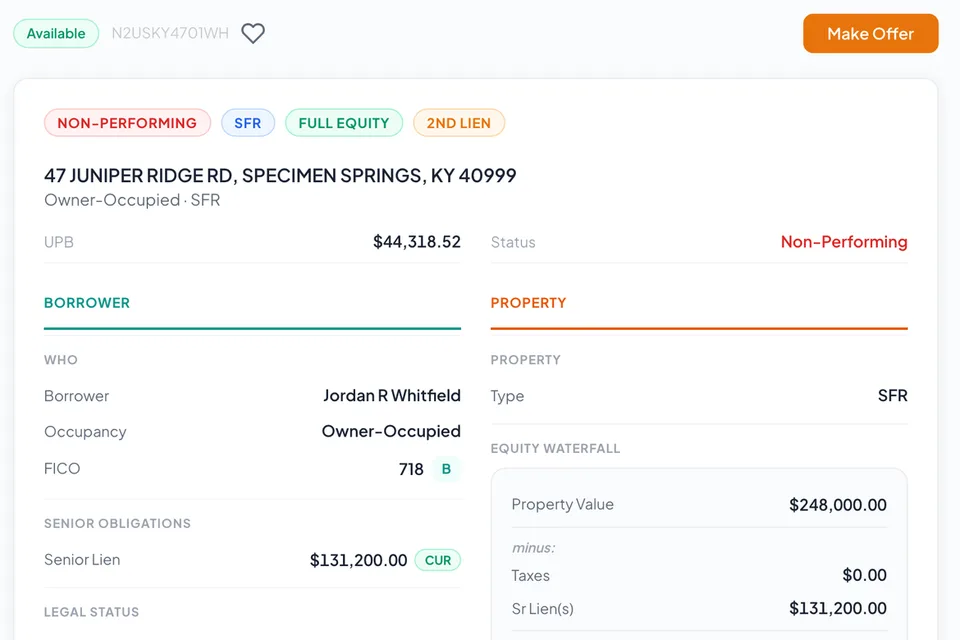
Consider a concrete example. A second-lien NPL with a $200,000 UPB sits behind a first mortgage with a $250,000 balance on a property appraised at $400,000. The equity behind the second lien is $150,000 ($400,000 value minus $250,000 first lien). A buyer who prices the second at 60% of UPB ($120,000) is purchasing a position with $30,000 of cushion between cost and the equity floor — before accounting for any payment recovery, DPO, or modification. If the property appreciates modestly, that cushion widens. If the first lien is being paid and the property is occupied, the risk profile improves further.
No equivalent calculation exists in unsecured debt. There is no property to appraise, no equity to compute, no legal process that compels an unwilling debtor to produce cash. The debtor's circumstances are the only variable, and the buyer cannot influence them directly.
Pricing Mechanics
Unsecured portfolios trade in volume-driven markets with established broker networks — platforms like Debexpert aggregate seller listings and facilitate competitive bidding across thousands of portfolios. Pricing is driven by debtor demographics, vintage (how old the charge-off is), asset type, and the buyer's projected collection rates based on their own performance history with comparable paper. A card portfolio from a prime issuer priced at five cents will trade at a different yield than a subprime medical portfolio at the same price per dollar of face.
Secured NPL pricing is more capital-intensive per transaction and more relationship-driven. Large pools are sold through advisors like Garnet Capital or through private GSE auctions managed by Fannie Mae and Freddie Mac. Smaller pools and individual loans trade through marketplaces like FIXnotes, broker networks, and direct seller relationships. The Mortgage Bankers Association National Delinquency Survey provides the supply-side context that institutional buyers use to track how much distressed inventory is building in the pipeline at any given time.
UPB-relative pricing for secured NPLs factors in several variables: lien position and estimated equity coverage, property condition and marketability, state foreclosure timeline and cost, borrower engagement history, and the buyer's target exit strategy. A first-lien NPL in a non-judicial foreclosure state with an occupied property and a borrower who has been communicating with the servicer will price higher than a second lien in a judicial state with no borrower contact, all else equal. These loan-level variables produce a wide pricing range within the 30–65% band — understanding each driver is how buyers determine where within that range a specific asset should fall.
Regulatory Exposure
The regulatory frameworks for unsecured and secured charge-offs share a CFPB overlay but diverge sharply in their specific requirements.
Unsecured debt buyers operate under the Fair Debt Collection Practices Act (FDCPA), which governs communication frequency, allowable contact methods, required disclosures, and dispute handling. State debt collection laws layer additional requirements that vary significantly — some states have adopted mini-FDCPAs with stricter standards than the federal baseline. The CFPB's Annual Debt Collection Report to Congress documents enforcement actions and complaint trends that any buyer operating in this market should monitor.
Litigation risk in unsecured collections is meaningful. The 11th Circuit's 2021 decision in Hunstein v. Preferred Collection illustrated how data-sharing practices between debt collectors and third-party vendors can expose buyers to statutory damages under the FDCPA — the case turned on whether transmitting debtor information to a mail vendor constituted a prohibited disclosure to a third party. Though the en banc court ultimately reversed the panel decision on standing grounds, the case underscored how routine collection workflows can generate class-action exposure under FDCPA's strict liability framework.
Secured NPL buyers face a different compliance surface. The Real Estate Settlement Procedures Act (RESPA), implemented through 12 CFR Part 1024 (Regulation X), governs mortgage servicing in detail. Servicer transfer requirements mandate written notices to borrowers within specific windows. Error-resolution procedures require servicers to acknowledge and respond to qualified written requests on defined timelines. Force-placed insurance rules cap what servicers can charge borrowers when property insurance lapses. Violation of Reg X provisions can expose the note holder — not just the servicer — to borrower claims.
CFPB UDAAP (Unfair, Deceptive, or Abusive Acts or Practices) enforcement applies to both markets. The practical implication is that buyers in both spaces need servicer partners with compliant practices and documented procedures — self-servicing without adequate compliance infrastructure creates exposure regardless of asset type. The difference is which regulatory stack dominates: FDCPA for unsecured, RESPA/Reg X for secured.
Which Market Are You Actually Buying?
When you see "charged-off debt portfolios for sale," the first question is which side of that market you are looking at. The listing volume, the pricing convention, the due diligence process, and the regulatory exposure are different enough that treating them as interchangeable is a mistake that costs buyers real money.
Unsecured charge-offs are a high-volume, low-margin business with significant FDCPA exposure and recovery rates that depend almost entirely on debtor behavior. The competitive landscape is professional and institutional — the largest buyers are well-capitalized funds with proprietary collection infrastructure, and pricing in competitive auctions reflects that.
Charged-off mortgages — real-estate-secured NPLs — are a lower-volume, higher-margin market with more durable recovery floors, wider resolution options, and a different regulatory compliance stack. The collateral anchors the economics in ways unsecured balances cannot. Due diligence is more intensive per loan, but the floor on outcomes is materially higher.
FIXnotes is built for the secured side. If you are sourcing charged-off debt portfolios secured by real property — first liens, second liens, contracts for deed — that is the market this platform serves. The deal flow, the underwriting framework, and the buyer community are calibrated to mortgage note investing specifically, not to the volume-collection model that drives unsecured portfolio trading.
Understanding the distinction is not academic. It is the first filter on where to put your capital.
Sources
-
Federal Reserve. "Charge-Off and Delinquency Rates on Loans and Leases at Commercial Banks." Board of Governors of the Federal Reserve System. https://www.federalreserve.gov/releases/chargeoff/
-
Mortgage Bankers Association. "National Delinquency Survey." MBA Research and Economics. https://www.mba.org/news-and-research/research-and-economics/single-family-research/national-delinquency-survey
-
Consumer Financial Protection Bureau. "Fair Debt Collection Practices Act: Annual Report to Congress." CFPB. https://www.consumerfinance.gov/data-research/research-reports/fair-debt-collection-practices-act-annual-report-to-congress/
-
Consumer Financial Protection Bureau. "12 CFR Part 1024 — Real Estate Settlement Procedures Act (Regulation X)." https://www.consumerfinance.gov/rules-policy/regulations/1024/
-
Hunstein v. Preferred Collection and Management Services, Inc., No. 19-14434 (11th Cir. 2021). United States Court of Appeals for the Eleventh Circuit. https://www.ca11.uscourts.gov/
-
Federal Financial Institutions Examination Council (FFIEC). "Uniform Retail Credit Classification and Account Management Policy." FFIEC. https://www.ffiec.gov/pdf/FFIEC_forms/FFIEC031_FFIEC041_FFIEC051_20190331_i.pdf
 Free Note Investor Workshop
Learn notes by pricing one.
Analyze a training loan modeled on a real deal, then submit practice offers on loans that actually sold.
- No credit card
- No email needed to start
- 7 steps · about 70 min