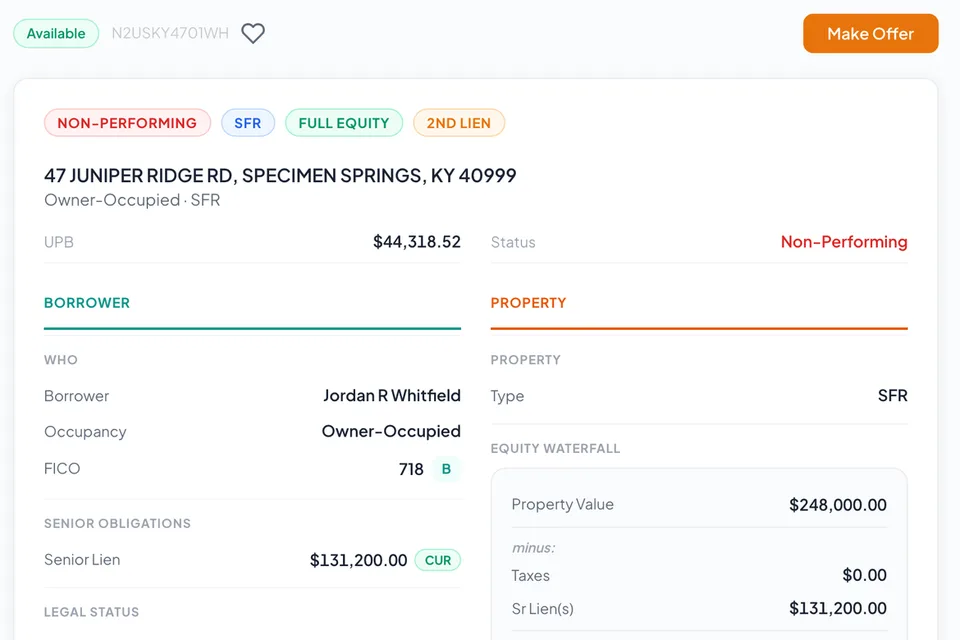
Note-on-Note Financing: How to Borrow Against Your Notes
Note-on-note financing lets you borrow against a mortgage note you own: how the UCC pledge works, what lenders ask for, and bank lines vs. other capital.
Note-on-note financing is a loan secured by a mortgage note you already own: you pledge the note to a lender, borrow against it, and keep collecting your borrower's payments while you repay. Legally it is a security interest in the note under UCC Article 9, and the mortgage comes along automatically, because attaching a security interest in a secured right to payment "is also attachment of a security interest in the security interest, mortgage, or other lien" (UCC §9-203(g)). You will also hear it called loan-on-loan financing or a collateral assignment, and once it covers a whole portfolio, it is usually a bank line of credit.
This guide covers how the pledge works, what a lender looks at, how a single-note loan compares with a portfolio credit line and other capital, and what can go wrong. Lenders generally find performing notes easier to finance than non-performing ones, and that difference runs through every section below.
What is note-on-note financing?
There are three parties. Your borrower owes you on the note. You owe your lender on the new loan. Your lender holds the note as security. As long as you pay, nothing changes for your borrower: payments still go to your servicer, and you keep the spread between what the note pays you and what the loan costs you.
The reason to do it is capital velocity. Without financing, every dollar you put into a note stays locked up until the borrower pays off, you sell, or the loan resolves. Borrowing against notes you already own frees part of that capital for the next purchase, without selling an asset you would rather hold.
The same structure shows up at three sizes:
- A single-note loan. One note, one lender, one loan.
- A portfolio credit line. A revolving facility secured by a pool of notes, drawn against a borrowing base, often from a bank or credit union you already work with.
- A debt facility. A committed pool of capital with draw schedules and deployment rules, sometimes from a group of lenders. A warehouse line is the revolving version used to buy loans and hold them until they are sold or refinanced.
How does the pledge work under the UCC?
A promissory note is personal property, so the pledge runs on Article 9 of the Uniform Commercial Code, a body of law "adopted in some form by every state and the District of Columbia" (Cornell LII). The fact that the note is itself secured by real estate does not take it outside Article 9: the article applies to a security interest in a secured obligation even when that obligation is secured by an interest the article does not cover (UCC §9-109(b)). Four rules do most of the work.
Attachment. A security interest is enforceable once value has been given, you have rights in the note, and either you have signed a security agreement describing it or the lender holds it under your security agreement (UCC §9-203(b)). That security agreement (often called a pledge agreement) is the core loan document.
The mortgage follows the note. Attachment to the note is also attachment to the mortgage that secures it (§9-203(g)), and perfecting the security interest in the note "also perfects a security interest in a security interest, mortgage, or other lien on personal or real property securing the right" (UCC §9-308(e)). The lender does not need a recorded mortgage assignment to have a perfected interest in the lien.
Perfection: possession or filing. A lender can perfect in a note by taking possession of it (UCC §9-313(a)) or by filing a financing statement (UCC §9-312(a)). Possession is the stronger position: a buyer who gives value and takes possession of a note in good faith, without knowing the sale violates the lender's rights, has priority over a lender perfected only by filing (UCC §9-330(d)). That is why lenders want the original note, endorsed or with an allonge, in their own vault or a custodian's.
Where the filing goes. Outside of possession, perfection is governed by the law of the jurisdiction where the debtor is located (UCC §9-301(1)), and an LLC or other registered organization is located in the state it was organized in (UCC §9-307(e)). So a lender files its UCC-1 against your entity in the state where the entity was organized, not in the county where the property sits.
| What the lender takes | The document | The UCC rule |
|---|---|---|
| A security interest in the note | Security (pledge) agreement you sign | §9-203(b) |
| Possession of the original note | The original, endorsed or with an allonge, delivered to the lender or a custodian | §9-313(a), §9-313(c) |
| Public notice against later creditors | UCC-1 financing statement in your entity's state of organization | §9-312(a), §9-307(e) |
| The mortgage lien | Follows the note automatically; a lender may also ask for a collateral assignment of the mortgage | §9-203(g), §9-308(e) |
Article 9 is enacted state by state, so have counsel confirm your state's version before you sign. If you want the land-records side of this, our guide to how an assignment of mortgage is recorded covers what recording does and doesn't do in different states.
What does a note-on-note lender look at?
Advance amounts, pricing and requirements vary by lender and by deal, but the same questions come up:
- Performance. Performing notes are easier to finance. A lender may count non-performing notes for less, leave them out of the borrowing base, or lend against them only through a separate, more expensive facility.
- Equity in the collateral. The lower your investment-to-value ratio (your basis against property value), the more cushion the lender has. Expect a lender to give value only to the notes and equity bands it is comfortable with, so only part of your book may count.
- Lien position. Second liens are harder to finance than firsts, and a lender that takes both will usually advance less against a second.
- The paper. The lender is lending against the collateral file. It will want the original note, a clean endorsement or allonge chain, and confirmation from your document custodian that it holds the originals. If a note is missing, read what happens if the promissory note is missing before you try to pledge it.
- Your books. The entity that owns the notes is the borrower, so its financials are what the lender reads. As a line grows, expect requests for audited financial statements.
At portfolio scale, all of this rolls into a borrowing base. The OCC's handbook for examiners describes the mechanism plainly: "Loan advances are limited to a percentage of eligible collateral (the 'borrowing base')," and a borrower can draw "up to the lesser of the available borrowing base or the revolver commitment amount" (OCC Comptroller's Handbook, Asset-Based Lending). The handbook's examples are receivables, where an account "is considered ineligible collateral when it is past due by three times the terms." In a note facility the loan agreement sets the eligibility rules, which is where performance and lien position come back in.
Single-note loan, bank line, or other capital?
Debt is one of several ways to fund note purchases, and it is not the right one at every stage.
| Capital source | How it works | Best fit | Main catch |
|---|---|---|---|
| Single-note loan | One note pledged for one loan | A performing note you want to keep while you buy the next one | Small loans carry the same legal work as large ones |
| Portfolio credit line | Revolving draws against a borrowing base | A seasoned book of performing notes | Requires a banking relationship, reporting and, as it grows, an audit |
| Debt facility | Committed capital with deployment deadlines | Funds with steady deal flow, including non-performing pools | Interest and unused-commitment fees if you can't deploy on schedule |
| Joint venture or fund equity | Investors share in the deal's profit | Early-stage operators without a book to borrow against | You give up a share of the upside, plus securities-law work |
| Selling or partial-selling notes | You sell the note, or part of its cash flow | Recycling capital without taking on debt | You give up the income you sold |
Private capital usually comes first, because a lender needs something to lend against. Our guide to funding note deals with other people's money covers joint ventures, profit splits and the securities rules that apply when you raise. The structure you hold notes in matters to a lender too, since the entity is the borrower and the debtor on the UCC filing; choosing the right entity for note investing walks through the options. If you are thinking about a partial sale instead, compare its cost to the interest you would pay to borrow.
Before you borrow, run the deal after tax as well as before it. Our guide to the tax implications of mortgage note investing covers how interest, payoffs and market discount on the note are taxed, and your CPA can tell you how the interest you pay on the loan is treated in your structure.
How do lenders hold the notes without an assignment of every loan?
On a pool, assigning and reassigning each loan to the lender every time a note goes in or out is slow and expensive. A common alternative is a bailee letter with a third-party document custodian: the custodian holds the original collateral files, acknowledges that it holds them for the lender's benefit, and an exhibit lists every loan covered. A loan comes off the exhibit only when the lender signs a release. The UCC supports this: a secured party takes possession of collateral held by someone else when that person acknowledges in a record that it holds the collateral for the secured party's benefit (UCC §9-313(c)). One letter can cover the whole pool, and loans can move in and out without new assignments.
Expect the lender to want your own equity underneath the debt as well. Financing replaces part of the capital in a pool, not all of it, and a lender that is the only money in a deal carries the first loss alone.
What are the risks of note-on-note financing?
- Two layers of credit risk. If your borrower stops paying, your loan doesn't. You cover the payment from other cash until the note resolves.
- Maturity mismatch. Non-performing notes resolve on court and borrower timelines, not your lender's. A loan that matures before your foreclosure or modification finishes forces a refinance or a sale at a bad time.
- The lender steps into your shoes. After a default, a secured party may notify your borrower to pay it directly (UCC §9-607(a)) and may sell the pledged note, as long as every aspect of the sale is commercially reasonable (UCC §9-610).
- A shrinking borrowing base. Payoffs, sales and new delinquencies all change what counts as eligible collateral. When the base falls below what you have drawn, eligible collateral no longer supports your balance, so plan on paying down the line.
- Release friction. Every sale or payoff needs the lender's release. Build that time into your exit plans and your sale agreements.
- Retirement accounts. If the notes sit in a self-directed IRA, a note the IRA buys with borrowed money is debt-financed property, and a share of its income in proportion to the debt counts as unrelated business taxable income (26 U.S.C. §514), a tax IRAs owe (§408(e)(1)); our guide to buying notes with a self-directed IRA covers UBIT. Talk to your custodian before you sign anything.
When to use note-on-note financing: a checklist
Borrow against a note only when every line is a yes:
- The note performs, or your lender understands the plan for it. Non-performing collateral needs a lender that underwrites resolutions, not just payment history.
- The cash flow covers the loan with room to spare. Run it with a late payment or two and a slower resolution than you expect.
- The loan outlasts your exit. Its maturity is later than your realistic payoff, modification or sale date.
- The paper is clean. You can deliver the original note with its endorsements or allonges, and the assignment chain matches.
- The next deal is lined up. Borrowed money sitting idle costs interest; on a debt facility, undrawn commitments can carry fees too.
- You know how a release works. Before you sign, get the release process in writing: who signs, how fast, and what it costs.
- There is equity underneath. If a lender asks you to replace all of your equity with debt, the structure is too thin.
If any answer is no, fund the next note with equity or a joint venture, or wait until the book is seasoned enough to borrow against.
Frequently asked questions
- What is note-on-note financing?
- It is a loan secured by a mortgage note you already own. You pledge the note to a lender, borrow against it, and keep collecting the borrower's payments while you repay the lender. Legally the lender takes a security interest in the note under UCC Article 9, and that security interest carries the mortgage with it (UCC §9-203(g)). It is also called loan-on-loan financing or a collateral assignment; across a whole portfolio it usually takes the form of a bank credit line.
- Does the lender need a recorded assignment of the mortgage?
- Not for the security interest itself. Under UCC §9-308(e), perfecting a security interest in the note also perfects it in the mortgage that secures the note. A lender may still ask for a collateral assignment of the mortgage so it can act in the land records if it ever has to enforce, and UCC §9-607(b) gives a secured party a recording route for non-judicial enforcement. Treat the lender's checklist, not the statute's minimum, as what you will actually have to deliver.
- Can you finance a non-performing note?
- Sometimes, but it is harder than financing a performing one. A borrowing base only counts eligible collateral, and a lender may count non-performing loans for less or leave them out. Non-performing pools are more often financed through a dedicated debt facility than a bank line, at a higher cost and with tighter deployment rules.
- Is a bank line of credit the same thing as note-on-note financing?
- It is the same idea at portfolio scale. Instead of pledging one note for one loan, you pledge a pool of notes and draw against a borrowing base that moves as notes are added, paid off or sold. The legal mechanics (security agreement, possession of the original notes, a filed financing statement) are the same.
 Free Note Investor Workshop
Learn notes by pricing one.
Analyze a training loan modeled on a real deal, then submit practice offers on loans that actually sold.
- No credit card
- No email needed to start
- 7 steps · about 70 min