Your First 90 Days as a Note Investor: A New Investor Roadmap
A 90-day roadmap for new note investors — from LLC formation and education through vendor setup, first tape review, and closing your first deal.
Why Do Most New Note Investors Stall Before They Start?
The secondary mortgage market is not short on information. Between YouTube channels, forums, blog posts, and courses, a new investor can spend months absorbing content without ever taking a concrete step toward buying a loan. The problem is rarely a lack of knowledge. It is a lack of sequence — knowing which actions matter in which order and having a timeline that creates accountability.
This 90-day roadmap breaks the early phase of a note investing business into three distinct stages. Days 1 through 30 focus on education and entity formation. Days 31 through 60 shift to building vendor relationships and reviewing your first tape. Days 61 through 90 are where you submit your first bid and work toward closing a deal. Each stage builds on the one before it, and skipping ahead creates gaps that become expensive to fill later.
The goal is not to become an expert in 90 days. The goal is to build the infrastructure, relationships, and operational habits that position you to make informed investment decisions — and then to act on one.
Days 1-30: Education and Entity Setup
What Should You Learn First?
The first 30 days are about building a knowledge base that supports real decision-making. Start with the foundational concepts: what a mortgage note is, how notes trade on the secondary market, how pricing works for performing versus non-performing loans, and what the resolution process looks like from acquisition through exit.
Focus your study time on the areas that directly affect your first transaction:
- Lien positions — understand the difference between first and second liens, the risk profiles of each, and how equity coverage changes the math
- Due diligence — learn the pre-bid waterfall process that filters a tape down to actionable targets before you spend money on property-level research
- Pricing — study how performing loans are priced on a yield basis and how non-performing loans are priced as a percentage of fair market value or unpaid principal balance
- Resolution strategies — familiarize yourself with loan modifications, discounted payoffs, short sales, deeds in lieu, and foreclosure as potential outcomes
Do not try to master every niche simultaneously. If you plan to start with non-performing second liens — which is common for new investors because the entry price is lower — go deep on that asset class first. You can expand into first liens, performing loans, and other strategies as your experience grows. The mortgage note investing roadmap for beginners covers how each note type is priced.
How Do You Set Up Your Business Entity?
Forming your LLC is one of the most tangible early milestones, and there is no reason to delay it. An LLC is the standard purchase entity for note investors. It signs the contract, holds the asset, and appears on the recorded assignment that evidences your ownership.
Here is what the entity setup process looks like:
-
Choose a company name. Avoid generic suffixes like "Capital" or "Investments" — they can raise red flags with banks when you seek financing later. A name that communicates a clear value proposition or service is stronger. If you plan to work directly with borrowers on non-performing resolutions, a borrower-facing name builds trust. Check your state's business registry and confirm domain availability before committing.
-
Register the LLC with your state. This is typically a same-day or next-day online process. Most states charge between $50 and $500 for formation.
-
Obtain an EIN. Apply for an Employer Identification Number through the IRS — it is free, takes five minutes online, and you need it to open a business bank account.
-
Open a business bank account. Bring your LLC formation documents and EIN confirmation. Fund the account with your starting capital. This account will hold your proof of funds and eventually fund your first trade.
-
Set up a business email and phone number. Connect a professional email address to your domain (not a free Gmail account). For a dedicated business phone line, Google Voice is a low-cost option that works well in the early stages.
-
Secure your web presence. You do not need a polished website on day one, but you do need a professional presence that counterparties can verify when they look you up. At minimum, build a one-page site that identifies your company, your focus area, and your contact information. Create a LinkedIn profile for the business.
What Does Your Vetting Package Include?
Sellers in the secondary mortgage market evaluate buyers before accepting offers. Your vetting package is the collection of documents that demonstrates you are a legitimate, organized counterparty. Start assembling it now so it is ready when you need it:
- Proof of funds — a recent bank statement or financial institution letter confirming available capital
- LLC documentation — your formation certificate and operating agreement
- Insurance certificates — errors and omissions coverage, general liability
- Servicer information — the name and contact details for your loan servicing company (you will secure this in days 31-60)
Having this package assembled before you start approaching sellers saves time and signals professionalism. Sellers who receive a complete vetting package alongside a letter of intent take you more seriously than a buyer who needs a week to pull documents together.
Days 31-60: Vendor Relationships and First Tape Review
Which Vendors Do You Need Before You Buy?
The second 30 days are about converting knowledge into operational readiness. You need relationships with several key vendors before you can execute a trade.
Licensed loan servicer. This is the single most important vendor relationship in your business. A servicer handles borrower communication, payment collection, escrow management, regulatory compliance, and year-end tax reporting. Federal and state law require that a licensed servicer manage these functions — self-servicing is technically possible but strongly discouraged for new investors.
Contact two or three servicers who work with individual note investors. Compare their fee structures, monthly minimums, and boarding timelines. Some servicers charge a $250 monthly minimum that requires roughly 10 loans to justify. If you are starting with one or two assets, find a servicer with lower minimums or negotiate introductory terms. Sign a servicing contract before you submit your first bid — a gap between funding and servicing creates regulatory exposure.
Legal counsel. Identify an attorney licensed in your target state who handles creditor-side mortgage work. You may not need legal counsel for your first trade, but having the relationship established means you can move quickly if a title issue, bankruptcy complication, or borrower dispute arises during due diligence.
CPA or bookkeeper. Note investing generates tax obligations that differ from traditional real estate. Interest income, discount accretion, and capital gains from note sales all have specific reporting requirements. A CPA familiar with debt instruments will save you money at tax time and help you structure your entity correctly from the start.
Due diligence service providers. You need access to property records (DataTree or similar), credit reports (TransUnion or equivalent), and bankruptcy records (PACER). Some of these services require a site inspection or credentialing process that takes two to four weeks — start the onboarding process early so you are not waiting when a deal appears.
How Do You Build Seller Relationships?
Deal flow in the secondary mortgage market is relationship-driven. Sellers do not list loans on a public exchange. They distribute tapes through private networks, and the investors who receive the best opportunities are the ones who have demonstrated reliability, professionalism, and follow-through.
Start building these relationships now, even before you are ready to buy:
- Join industry communities. Online forums, social media groups, and note investing communities connect you with active sellers, brokers, and peers. Participate genuinely — ask informed questions, share insights, and avoid pitching yourself before you have credibility.
- Attend conferences and events. Industry events hosted by organizations like IMN, NoteExpo, and Paper Source put you in the same room as sellers and experienced investors. The connections made at a single conference can generate deal flow for years.
- Offer value before asking for deals. The earn-and-learn approach works here. If you have analytical skills, offer to help an experienced investor review a tape or run due diligence. If you have marketing expertise, help someone improve their web presence. Providing value builds relationships that eventually produce opportunities.
The goal during days 31-60 is to get on at least one seller's distribution list so that you are receiving tapes to review.
What Does Your First Tape Review Look Like?
A tape is a spreadsheet containing loan-level data for every asset a seller has available. Your first tape review will feel overwhelming — tapes can contain dozens or hundreds of loans, each with 30 or more data fields.
Apply the pre-bid waterfall process to filter the tape systematically:
- Secured versus unsecured — eliminate any loans not secured by real property
- Lien position — separate first liens from junior liens based on your investment focus
- Geography — remove states where you are uncomfortable operating due to foreclosure timelines, licensing requirements, or lack of legal counsel
- Property value and equity coverage — screen for adequate collateral protection in your target lien position
- Delinquency status — assess how long the loan has been non-performing
- Bankruptcy status — flag active bankruptcy filings that add complexity
The waterfall narrows a tape of 100 loans down to 5 or 10 that warrant deeper analysis. Practice this process on every tape you receive, even if you are not yet ready to bid. Each review sharpens your eye for pricing, risk factors, and market patterns.
For a detailed walkthrough, see The Pre-Bid Waterfall Process.
Days 61-90: First Bid and Closing
Are You Ready to Submit Your First Offer?
Before you submit a bid, run through this readiness checklist:
| Requirement | Status |
|---|---|
| LLC formed and in good standing | Confirmed |
| Business bank account funded | Confirmed |
| Proof of funds letter ready | Confirmed |
| Servicing contract signed | Confirmed |
| Due diligence vendor accounts active | Confirmed |
| At least one tape reviewed using waterfall process | Confirmed |
| Target asset identified with preliminary pricing | Confirmed |
If every item is checked, you are ready. If any item is missing, address it before you submit an offer. The worst thing you can do as a new investor is submit a letter of intent and then fail to follow through. Sellers track this behavior, and it will cost you future deal flow.
How Do You Price and Bid on Your First Loan?
Pricing depends on the asset type and performance status:
- Performing loans are priced on a yield basis — you calculate the purchase price that delivers your target return given the loan's remaining payment stream
- Non-performing first liens are typically priced as a percentage of the property's fair market value
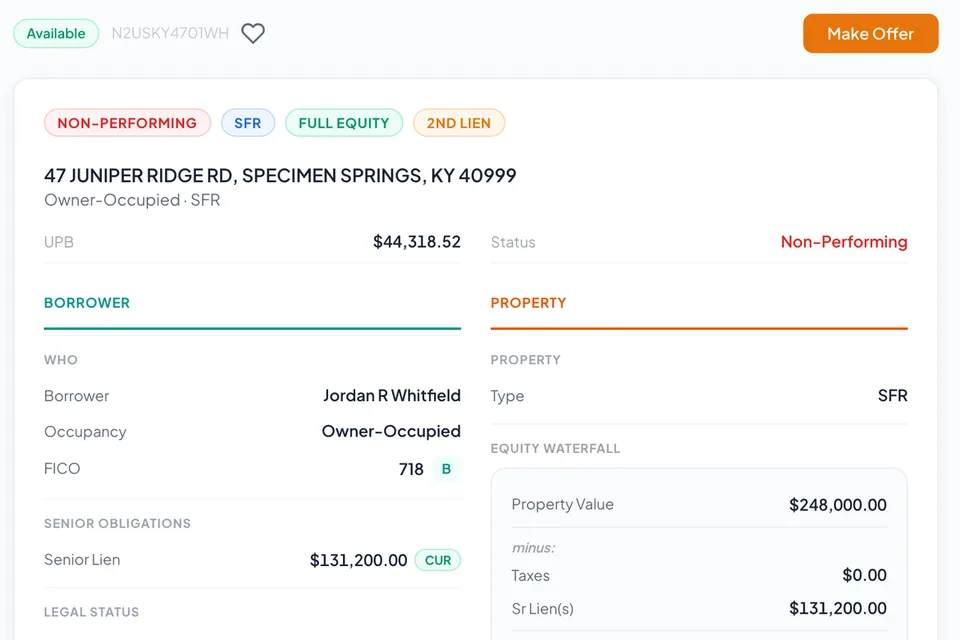
- Non-performing junior liens are priced as a percentage of the unpaid principal balance, heavily discounted to account for the risk that the senior lien may consume most or all of the property's value
Your indicative bid is based on the data provided in the tape. It communicates your preliminary price to the seller, subject to confirmation through your own due diligence. Include your proof of funds and a proposed timeline for completing diligence and funding the trade.
If your offer is accepted, you enter the due diligence window — typically 7 to 10 days. During this period, order your BPO (broker price opinion), title report, and credit report on day one. These reports take 5 to 7 business days to return, and the results determine whether you proceed at your original price, negotiate a reduction, or walk away.
What Happens Between Accepted Offer and Closing?
The post-bid process follows a defined sequence. For a detailed step-by-step walkthrough, see How to Buy Your First Mortgage Note. Here is the condensed version:
Due diligence (days 1-10). Verify the seller's representations against your own independent research. Confirm property value through a BPO. Check the chain of title for defects, intervening liens, or recording gaps. Pull a credit report to assess the borrower's financial profile and identify any active bankruptcy filings. If your findings match the tape data, proceed. If they reveal discrepancies — a lower property value, undisclosed liens, title defects — present a data-supported price adjustment to the seller.
Contract execution (days 10-15). Once both parties agree on the final price, you sign the loan purchase sale agreement. Review the representations and warranties carefully — this section defines your post-closing recourse if the seller's data turns out to be inaccurate.
Funding and post-closing (days 15-30). Wire the purchase proceeds. Include your servicer's contact information and collateral file delivery address in the same communication. The seller prepares the assignment of mortgage and allonge, ships the physical collateral package, and initiates the servicing transfer. On your end, record the assignment with the county recorder immediately — this ensures you receive notice of any future action affecting the property.
Servicing transfer (days 15-45). Your servicer and the seller's servicer coordinate the transfer of loan data and borrower communication. The borrower receives legally required notice letters from both the outgoing and incoming servicer. Once the transfer is complete and your loan is boarded, you are actively managing the asset.
What Should Your 90-Day System Look Like?
By the end of 90 days, you should have more than a single transaction in progress. You should have a repeatable system — one that covers the following components:
A data management process. Whether you use a CRM platform like Podio or a structured spreadsheet, every loan in your pipeline should be tracked with its current status, next action, and deadline. Tag assets by resolution stage and review the pipeline weekly.
A due diligence workflow. Document your waterfall criteria, your vendor contacts, and the order in which you pull reports. The second tape review should take half the time of the first. The tenth should be routine.
A vendor network. Your servicer, attorney, CPA, and due diligence providers are the operational backbone of your business. Maintain these relationships actively — communicate clearly, pay invoices promptly, and provide organized information. Vendors who trust you will prioritize your work.
A professional presence. Your LLC, website, LinkedIn profile, vetting package, and conference connections form the public face of your business. Keep them current and consistent. Every counterparty you interact with — sellers, servicers, attorneys, borrowers — will look you up before they engage.
What Mistakes Should You Avoid in the First 90 Days?
Spending all 90 days on education. Learning is essential, but it has diminishing returns without application. Set a hard deadline for when you will start reviewing real tapes and reaching out to real sellers. Days 31-60 exist for this reason.
Skipping the entity setup. Operating without an LLC exposes your personal assets and puts your name on public records. It also signals to sellers that you are not a serious counterparty. Form the LLC in the first two weeks.
Approaching sellers without a vetting package. Requesting a tape before you have proof of funds, a servicing relationship, and a professional web presence wastes the seller's time and damages your credibility. Prepare your materials before you make the ask.
Bidding on assets you have not researched. The waterfall process exists to prevent this. Run every loan through the screening criteria before you invest in BPOs, title reports, and credit pulls. A $500 due diligence spend on a loan you should have eliminated at step one is money you cannot recover.
Trying to automate before you understand the manual process. CRM integrations, workflow automations, and API connections are valuable — eventually. In the first 90 days, do everything manually. Understand why each step matters, what data flows between each vendor, and where errors are most likely to occur. Automate only after you have a process worth automating.
How Does Day 91 Look Different?
If you have followed this roadmap, day 91 is not a starting line. It is a continuation. You have an entity, a funded bank account, active vendor relationships, at least one tape review under your belt, and — ideally — a first trade in progress or completed. You understand the acquisition process from bid to boarding. You have a system for tracking your pipeline.
From here, the work shifts from setup to execution and refinement. You review more tapes, submit more bids, close more trades, and begin building the portfolio data that reveals which asset classes, geographies, and resolution strategies produce the best returns for your business. The first 90 days give you the foundation. Everything after that is compounding.
For a deeper look at the operational principles that guide experienced note investors, see Mortgage Note Investing: Set Up for Success. For a full walkthrough of the acquisition process, see How to Buy Your First Mortgage Note. And if you are evaluating how much starting capital you need, see How Much Money Do You Need to Start Investing in Mortgage Notes.
 Free Note Investor Workshop
Learn notes by pricing one.
Analyze a training loan modeled on a real deal, then submit practice offers on loans that actually sold.
- No credit card
- No email needed to start
- 7 steps · about 70 min