Non-Performing Assets: The Complete Investor's Guide (And Why Mortgage Notes Win)
What are non-performing assets? A full breakdown of every NPA type — and the case for why secured residential mortgage notes are the best class to own.
What Are Non-Performing Assets?
A non-performing asset (NPA) is any loan or credit instrument on which the borrower has stopped making scheduled payments — typically for 90 days or more. From the lender's perspective, the asset has stopped producing the income it was underwritten to generate. From an investor's perspective, it's a mispriced opportunity.
The banking industry uses the term broadly. Commercial banks, credit unions, insurance companies, and government-sponsored enterprises all hold NPAs on their balance sheets. When those positions become large enough, they trigger regulatory capital requirements, credit ratings pressure, and reputational risk that make holding the assets more expensive than selling them — often at steep discounts.
That discount is the engine of the entire distressed debt investing ecosystem. Banks need to move NPAs off their books. Investors who know how to value and resolve those assets can buy them at 30–70 cents on the dollar and generate returns far exceeding what's available in conventional real estate or fixed-income markets.
Before you can evaluate which NPAs to target, you need to understand the full landscape of what's out there — and why some asset classes are structurally better than others.
The Major Types of Non-Performing Assets
Not all NPAs are created equal. The type of debt, the type of collateral (if any), and the legal framework governing resolution all determine what a non-performing asset is worth and how difficult it will be to resolve.
1. Non-Performing Mortgage Loans (Residential)
These are non-performing loans secured by a first or second lien on a residential property. The borrower has stopped making payments — usually 90+ days past due — and the bank has classified the loan as non-performing under regulatory guidelines.
Residential NPLs are the most actively traded asset class in the NPA universe. They're originated in massive volume, held by thousands of institutions, and regularly sold through organized channels: the GSE programs (Fannie Mae's CRT/NPL sales, HUD's DASP program), bank bulk tape sales, and the growing secondary marketplace where individual investors and smaller institutions transact.
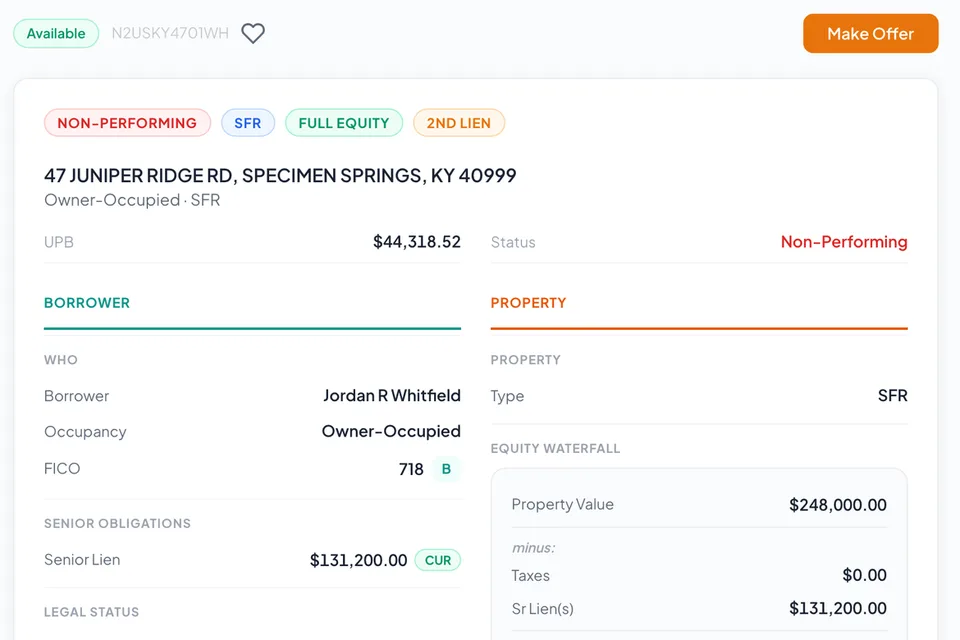
These are the notes that FIXnotes investors buy and resolve. We'll come back to why this class is structurally superior — but first, the full picture.
2. Non-Performing Commercial Real Estate Loans
Commercial mortgages — secured by office buildings, retail centers, industrial properties, multifamily complexes — also go non-performing. When they do, the scale is larger and the resolution complexity is higher.
A non-performing commercial loan on a 100,000-square-foot office park might have a UPB of $8 million. The workout requires environmental assessments, complex appraisals, lease analysis, and often years of litigation. Institutional players — private equity funds, special servicers, commercial note desks at investment banks — dominate this space. The barrier to entry is high. Individual investors rarely participate.
3. Non-Performing Auto Loans
Auto loans go non-performing when borrowers stop making car payments. Banks and credit unions hold large portfolios. The collateral is depreciating (and usually insurable), repossession is faster and less costly than real estate foreclosure, and the per-loan balances are smaller.
The challenge: repossession and resale of vehicles produces thin margins, and the regulatory environment for auto collections is complex. Most non-performing auto paper is sold in bulk to specialized servicers, not to individual investors.
4. Non-Performing Credit Card Debt (Charge-Offs)
When a credit card balance goes 180 days past due, the issuer typically charges it off — removes it from performing assets on the balance sheet — and either sells it to a debt buyer or places it with a collection agency.
These are unsecured obligations. There is no collateral. Collection depends entirely on the borrower's ability and willingness to pay, and the statute of limitations on debt collection varies by state. Debt buyers (Portfolio Recovery, Midland Credit, Encore Capital) operate in this space at scale. Returns can be high, but the workflow is pure collections — high volume, high attrition, legally regulated to the minute.
5. Non-Performing Student Loans
Federal student loans in default are technically non-performing, though the government's collection tools (wage garnishment, tax refund offset) are unique and not replicated in the private market. Private student loans trade in NPL portfolios but occupy a niche corner of the market with limited secondary market infrastructure.
6. Non-Performing Business/Commercial Loans (C&I)
Commercial and industrial loans — lines of credit, term loans, equipment financing for businesses — go non-performing when the borrowing company misses payments. These are frequently unsecured or secured by business assets (inventory, receivables, equipment) rather than real property. Resolution often involves bankruptcy proceedings, UCC foreclosure on business collateral, or negotiated settlements. The secondary market is less liquid and less transparent than residential.
How Banks Define "Non-Performing"
The federal banking regulators (OCC, FDIC, Federal Reserve) have precise criteria:
- 90+ days past due — a loan is technically non-accrual (no longer accruing interest income on the bank's books) once it's 90 days past due
- Doubtful or loss classification — examiners can force NPA status based on collateral and borrower deterioration even before 90 days
- Troubled debt restructuring (TDR) — a loan modified under financial distress may remain classified as non-performing even after modification
For the bank, NPA status triggers reserve requirements — regulators mandate that the bank set aside capital against potential losses. A $5 million NPA portfolio might require $1.5–3 million in capital reserves, capital that cannot be deployed elsewhere. That's the carrying cost that creates urgency to sell.
The regulatory math is why banks sell non-performing loans at steep discounts even when they believe the loans could eventually be resolved at or near face value. The time value of capital and the regulatory cost of holding NPAs often makes selling at a loss the economically rational decision.
Non-Performing Mortgage Notes: The Investor's Sweet Spot
Of every non-performing asset class available to individual investors, residential first-lien mortgage notes offer the most favorable combination of:
- Real property collateral
- Transparent secondary market infrastructure
- Multiple resolution pathways
- Regulatory familiarity (residential lending is the most heavily documented lending category in the US)
- Accessible price points ($10,000–$100,000+ per note)
- Investment horizons matched to individual capital deployment
Here's why the math works in mortgage notes' favor compared to every other NPA class.
The Collateral Advantage
Unlike unsecured credit card debt or student loans, a non-performing mortgage note is backed by a physical asset: a house. The property does not depreciate because the borrower stopped paying. If anything, time and a recovering market may work in the note investor's favor.
The fundamental pricing metric in NPL investing is Investment to Value (ITV) — the ratio of your purchase price to the property's current market value. If a note has a $120,000 UPB and you buy it for $48,000 while the house is worth $100,000, your ITV is 48%. Even in a worst-case scenario — the borrower never cooperates, the property requires foreclosure — you own a $100,000 asset for $48,000. That's a built-in margin of safety that unsecured debt can never offer.
Compare that to non-performing credit card debt. If the borrower has no attachable assets, "resolving" the debt means litigating for a judgment you may never collect. There's no collateral to fall back on.
The Resolution Pathway Advantage
Non-performing residential mortgage notes have more resolution pathways than any other NPA class. When you own the note, you have options:
- Loan modification — Restructure the terms (rate reduction, payment reduction, balance deferral) so the borrower can resume paying. A re-performing loan can be held for cash flow or sold at a premium.
- Discounted payoff — Negotiate a lump-sum settlement with the borrower at a discount to the UPB. They get debt relief; you get a fast exit.
- Reinstatement — The borrower comes current by paying the full arrears. The loan returns to performing status.
- Deed-in-lieu — The borrower voluntarily transfers the property. You avoid foreclosure costs and timeline.
- Short sale — The borrower sells the property for less than the loan balance with your approval. Clean exit, no REO.
- Foreclosure — Last resort. You take the property. In many markets, a home acquired at 40–50 cents on the dollar via foreclosure still produces a strong return.
Non-performing commercial loans have fewer borrower-friendly options and more complex legal proceedings. Non-performing auto loans produce a repossessed car, not a house. Non-performing credit card debt produces a judgment — maybe.
The Market Access Advantage
Residential mortgage notes are the one NPA class where individual investors can access institutional-quality deal flow without institutional capital. The secondary mortgage market has evolved a working infrastructure: tape brokers, specialized servicers, online platforms (like FIXnotes), and an active community of buyers and sellers. That infrastructure includes dedicated listings of secured charge-off portfolios — mortgage-backed assets already written off by lenders and available at structured discounts to UPB.
An investor with $30,000–$50,000 can buy a legitimate non-performing first lien on a single-family residence. The same investor cannot buy a meaningful position in non-performing commercial real estate, where minimum trade sizes routinely exceed $1 million.
The Competition Advantage
Hedge funds and private equity dominate NPL purchasing for bulk packages of 50–500+ loans. But individual-loan transactions, especially those under $100,000 UPB, are below their minimum deployment threshold. That creates a structural inefficiency that individual investors can exploit: you're not competing against sophisticated, well-capitalized institutions. You're often buying from regional banks and credit unions whose compliance teams are tired of carrying the asset.
"Everyone told me hedge funds get all the good deals. What they don't tell you is that hedge funds need to deploy $50 million at a time. They don't buy $40,000 notes on three-bedroom ranches in Ohio. We do." — Robert Hytha
The Documentation Advantage
Residential mortgages are the most heavily documented loans in the US financial system. Federal and state laws mandate disclosures, appraisals, title searches, insurance, and servicer records at every step of the loan's life. When you buy a non-performing residential mortgage note, you have a paper trail: the note, the security instrument, a history of payments (or non-payments), servicer records, property taxes, insurance.
Non-performing commercial loans, business debt, and consumer charge-offs often have far weaker documentation. The chain of title on a charged-off credit card balance sold three times between collectors may be impossible to establish without litigation.
The FIXnotes Numbers: What This Looks Like in Practice
FIXnotes investors have documented $68.2 million in client revenue across thousands of NPL transactions. The founder has personally handled 10,000+ assets and overseen $777 million in NPL UPB. These aren't theoretical numbers from a textbook. They come from buying discounted residential mortgage notes, resolving them — modification, payoff, foreclosure, sale — and reinvesting the proceeds.
The entry point is lower than most investors assume. One FIXnotes member closed their first deal for $1,850 — a performing note purchased off a $134,000 UPB loan sold at $40,000. That's a real transaction, documented in our Deal Analysis Worksheet. It's the kind of deal that does not exist in commercial real estate, does not exist in consumer debt buying, and does not exist in any other NPA class.
Non-Performing Assets vs. Other Asset Classes: A Side-by-Side View
| Asset Class | NPA Type | Collateral | Entry Point | Individual Access | Resolution Options |
|---|---|---|---|---|---|
| Residential mortgage notes | Mortgage NPL | Real property (house) | $10K–$100K+ | High | 6+ pathways |
| Commercial RE loans | Commercial NPL | Commercial property | $500K–$10M+ | Low | Complex, limited |
| Auto loans | Consumer NPL | Depreciating vehicle | Bulk only | Very low | Repo & resale only |
| Credit card debt | Consumer charge-off | None (unsecured) | Bulk only | Medium (specialized) | Judgment only |
| Student loans | Federal/private NPL | None | Not accessible | None | Garnishment (federal) |
| Business loans (C&I) | Commercial NPL | Business assets | $100K+ | Low | Complex |
Residential mortgage notes stand alone as the NPA class that offers real collateral, accessible entry, multiple resolution pathways, and infrastructure designed for individual investors.
What "Non-Performing" Does NOT Mean
Before you start researching NPL investing, let's clear up the most common myths we hear from investors:
Myth: Non-performing means the borrower is a deadbeat who will never pay.
Reality: Most NPL borrowers stopped paying because of a life event — job loss, divorce, medical emergency, death in the family. Many want to keep their homes and will cooperate with a solution that gives them a realistic path forward. The investor who calls with a modification offer often gets a very different conversation than the bank calling with a foreclosure notice.
Myth: Buying non-performing assets requires a license.
Reality: Buying mortgage notes as an investor does not require a real estate license, a mortgage originator license, or a financial advisor license. You're purchasing an existing debt obligation, not originating a new one. Standard legal and compliance requirements apply (FDCPA, RESPA for the servicer), but note investing itself is not a licensed activity.
Myth: You need $50,000–$100,000 minimum to start.
Reality: Individual non-performing notes regularly trade for $10,000–$30,000 purchase price on loans with $50,000–$100,000+ UPB. The entry point is a function of geography, property value, and discount — not a fixed institutional minimum.
Myth: Hedge funds get all the inventory.
Reality: Hedge funds operate at scale. They buy pools of 50–500 loans at a time, which means individual assets in smaller markets are structurally below their radar. The secondary market for individual NPLs traded between individual investors and regional institutions is entirely separate.
How to Start Investing in Non-Performing Mortgage Notes
The learning curve in NPL investing is real. The secondary market has its own vocabulary, its own pricing framework, its own due diligence checklist, and its own legal considerations. Getting the education right before you deploy capital is not optional.
Here's the sequence that FIXnotes members follow:
-
Learn the core terms. UPB, ITV, yield, servicer transfer, resolution outcomes. You need 15–20 foundational terms before you can evaluate a single deal. The free Note Investor Workshop walks through them on a real deal.
-
Understand deal analysis. Before making an offer on a non-performing note, you need to model at least three resolution scenarios (best case, base case, worst case) and calculate an acceptable purchase price for each. This is the skill that protects your capital.
-
Build your buy box. Geography, lien position (first vs. second), UPB range, property type, borrower circumstances — these filters determine which deals you even look at. A focused buy box is more valuable than a large one.
-
Access deal flow. The FIXnotes marketplace lists non-performing residential mortgage notes available for purchase. You can search by state, lien position, UPB, and property type. Our buyer qualification process ensures you're looking at real inventory with real documentation.
-
Execute due diligence. Before closing, you verify collateral value, review the title history, confirm servicer records, assess the property condition, and evaluate the borrower's circumstances. Due diligence is where risk is managed.
-
Close and transfer. A note purchase is documented through a Loan Purchase and Sale Agreement (LPSA), followed by assignment of the security instrument and endorsement of the note. Servicing transfers to a licensed servicer who handles all borrower communications going forward.
The Bottom Line on Non-Performing Assets
Non-performing assets represent a structural inefficiency in the credit markets. Banks and institutions are compelled to sell distressed loans at discounts to face value — not because the assets are worthless, but because holding them is too expensive given regulatory capital requirements and operational complexity.
Of every NPA class available, residential first-lien mortgage notes offer the best combination of collateral protection, accessible entry points, multiple resolution pathways, and an active secondary market infrastructure built for individual investors.
That's the market FIXnotes was built for. Not hedge fund portfolios. Not billion-dollar distressed debt funds. The independent investor who wants to buy real assets, at real discounts, and resolve them with real expertise.
If you want to see what a real non-performing mortgage note deal looks like — the actual numbers, the actual analysis, the actual resolution — the free Note Investor Workshop walks you through a training loan modeled on a completed deal, then has you submit practice offers on real loans sold in the last 90 days.
No credit card. No sales pitch. Just the real framework for buying non-performing assets at 40 cents on the dollar.
 Free Note Investor Workshop
Learn notes by pricing one.
Analyze a training loan modeled on a real deal, then submit practice offers on loans that actually sold.
- No credit card
- No email needed to start
- 7 steps · about 70 min