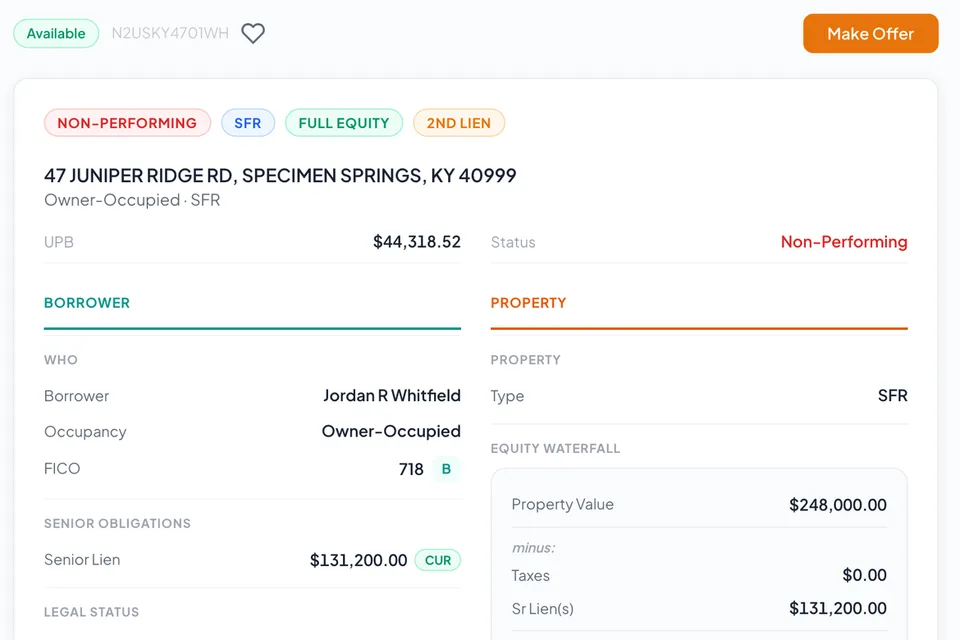
$1,250 into $4,445: Mobile Home Note Case Study (255% ROI)
NPL case study: a $1,250 non-performing mobile home note paid off in full at $4,445 within four months — a 255% ROI with annualized IRR over 200%.
The Setup
A non-performing loan secured by a mobile home came across the tape at a price that most investors would overlook: $1,250. The property had a fair market value of $62,121, there were $0 in delinquent taxes owed, and the unpaid principal balance (UPB) stood at roughly $4,445. That purchase price of $1,250 represented about 28% of UPB — a steep discount, but typical for small-balance, non-performing mobile home paper that institutional buyers often pass over entirely.
From an equity standpoint, the numbers were compelling. With no tax liens eating into the position, the full $62,121 of fair market value sat behind the mortgage. That meant $62,000+ in equity protecting a $4,445 debt — a massive cushion that dramatically reduced the downside risk.
The question, as always, was whether the borrower could be reached and whether a resolution could be crafted.
Borrower Outreach: The Three Questions
In NPL investing, every resolution begins with the same framework — three questions posed to the borrower:
- What happened? Why did payments stop?
- Where are you now? What is the borrower's current situation?
- What do you want to do? What outcome does the borrower want?
The answers to these questions determine the resolution strategy. In this case, the answers revealed a difficult personal situation — but also a clear path forward.
The borrower was in rehabilitation for alcoholism and facing the possibility of hospitalization. He was not in a position to manage the property or communicate about the account himself. However, his sister had stepped in to help stabilize the situation.
She had already taken two important actions:
- Paid three years of delinquent property taxes to bring the account current and prevent a tax sale.
- Received a quit-claim deed from her brother, transferring ownership of the mobile home into her name so she could manage the property going forward.
The sister was motivated, organized, and had the financial means to resolve the debt. She just needed a reasonable offer.
Secured vs. Unsecured: A Key Due Diligence Lesson
This deal illustrates an important concept that trips up newer investors. If you pulled up this loan in public records, you might conclude the note was unsecured. Why? Because the borrower on the mortgage no longer matched the owner on title. The sister — not the original borrower — was now the record owner of the property.
But that conclusion would be wrong.
The critical detail was the transfer type of the last deed instrument. The quit-claim deed was recorded subject to the existing mortgage. That means even though the sister now owned the home, the mortgage lien remained attached to the property. The note was still a secured note — the collateral had not been stripped away.
This is a common scenario in mobile home and small-balance note investing. Properties transfer between family members via quit-claim deeds all the time, especially during health crises. If you see a borrower-owner mismatch during due diligence, do not automatically classify the note as unsecured. Pull the deed and read the transfer language. In many cases, the mortgage survives the transfer.
Structuring the Payoff
The sister signed a homeowner's authorization letter — a third-party authorization that allowed the servicer and investor to communicate with her directly about the account. With that paperwork in place, the negotiation could proceed.
She had the funds to settle the balance and wanted the property free and clear. The investor's offer was straightforward:
- Full payoff of the UPB: $4,445
- No accrued interest added
- No late fees added
This is a clean, borrower-friendly resolution. Rather than stacking penalties on top of the balance — which is the investor's right — the offer waived all extras as an incentive for prompt payment. Pay the principal, get a satisfaction of mortgage, and move on.
The sister accepted. The payoff was completed, the title was cleared, and the property was back on track with taxes current and no outstanding liens.
The Numbers
| Metric | Value |
|---|---|
| Purchase Price | $1,250 |
| UPB | $4,445 |
| Purchase as % of UPB | 28% |
| Fair Market Value | $62,121 |
| Taxes Owed | $0 |
| Equity Protecting Position | $62,121 |
| Payoff Amount | $4,445 |
| Expenses | $420 |
| Net Profit | $2,775 |
| Hold Time | 4 months |
| ROI | 255% |
| Annualized IRR | 200%+ |
The gross return was $4,445 on a $1,250 investment with $420 in expenses, yielding a net profit of approximately $2,775. The ROI of 255% is striking on its own, but the real story is the internal rate of return.
Why the Four-Month Timeline Matters
IRR is the time value of money. A 255% ROI over four months is fundamentally different from a 255% ROI over four years. When you annualize a four-month turnaround at this return level, the IRR exceeds 200%.
To put that in perspective: if the same deal had taken a full year to resolve instead of four months, the IRR would have been roughly 70%. Still excellent — but not in the same league. The speed of resolution is what transforms a good deal into an extraordinary one.
This is why experienced NPL investors prioritize deals where the resolution path is short and clear. A borrower (or borrower's family member) who has the means and motivation to pay is the highest-probability, fastest-exit scenario in the playbook.
Compounding Small-Balance Wins
One of the most powerful aspects of small-balance note investing is the ability to redeploy capital quickly. Consider the math:
- Scenario A: You invest $1,250 in one deal and earn $2,775 in profit over four months. Strong.
- Scenario B: You take that same $1,250, turn it into $4,445 in four months, reinvest the full amount into two or three similar deals, and repeat. Over the course of a year, you could complete three full cycles.
If you can average even a fraction of this deal's return across multiple cycles, the compounded annual return dwarfs what a single buy-and-hold investment would produce. This is the small-balance note investor's edge — low entry cost, fast resolution, rapid redeployment.
The math works because:
- The capital requirement is low. $1,250 is an accessible entry point for most investors.
- The hold times are short. Mobile home and small-balance notes often resolve in months, not years.
- The equity cushion provides protection. A $62,000 property behind a $4,445 debt means there is enormous margin for error.
Lessons from This Deal
1. Do Not Ignore Small-Balance Notes
Institutional investors skip mobile home notes and sub-$5,000 balances because the absolute dollar profit does not move the needle for a fund managing millions. That creates opportunity for individual investors. The returns on a percentage basis can be extraordinary precisely because competition is low and pricing is aggressive.
2. Check the Deed Transfer Language
When the borrower on the note does not match the owner on title, your first instinct should not be to classify the note as unsecured. Pull the most recent deed. If it is a quit-claim deed recorded subject to the existing mortgage, the lien survived the transfer. The note remains secured, and your position is intact.
3. Waiving Fees Can Accelerate Resolution
This investor chose to waive accrued interest and late fees in exchange for a prompt payoff. That is not leaving money on the table — it is a strategic decision to prioritize speed. A $4,445 payoff in four months beats a $5,500 payoff that takes eighteen months of back-and-forth negotiation. The IRR math strongly favors the faster resolution every time.
4. Borrower Communication Is the Catalyst
None of this happens without effective outreach. The three questions framework — what happened, where are you now, what do you want to do — opened the door to a conversation with the sister. She became the point of contact, the decision-maker, and ultimately the person who wrote the check. Meeting borrowers (and their families) where they are is the foundation of every successful NPL resolution.
5. Speed Is the IRR Multiplier
A four-month hold turned a solid return into a standout one. Every additional month a deal sits unresolved erodes the annualized return. When you find a deal with a motivated counterparty and a clear path to resolution, move quickly. Handle the paperwork, make the offer, and close.
The Takeaway
This mobile home note case study demonstrates that high-percentage returns in note investing do not require six-figure investments or complex legal proceedings. A $1,250 purchase, a motivated borrower's family member, a clean payoff offer, and a four-month timeline produced a 255% ROI.
The deal worked because the fundamentals were sound: deep equity protection, a secured lien, low purchase price relative to UPB, and a borrower-side contact who had both the means and the motivation to pay. These are the characteristics to look for in every small-balance deal you evaluate.
For investors willing to work the phones, manage small files, and move quickly when the opportunity is there, mobile home and small-balance notes remain one of the most accessible and highest-returning niches in the non-performing note market.
 Free Note Investor Workshop
Learn notes by pricing one.
Analyze a training loan modeled on a real deal, then submit practice offers on loans that actually sold.
- No credit card
- No email needed to start
- 7 steps · about 70 min