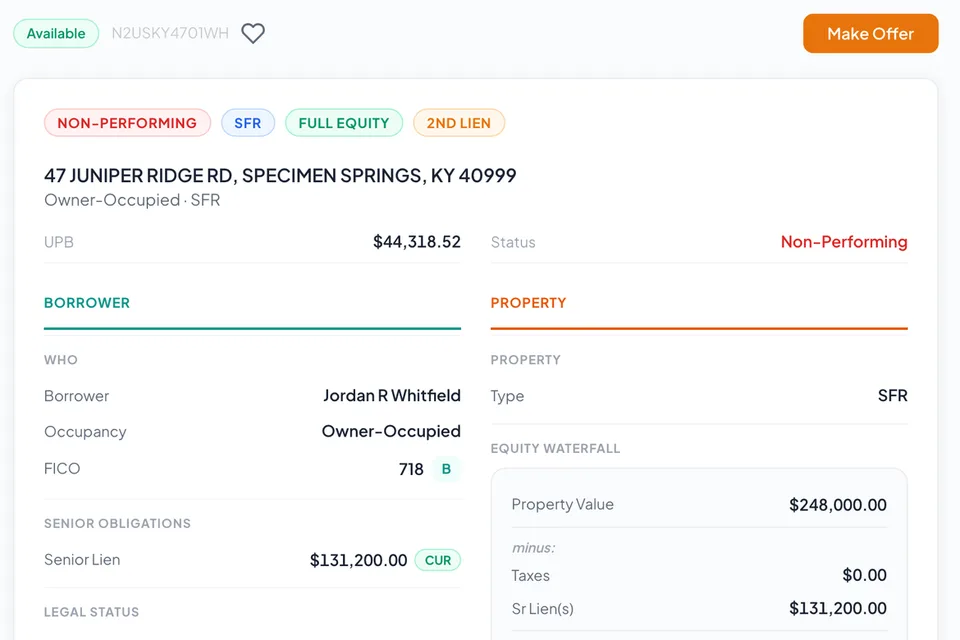
$280,000 Payoff on a 2nd Mortgage Note
NPL case study: a $164,900 second lien on a $1.25M property settled for $280,000 via discounted payoff — 69.8% ROI and 49.25% annualized IRR.
The Setup
An investor identified a non-performing loan in a junior lien position — a second mortgage where the borrower had stopped making payments. The property securing the note was a single-family residence valued at approximately $1,250,000, located behind a current first mortgage with a balance of $756,000.
Two factors made this deal attractive from day one. First, the borrower was still paying the senior lien every month, which meant they had income and were motivated to keep the home. Second, there was significant equity protecting the junior position.
The Deal Metrics
| Metric | Value |
|---|---|
| Property Value (FMV) | ~$1,250,000 |
| First Lien Balance | $756,000 |
| Equity Above Senior | $492,268 |
| Second Lien UPB | $334,716 |
| Equity Coverage Ratio | 1.47x |
| CLTV | 87.38% |
| Purchase Price | $164,900 (49.27% of UPB) |
| Original Monthly Payment | $2,343 |
The unpaid principal balance on the second lien was $334,716. After subtracting the first lien balance from the property's fair market value, $492,268 of equity remained to secure that junior position. Dividing equity by UPB gives an equity coverage ratio of 1.47 — meaning the borrower's equity fully covered the second lien with room to spare.
From the borrower's perspective, the combined loan-to-value (CLTV) was 87.38%. Since CLTV was below 100%, the borrower had skin in the game — the total debt across both liens was less than the property's value. This is critical because borrowers who are underwater have far less incentive to negotiate or settle a junior lien.
The investor acquired the note for $164,900, roughly 49 cents on the dollar of UPB. At that basis, even a modification back to the original $2,343 monthly payment would have generated approximately 17% annualized returns. But the investor had reason to believe a lump-sum resolution was possible — and pursued it.
The Borrower Story
This borrower was difficult to work with, but not in the way investors typically fear. There was no hostility or avoidance. Instead, the borrower insisted on communicating exclusively by mail — no email, no phone calls. Every exchange went through the postal service, which slowed the negotiation timeline considerably.
Behind the scenes, the borrower was dealing with a medical issue and an upcoming hospital admission. They wanted to resolve this financial stressor before that happened, which meant they were motivated to reach a lump-sum settlement rather than enter a long-term modification.
How the Negotiation Unfolded
The back-and-forth played out over several months:
-
Borrower's opening offer: $190,000. The borrower initiated the conversation with a discounted payoff offer of $190,000 — roughly 57% of UPB but only $25,000 more than the investor's cost basis. Not enough.
-
Investor's counter: $290,000. The investor pushed back, anchoring closer to full UPB to leave room for negotiation.
-
Investor pivots to a modification proposal. Rather than simply rejecting the $190,000, the investor made a strategic counter: if the borrower had $190,000 available, why not apply it as a large down payment toward a loan modification on the remaining balance? This tactic serves two purposes — it tests whether the borrower truly has access to funds, and it presents a less attractive alternative that makes the DPO look more appealing by comparison.
-
Modification falls through. The borrower explored the modification path but ultimately declined. Given the upcoming medical situation, a long-term repayment plan was not what they wanted.
-
Borrower comes back at $275,000. With the modification off the table, the borrower returned with a significantly improved offer.
-
Final settlement: $280,000. The investor negotiated the final $5,000 and closed the deal at $280,000.
The entire negotiation took 17 months from acquisition to payoff — longer than ideal, but largely a function of the snail-mail communication format rather than borrower resistance.
The Returns
| Metric | Value |
|---|---|
| Purchase Price | $164,900 |
| Settlement Amount | $280,000 |
| Gross Profit | $115,100 |
| Hold Time | 17 months |
| ROI | 69.8% |
| Annualized IRR | 49.25% |
The math is straightforward. The investor collected $280,000 on a $164,900 investment for a gross profit of $115,100 — a 69.8% return on investment. Because the deal took 17 months to close, we annualize by dividing by 1.417 (17 months / 12 months), which brings the internal rate of return to approximately 49.25%.
For a back-of-the-envelope IRR calculation on a single lump-sum exit:
IRR = (Settlement - Cost Basis) / Cost Basis / (Months to Exit / 12)
($280,000 - $164,900) / $164,900 / (17 / 12) = 49.25%
A more precise IRR would use the XIRR function in Excel, mapping each cash outflow and inflow to its exact date. But for a deal with one purchase and one lump-sum payoff, this simple formula gives an accurate approximation.
Why This Worked
Full Equity Coverage
The single most important factor in this deal was the equity position. With $492,268 of equity securing a $334,716 UPB, the investor's position was fully covered. This gave the investor leverage — if negotiations broke down entirely, foreclosure was a viable backstop because the property's value could satisfy the junior lien.
A Motivated Borrower
The borrower had two layers of motivation. They were current on their first mortgage, proving attachment to the home and the ability to pay. And they had a medical situation that created urgency to resolve the second lien before a hospital stay. Motivation plus access to funds is the formula for a DPO.
The Right Purchase Price
Buying at 49 cents on the dollar gave the investor a wide margin of safety. Even the borrower's initial lowball offer of $190,000 would have generated a positive return. The investor was never in a position where walking away from a settlement meant losing money on a modification or foreclosure alternative.
Patience with the Process
The 17-month timeline was not ideal, but the investor adapted to the borrower's preferred communication method rather than trying to force a faster channel. That patience preserved the relationship and kept the negotiation moving forward. Pushing too hard on communication format could have shut down the conversation entirely.
Key Takeaways
1. Communicate in the Borrower's Preferred Format
This investor would have preferred email and phone calls. Instead, they spent 17 months exchanging letters through the postal service. The lesson: borrower cooperation matters more than your convenience. If mail is how they communicate, mail is how you negotiate. Push for faster channels when you can, but do not sacrifice the deal over it.
2. Verify the Source of Funds
A $275,000 settlement offer means nothing until the borrower proves they can access those funds and release them on a defined timeline. Before agreeing to any discounted payoff, confirm where the money is coming from — savings, a home equity line, family support, retirement account — and what the realistic timeline is for disbursement.
3. Use the Modification as a Negotiation Tool
When a borrower offers a discounted settlement that does not meet your objectives, counter with a modification proposal. If they claim to have $190,000 available, suggest applying it as a down payment toward a modified loan for the remaining balance. This does two things: it tests whether the borrower truly has the funds, and it makes the DPO settlement look more attractive by comparison. In this case, the borrower's medical situation made a long-term modification unappealing — which pushed them back toward a higher lump-sum offer.
4. Weigh Foreclosure Time and Cost Against a DPO
Before rejecting any settlement offer, calculate your potential IRR under both scenarios: accepting the DPO now versus pursuing foreclosure over 12 to 24+ months. In judicial foreclosure states like New York and New Jersey, the legal process alone can take two years or more. A discounted payoff today may produce a higher IRR than a full-balance recovery two years from now — especially after factoring in legal fees, property maintenance, and the opportunity cost of tied-up capital.
5. Start Small, Apply the Same Principles
This was a six-figure investment that produced a six-figure payoff. But every strategy used here — equity analysis, borrower negotiation, the modification counter, DPO structuring — works identically on loans with sub-$10,000 balances that you can acquire for a fraction of the cost. Smaller deals let you build the skill set before deploying larger amounts of capital.
The Bottom Line
This deal illustrates the core mechanics of profitable junior lien investing: buy at a discount to UPB, confirm equity coverage, and negotiate a resolution that works for both sides. The $280,000 settlement on a $164,900 investment produced a 49.25% annualized IRR — a strong outcome made possible by full equity coverage, a motivated borrower, and the patience to work through a 17-month negotiation by mail. Not every deal will resolve this cleanly, but the fundamentals — buy right, verify equity, and negotiate persistently — apply to every non-performing second lien in your portfolio.
 Free Note Investor Workshop
Learn notes by pricing one.
Analyze a training loan modeled on a real deal, then submit practice offers on loans that actually sold.
- No credit card
- No email needed to start
- 7 steps · about 70 min