Why Can't You Buy Mortgage Notes Directly from Banks?
Banks sell mortgage notes to institutional buyers, not individuals. Learn why — and where to source notes through the secondary market instead.

The Short Answer: Banks Are Not Retail Sellers
One of the most common questions from new note investors is deceptively simple: "Why can't I just go to a bank and buy a mortgage note?" It seems logical. Banks originate mortgage loans. Banks sometimes want to get rid of those loans. You want to buy them. Supply meets demand. Deal done.
Except it does not work that way. Banks are not set up to sell individual loans to individual investors. The way banks dispose of loan assets is shaped by regulatory requirements, institutional risk management, and internal processes that have nothing to do with finding the highest bidder. Understanding why this gap exists is the first step toward understanding how the secondary market actually works — and where you fit into it.
Why Do Banks Sell Mortgage Notes?
Before diving into why banks will not sell to you directly, it helps to understand why they sell at all. Banks are in the business of lending money. When a borrower stops paying, the bank has a problem — but not the kind of problem most people think.
The real issue is not the missing monthly payment. The real issue is the bank's balance sheet.
When a borrower defaults for an extended period — typically 120 to 180 days — banking regulations require the lender to charge off the loan. This means removing it from the balance sheet as an earning asset and recognizing the loss. The charge-off is an accounting event, not a legal one. The debt still exists. The lien is still attached to the property. The borrower still owes the money. But on the bank's books, that loan is now a liability instead of an asset.
Once a loan has been charged off, the bank has already taken the accounting hit. At that point, the bank's incentive is simple: recover whatever cash it can from the loan while expending the least possible effort and risk. That means packaging charged-off loans into pools and selling them into the secondary market at steep discounts to the unpaid principal balance (UPB).
This is where the disconnect begins. Banks are not selling these loans as a profit center. They are selling them to clean up their balance sheets. And that fundamental motivation changes everything about how they choose who to sell to.
What Banks Actually Look for in a Buyer
Here is the part that surprises most new investors: banks are not looking for the highest bidder. They are looking for the best buyer.
Those are two very different things. When a bank evaluates potential counterparties for a loan sale, price is only one factor — and often not the most important one. Here is what banks actually prioritize:
Operational Ease
Banks have internal processes for loan sales that have been refined over years. They have specific file repositories, SFTP sites with layered firewalls, compliance workflows, and documentation requirements. The bank is not going to redesign those systems for a one-off buyer purchasing a single loan.
When a bank sends collateral images, they may use a particular file repository they have maintained for years with established counterparties. If they switch to a different repository for a specific trade, they expect the buyer to set up the required SFTP access, navigate the firewalls, and follow the process without hand-holding. Jumping through those hoops matters — not because the hoops are fun, but because they demonstrate that you can work within the bank's existing infrastructure.
At the end of the day, being an easy counterparty to work with is worth more to the bank than squeezing out an extra percentage point on price. A buyer who follows the bank's process, responds promptly, and closes without drama will get invited back for the next trade. A buyer who is high-maintenance, even if they pay a premium, is a headache the bank does not need.
Reputational Safety
Banks are publicly visible institutions that answer to regulators, shareholders, and the media. When they sell a portfolio of defaulted loans, they need to know those loans will be handled responsibly. The last thing a bank wants is to sell a pool of charged-off mortgages to a buyer who harasses borrowers, ignores consumer protection laws, or ends up in a news story that traces the loan back to the originating bank.
This is what the industry calls headline risk. Banks sell to buyers who will not put them in the headlines. That means selling to established firms with compliance infrastructure, track records of responsible servicing, and the operational maturity to handle distressed debt without creating public relations problems.
An individual investor with an LLC and a checking account — no matter how well-intentioned — does not provide the reputational assurance a bank requires.
Volume and Consistency
Banks do not sell loans one at a time. They sell in pools — sometimes dozens of loans, sometimes hundreds, sometimes thousands. The economics of a bank's loan sale operation only make sense at scale. The legal review, compliance checks, due diligence coordination, and servicing transfer work required to sell a single loan costs the bank nearly as much as selling a hundred loans. So they sell in bulk to pool buyers who can absorb volume.
Individual investors looking to buy one or two loans simply do not fit this model. The bank's cost-per-loan to execute a one-off trade is prohibitive relative to the recovery amount.
The Role of Regulatory Optics
Regulation plays a significant role in shaping how banks sell distressed debt. Federal regulators — particularly the Office of the Comptroller of the Currency (OCC) — issue guidelines that influence which loans banks will sell and to whom.
For example, OCC guidelines advise banks against selling certain categories of loans, including:
- Loans where the borrower is in active bankruptcy
- Loans involving deceased borrowers
- Loans with unresolved regulatory issues
These are guidelines, not laws. Banks are not legally prohibited from selling these loans. But the distinction between a law and a regulatory guideline matters less than you might think in a heavily regulated industry. Banks operate in an environment where the appearance of compliance is nearly as important as compliance itself.
This is why the concept of optics is so central to bank loan sales. Sometimes a bank will strip out all bankruptcy accounts from a portfolio before selling — not because selling them would be illegal, but because the bank does not want the regulatory scrutiny. In other cases, a bank might sell loans involving deceased borrowers while excluding bankruptcy accounts, even though both appear on the same OCC guidance list. The bank's internal risk committee makes these calls based on their own comfort level and regulatory relationship.
For an individual investor, this means that even if you could somehow get in front of a bank's trading desk, you would need to demonstrate awareness of these regulatory considerations. Banks want counterparties who understand the compliance landscape and can have informed conversations about which loan types are appropriate for sale. Showing that awareness — even when the guidelines are not technically binding — builds the trust that makes trades happen.
How Loan Sales Actually Work at the Institutional Level
Understanding the mechanics of how banks sell loans clarifies why individual investors are excluded from the process. Here is what a typical institutional loan sale looks like:
| Stage | What Happens |
|---|---|
| Portfolio identification | The bank identifies a pool of charged-off or non-performing loans it wants to remove from its balance sheet |
| Data preparation | The bank creates a tape — a standardized spreadsheet with loan-level data including UPB, interest rate, last payment date, property address, and lien position |
| Buyer solicitation | The bank distributes the tape to a short list of pre-approved counterparties — typically hedge funds, loan aggregators, and established note buyers with existing relationships |
| Bid collection | Approved buyers submit indicative bids on the pool or selected loans |
| Counterparty selection | The bank selects the buyer based on price, operational track record, compliance reputation, and ability to close |
| Due diligence and closing | The selected buyer completes due diligence, executes the LPSA, wires funds, and coordinates servicing transfer |
Notice what is missing from this process: there is no public listing, no open marketplace, and no mechanism for an unknown buyer to submit an offer. The tape goes to a curated list of counterparties the bank already knows and trusts. If you are not on that list, you never see the loans.
Best Execution vs. Best Price
One of the most important concepts in understanding bank loan sales is the difference between best price and best execution.
Best price is straightforward — whoever offers the most money wins. That is how most retail markets work. But bank loan sales, particularly for charged-off and non-performing portfolios, operate on best execution.
Best execution means the bank evaluates the total package:
- Will the buyer close on time? A buyer who bids high but takes three months to fund is worse than a buyer who bids slightly lower and wires money in two weeks.
- Will the buyer follow the process? Banks have defined workflows. Buyers who require special accommodations, request exceptions, or push back on standard procedures create friction that costs the bank time and money.
- Will the buyer create problems post-sale? Regulatory complaints, borrower lawsuits, or media attention that traces back to the bank's loan sale are existential risks for the people who approved the trade.
- Is there a long-term relationship? A buyer who purchases one pool this quarter and three pools next quarter is more valuable than a one-time buyer, even at a lower per-trade price.
For charged-off loans in particular, the bank has already written the loss. These trades are not profit centers. The bank is recovering whatever it can from assets it has already given up on. In that context, a smooth, compliant, no-drama transaction with a trusted counterparty at 40 cents on the dollar is far more attractive than a complicated, high-maintenance transaction at 45 cents.
How Individual Investors Actually Access Bank-Originated Loans
If you cannot buy directly from banks, how do individual investors end up owning loans that were originally on bank balance sheets? The answer is the secondary market food chain.
Here is how bank-originated loans flow down to individual investors:
- Banks sell pools of charged-off loans to institutional buyers — hedge funds, loan aggregators, and large-scale pool buyers
- Institutional buyers cherry-pick the best loans from the pool for their own portfolio, then resell the remaining loans individually or in smaller packages
- Brokers and trading desks facilitate these smaller trades, connecting institutional sellers with mid-size and individual buyers
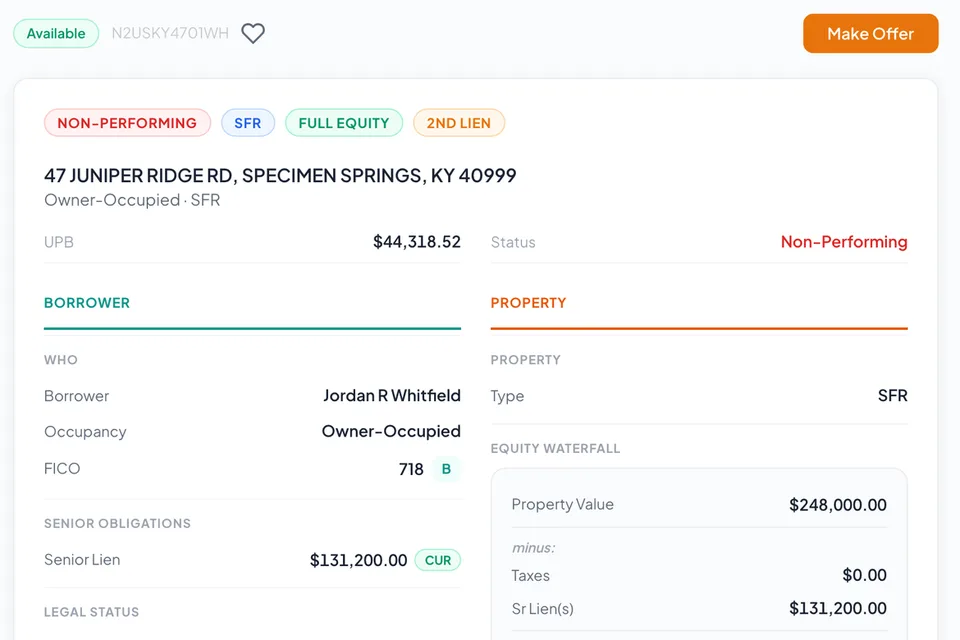
- Individual investors purchase loans one at a time or in small groups from brokers, online marketplaces, or directly from institutional sellers who have broken down the original bank pool
By the time a loan reaches an individual investor, it may have changed hands two or three times since leaving the bank's balance sheet. Each intermediary adds a markup, which means the individual investor pays more per loan than the institutional buyer who purchased the original pool. But the individual investor also gets something the institutional buyer does not: the ability to buy a single carefully selected loan that matches their specific investment criteria, rather than being forced to take an entire pool with varying quality.
Most of the non-performing loans you will encounter on the secondary market, if they were institutionally originated, have been charged off at some point. That charge-off event is what set them free from the bank's balance sheet and into the ecosystem where individual investors can eventually access them.
Bank-Originated NPLs vs. Private Seller NPLs
Not every non-performing loan on the secondary market comes from a bank. Some come from private lenders — individuals or small companies that originated seller-financed loans. The distinction matters because it directly affects pricing.
| Factor | Bank-Originated NPLs | Private Seller NPLs |
|---|---|---|
| Charge-off status | Almost always charged off | Rarely charged off |
| Seller's cost basis | Already written off — the bank has taken the loss | At par — the seller originated the loan and is in at 100% of UPB |
| Pricing expectations | Deep discounts — often less than 50 cents on the dollar, sometimes far less | Much higher — private sellers want close to full balance recovery |
| Volume | Sold in pools; individual loans available through intermediaries | Typically sold one at a time |
| Compliance infrastructure | Extensive — bank servicers maintain detailed records | Variable — documentation quality depends on the originator |
A private lender selling a non-performing note has not charged it off because the charge-off process is a sophisticated accounting procedure that most private lenders do not complete. That means the private seller is still "in at par" — they originated the loan, they funded it with their own money, and they want as close to 100% of the balance as they can get.
A bank that has charged off a loan has already recognized the loss. At that point, anything they recover is found money. That is why bank-originated NPLs trade at such steep discounts — the seller has already written the asset to zero.
For investors, this creates a clear value proposition: bank-originated charged-off loans, purchased through the secondary market, offer the steepest discounts and the widest margin for profit. The trade-off is that you cannot buy them directly from the source.
How to Position Yourself as a Serious Buyer
Even though you likely will not buy directly from a bank as an individual investor, understanding what banks value in a counterparty makes you a better buyer at every level of the market. The same principles that govern bank-to-institution sales filter down through the entire secondary market:
- Follow the seller's process. Every seller — whether a bank, a hedge fund, or an individual — has a preferred way of doing business. Adapt to their workflow rather than insisting they adapt to yours.
- Close when you say you will close. Reliability is the most valuable currency in the secondary market. If you commit to a timeline, hit it.
- Demonstrate compliance awareness. Know the regulatory landscape. Understand borrower protections. Show that you will service the loan responsibly.
- Build long-term relationships. One-off transactions are expensive for everyone. Sellers who know you will come back for more deals are more likely to give you favorable pricing and first looks at new inventory.
- Scale intentionally. As your portfolio grows and your track record strengthens, you may eventually build relationships that give you access to smaller institutional trades — not directly from banks, but from the aggregators and hedge funds that sit one step below banks in the food chain.
For a comprehensive guide to the sourcing channels available to individual investors, see How to Find and Buy Mortgage Notes for Sale.
The Bottom Line
You cannot buy mortgage notes directly from banks because the bank loan sale process is built around institutional buyers who offer something more valuable than a high bid: operational ease, regulatory safety, volume, and long-term partnership. Banks sell charged-off loans to clean up their balance sheets, not to maximize sale price. That means they optimize for best execution, not best price — and best execution requires a level of compliance infrastructure, reputational stability, and transaction volume that individual investors simply do not provide.
The good news is that you do not need to buy directly from banks to access bank-originated loans. The secondary market exists precisely to bridge this gap. Institutional buyers purchase pools from banks and redistribute individual loans through brokers, trading desks, and online marketplaces where individual investors can buy them one at a time. You pay a markup compared to the institutional pool price, but you gain the ability to select individual loans that match your criteria and build a portfolio on your own terms.
Understanding this supply chain — from bank balance sheet to institutional pool buyer to secondary market broker to individual investor — is fundamental to operating effectively in the mortgage note space. The investors who thrive are the ones who know where they sit in the food chain, build relationships with sellers at their level, and execute trades with the same professionalism that banks demand from their own counterparties.
 Free Note Investor Workshop
Learn notes by pricing one.
Analyze a training loan modeled on a real deal, then submit practice offers on loans that actually sold.
- No credit card
- No email needed to start
- 7 steps · about 70 min