Fix and Flip Non-Performing Mortgage Notes
Fix and flip non-performing notes: buy defaulted loans at a discount, resolve them, and sell re-performing loans at a premium for high IRRs.
What Does "Fix and Flip" Mean in Mortgage Notes?
In real estate, fix and flip means buying a distressed property, renovating it, and selling it for a profit. In mortgage notes, the concept is the same -- but the asset you are fixing is the loan itself, not the house.
The process works like this: you buy a non-performing loan at a steep discount to the unpaid principal balance. You work with the borrower to reach a resolution -- typically a loan modification that converts the defaulted loan into one with regular monthly payments. Once the borrower has established a track record of consistent payments, you now hold a re-performing loan -- an asset worth significantly more than what you paid for it. You sell that re-performing loan to a passive investor looking for cash flow, pocket the spread, and redeploy the capital into the next deal. The raw material for this strategy -- real-estate-secured charge-offs priced at deep discounts to UPB -- is available through secondary market platforms that specialize in mortgage debt.
The "fix" is the resolution work. The "flip" is the sale of the re-performing asset. The profit comes from the spread between your discounted purchase price and the premium that a cash-flow investor will pay for a seasoned, performing loan.
Why Does This Strategy Work?
The fix-and-flip model works because non-performing loans and re-performing loans trade at fundamentally different prices, and that gap creates an arbitrage opportunity.
Non-performing loans carry enormous uncertainty. The borrower is not paying. You do not know whether they will cooperate, whether they will reinstate, whether you will need to foreclose, or how long any resolution will take. That uncertainty is priced into the acquisition cost -- NPLs trade at deep discounts, often 30-65% of UPB for junior liens and as a percentage of fair market value for senior liens.
Re-performing loans have far less uncertainty. The borrower is making payments. There is a documented modification agreement in place. The risk of non-payment has been partially de-risked by the borrower's demonstrated willingness and ability to pay. RPLs trade at a premium to NPLs -- typically priced on yield, in the range of 7.5-12.5% for seniors and 11-20% for juniors.
The spread between those two pricing levels is where the profit lives. Every dollar of uncertainty you remove through resolution work translates directly into increased asset value.
How Are Non-Performing Loans Priced?
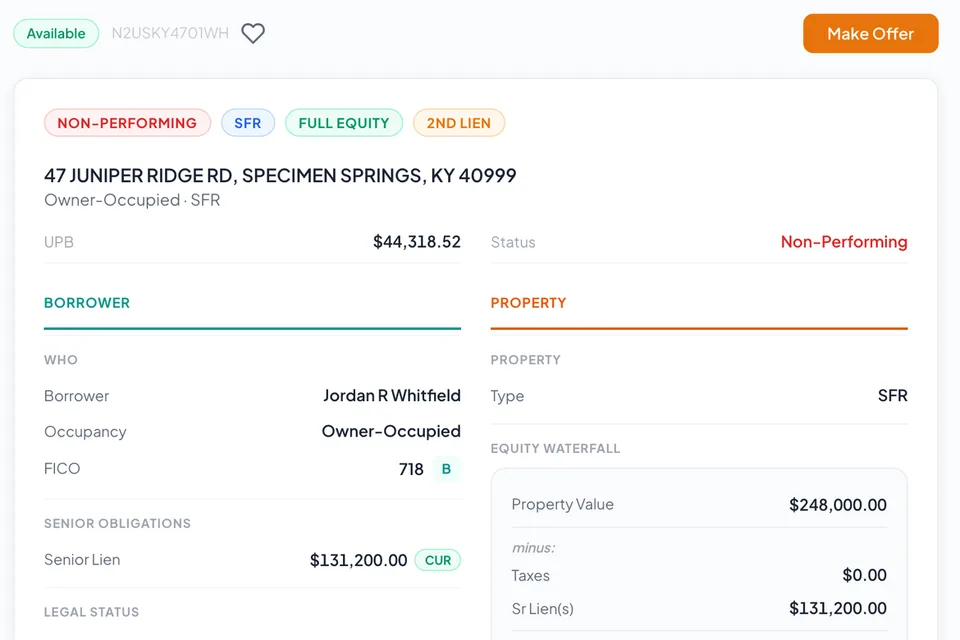
Pricing NPLs requires a different framework than pricing performing assets. You cannot use yield-based pricing on a loan that produces no cash flow. Instead, NPLs are priced based on two anchors:
| Lien Position | Primary Pricing Anchor | Rationale |
|---|---|---|
| Senior liens | Percentage of fair market value (collateral value) | Senior liens resolve primarily through the property -- foreclosure, deed-in-lieu, or property sale |
| Junior liens | Percentage of UPB | Junior liens resolve primarily through the borrower -- modifications, DPOs, or reinstatements |
For senior liens, you must ensure your price does not exceed the unpaid principal balance, even on properties with significant equity. For junior liens, you must evaluate the equity position carefully using the equity coverage formula: fair market value minus senior UPB, divided by junior UPB. That ratio tells you how much collateral protection stands behind your position.
The non-performing waterfall evaluation drives pricing decisions across several categories: secured versus unsecured status, lien position, collateral value, bankruptcy status, occupancy, title condition, taxes, first-lien status, and equity coverage. Each factor either adds or subtracts value from the loan, and together they determine where on the pricing spectrum a particular asset falls.
What Makes Modification Agreements the Core of the Strategy?
Executing a borrower modification agreement is often the path of least resistance for NPL resolutions -- especially for second liens. If the borrower intends to retain the property and avoid foreclosure, a modification gives both parties a workable path forward.
Your leverage as the lender is the enforcement of the full reinstatement amount. When a loan is in default and has been charged off, the entire balance is typically accelerated and due in full. The borrower cannot simply resume their old payment schedule without curing the full arrearage. This gives you significant negotiating power to structure terms that work for both sides.
Points of Negotiation
The terms you can adjust to fit the borrower's financial situation include:
- Down payment amount -- reduces the principal balance and demonstrates borrower commitment
- Monthly payment amount -- must be affordable enough that the borrower can sustain it long-term
- Interest rate -- higher rates reflect the borrower's current credit risk; typical modifications are structured at 6.5-10%
- Term length -- extending the term reduces the monthly payment; 30 years is the maximum for a fully amortized modification
These variables are inextricably linked through the amortization formula. Adjusting one changes the others. A useful rule of thumb: target approximately 1% of UPB as the monthly payment. For a $36,000 loan, that means roughly $360 per month -- an amount that can be properly amortized within a reasonable timeframe even at interest rates of 7-9%.
Why You Never Charge a Prepayment Penalty
One of the most important structural decisions in any modification is to waive the prepayment penalty. The reason is simple: early payoffs dramatically increase your internal rate of return. Instead of collecting monthly payments over the full term of the modification, receiving a lump-sum payoff through a refinance accelerates your capital recovery and allows you to redeploy those funds into the next deal. Prepayment penalties discourage exactly the behavior you want to incentivize.
Most borrowers who complete a modification and establish 6-12 months of payment history will be in a position to refinance with a traditional lender at a lower rate. When that happens, you receive a full payoff on a loan you purchased at a fraction of face value. Removing the prepayment penalty makes that outcome more likely, not less.
What Is the Interest-Only Step-Rate Modification?
When a borrower cannot afford the monthly payment required to properly amortize the loan, the interest-only step-rate modification is your plan B.
An interest-only modification keeps payments low by requiring only interest on the principal balance each month. No principal is reduced during the term. At the end of the term, a balloon payment for the full remaining balance comes due.
This structure works because it gives the borrower breathing room to stabilize financially while preserving your position. The step-rate component -- increasing the interest rate by 1% per year -- gently nudges the borrower toward refinancing before the balloon matures.
There are diminishing returns on extending the amortization term. For a $36,000 loan with a borrower who can only afford $175 per month, even pushing the term out to absurd lengths will not bring the fully amortized payment low enough. Interest-only solves this by decoupling the payment from the principal reduction requirement.
Important: Interest-only terms must be fully disclosed to the borrower. The borrower needs to understand that they are paying interest only, that the principal balance does not decrease, and that a balloon payment is due at the end of the term. Proper disclosure protects both parties.
When using an interest-only modification, the borrower signs three documents instead of one: the modification agreement, the balloon payment addendum, and (optionally but recommended) the ACH authorization.
How to Execute a Modification in Four Steps
Steps for the Lender
-
Negotiate the payment amount. Use the three-question framework -- what happened, where are you now, what do you want to do -- to understand the borrower's financial situation. Determine a monthly payment they can sustain. Use an online amortization calculator or a financial calculator to run scenarios across different interest rates and terms until you land on numbers that work for both sides.
-
Confirm the original note details. The modification agreement must reference the original note date, original loan amount, and borrower names. This ties the modification to the specific loan being modified and establishes continuity in the chain of documentation.
-
Prepare and send the modification agreement. Include the new terms -- principal balance (after any down payment), interest rate, monthly payment, term, and start date. Include the ACH authorization form from your loan servicer and, if applicable, the balloon payment addendum for interest-only modifications.
-
Countersign and deliver to the servicer. Once the borrower returns the signed package, countersign as the lender and send the complete file to your loan servicer. The servicer then collects the down payment, the modification fee (typically around $250 for document preparation), and begins processing the monthly ACH withdrawals.
Steps for the Borrower
- Review and confirm the terms of the modification agreement.
- Sign, scan, and return the completed agreement along with the ACH authorization.
- Add the lender as additionally insured on their property insurance policy.
- Call in the down payment and first monthly payment to the loan servicer.
Should Modifications Be Notarized and Recorded?
A modification agreement can be recorded at the county level, but it is not always required. Recording requires notarization. The primary reasons to record a modification:
- Securitization. If you plan to package re-performing loans for sale to an institutional buyer, they will typically require notarized and recorded modifications.
- Lien priority protection. If the modification is recorded and there are subsequent liens on the property, you will need a subordination agreement from those junior lien holders to preserve your priority position. Without subordination, recording the modification could inadvertently place you behind a junior lien.
For most individual investors, notarizing the modification and keeping it in the file -- ready to record if needed -- is the practical approach. Recording becomes necessary when you are selling the re-performing loan to buyers who require it.
How Does the Fix-and-Flip Model Play Out in Practice?
Case Study 1: Second-Lien Reinstatement -- 129% IRR
| Detail | Value |
|---|---|
| Lien position | Second |
| Property type | Single-family residential |
| Fair market value | $264,000 |
| Senior lien balance | $141,961 |
| Equity coverage | $122,039 |
| UPB | $15,815 (original balance $26,000) |
| Purchase price | $10,500 (40% of UPB) |
What happened: The borrower's income was reduced, and the loan was charged off in 2018 after they could no longer afford payments. However, they stayed current on their first-position loan -- a strong signal that they intended to keep the property.
Where are they now: Income had recovered. They had savings in place and were ready to resume payments.
What do they want to do: The borrower proactively contacted the lender to bring the loan current. They proposed a $5,000 down payment and approximately $400 per month.
How it resolved: An 8.75% modification was quoted, but the borrower opted for a different path. They requested a reinstatement quote directly from the servicer -- $12,000 to cure all arrears and bring the loan current at its original 6% interest rate. The borrower preferred paying the lower original rate over accepting the higher modification rate. After reinstating, they resumed payments at $387 per month on the original terms.
The numbers:
| Metric | NPL Investor (Fix and Flip) | RPL Investor (Cash Flow) |
|---|---|---|
| Acquisition cost | $10,500 | $13,212 |
| Hold period | 13 months | Full term |
| Expenses | $270 | -- |
| Sale price / value | $13,212 | UPB at 6% interest |
| IRR | 129% | 30%+ cash-on-cash |
Key takeaway: A modification offers the borrower a more generous entry point -- lower or no down payment -- while a reinstatement requires curing the full arrearage but preserves the original loan terms. Presenting both options gives the borrower control over their own decision and builds the kind of trust that bureaucratic bank collection teams never establish.
Case Study 2: First-Lien Vacant Land Modification -- 24% IRR
| Detail | Value |
|---|---|
| Lien position | First |
| Property type | Vacant land |
| Fair market value | $20,500 |
| UPB | $3,604 (original balance $12,000) |
| Purchase price | 64% of UPB |
| Taxes | Current |
What happened: The borrower lapsed on payments and the loan was charged off. However, they kept property taxes current -- a reliable proxy for borrower intent to retain the property, especially on vacant land where many borrowers walk away.
Where are they now: Interested in keeping the lot. Responded to a discounted settlement options letter.
What do they want to do: The borrower attempted to negotiate a discounted payoff structured as a monthly payment plan at 0% interest. The lender countered at 8%. They settled on a 6.5% interest rate with arrears forgiven, a $2,000 down payment, and $268 per month.
The numbers:
| Metric | NPL Investor (Fix and Flip) | RPL Investor (Cash Flow) |
|---|---|---|
| Hold period | 49 months | Full term |
| Expenses | $835 | -- |
| RPL sale price | $3,100 | -- |
| IRR | 24% | 20%+ |
Key takeaway: This deal produced a modest return because it took 49 months -- nearly four years -- to season and sell. The lesson is about pricing discipline and outreach strategy. The lender sent algorithmic discounted settlement offers across the entire portfolio, including full-equity loans that did not warrant a discount. The borrower used that offer as his opening negotiating position, which weakened the lender's footing from the start. Do not offer a discounted payoff on a full-equity loan. If you never present the discount, you negotiate from a position of strength and can modify at the full balance with a market-rate interest rate.
What Does a Real Portfolio Look Like in the First 60 Days?
Resolution results from a 288-loan portfolio ($10.8 million UPB) transferred in September illustrate how the fix-and-flip pipeline develops in practice:
| Category | Senior Liens (49 loans, $800K UPB) | Junior Liens (249 loans, $10M UPB) |
|---|---|---|
| Inbound cooperative | 3% | 8% |
| Hostile contact | 2% | 3% |
| Notices received | -- | 3% |
| Resolution achieved | 2% | 4% |
Breaking down the resolutions achieved (as a percentage of the resolved subset):
| Resolution Type | Senior Liens | Junior Liens |
|---|---|---|
| Potential modifications (in progress) | 54% | 64% |
| Completed modifications | 16% | 24% |
| Discounted payoffs | 18% | 12% |
| Full payoffs | 12% | -- |
Several patterns stand out. Junior liens generated more cooperative inbound contact than seniors in the first 60 days. Full payoffs appeared on the senior side where properties had full equity and current taxes -- borrowers with significant equity at risk are the most motivated to cure. And the majority of active resolutions across both lien types were modifications, either completed or in progress.
One loan in the portfolio turned out to be unsecured -- the property had been sold years earlier and the issue slipped through due diligence. That loss, while small (under 1% of UPB), is a reminder to continuously audit your portfolio for loans where the collateral no longer exists.
How Do You Maximize the Velocity of Money?
The fix-and-flip model lives and dies on velocity of money -- how quickly you can cycle capital from acquisition through resolution and back into the next deal. Every month a loan sits unresolved is a month your capital is not compounding.
Three levers control velocity:
1. Resolution speed. The three-question framework -- what happened, where are you now, what do you want to do -- is not just a rapport-building tool. It is a diagnostic that immediately narrows your strategy to the most efficient resolution path. A borrower who wants to stay and can afford payments is a modification candidate. A borrower who wants to walk away is a deed-in-lieu candidate. Identifying the right path on the first conversation saves weeks of back-and-forth.
2. Payment seasoning. RPL buyers want to see 3-6 months of on-time payments before paying a premium. Twelve months of seasoning commands the highest prices. The tradeoff is clear: longer seasoning means higher sale price but slower capital turnover. Structure your modifications with ACH authorization to minimize the risk of missed payments during the seasoning window.
3. Sale execution. Once the loan is seasoned, sell it quickly. Have your buyer relationships in place before the loan is ready to trade. The tape should be clean -- modification agreement, payment history, current property valuation, and title report all documented and ready for buyer review.
The first case study above produced a 129% IRR in 13 months. The second produced 24% IRR over 49 months. Same strategy, dramatically different returns -- and the difference was almost entirely about speed.
What Are the Key Takeaways?
The fix-and-flip model for non-performing notes is not a passive strategy. It requires active resolution work, borrower communication, and coordination between your servicer, your attorney, and your own deal management. But it produces returns that passive note investments cannot match, precisely because you are being compensated for doing the work that eliminates uncertainty.
The core principles:
- Price based on your worst exit. If the deal works at a foreclosure recovery, everything better than that is upside.
- Never charge prepayment penalties. Early payoffs are your best outcome, not something to penalize.
- Target 1% of UPB as the monthly payment. This rule of thumb produces payments that amortize properly and that borrowers can sustain.
- Do not offer discounted payoffs on full-equity loans. Reserve DPOs for negative-equity situations where the borrower genuinely cannot pay in full.
- Use interest-only step-rate modifications as plan B. When a borrower cannot afford a fully amortized payment, interest-only keeps them paying while you preserve optionality.
- Require ACH authorization. It is optional in theory but essential in practice. Automated payments reduce re-default risk and protect your re-performing loan's value.
- Speed beats precision. A good resolution closed quickly produces better returns than a perfect resolution that takes four years to negotiate.
The fix-and-flip note investor buys what the banks could not resolve, fixes the relationship with the borrower, and sells a performing asset to the market. The borrower gets a second chance. The cash-flow investor gets a yield. And you get the spread for doing the work that made it all possible.
 Free Note Investor Workshop
Learn notes by pricing one.
Analyze a training loan modeled on a real deal, then submit practice offers on loans that actually sold.
- No credit card
- No email needed to start
- 7 steps · about 70 min