Case Study: $4,965 Full Payoff from Surplus Funds on a Second Lien
NPL case study: a $4,965 second lien paid off in full through surplus funds after the senior lienholder foreclosed — zero legal costs to the investor.
A Borrower in Trouble on Both Liens
The borrower had stopped paying on everything. The first mortgage, the second mortgage — both delinquent. The senior lienholder was already moving toward foreclosure on a single-family residential property in Kentucky, and there was nothing the investor holding the junior non-performing loan (NPL) could do to stop that process.
On the surface, this looks like a deal heading toward a total loss. A second lien investor watching the senior foreclose might assume their position is about to get wiped out. But that assumption misses a critical variable: equity.
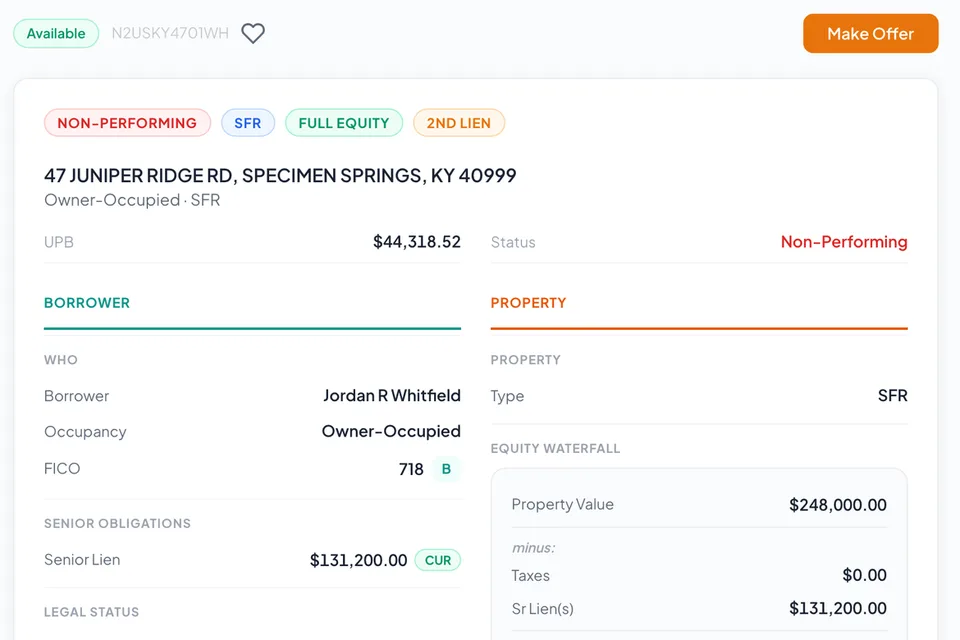
The property had a fair market value (FMV) of $90,000. The first mortgage balance was $53,000. That left $36,000 of equity sitting above the senior lien — more than seven times the unpaid principal balance (UPB) of the second mortgage. When a foreclosure sale generates proceeds above what is owed to the foreclosing lienholder, the excess does not disappear. It becomes surplus funds, and junior lienholders have a legal claim to those funds up to the amount they are owed.
The investor's job was not to negotiate with the borrower, initiate legal action, or engineer a workout. It was to wait, file the right paperwork, and collect.
The Deal at a Glance
| Metric | Value |
|---|---|
| Property Value (FMV) | $90,000 |
| Senior Lien Balance | $53,000 |
| Equity Above Senior | $37,000 |
| Second Lien UPB | $4,965 |
| Lien Position | Second (Junior) |
| Resolution Type | Full Payoff via Surplus Funds |
| Payoff Amount | $4,965 |
| Investor Legal Costs | $0 |
| Hold Period | < 12 months |
The equity math is what made this deal safe from the start. Even after the senior lien was satisfied, $37,000 remained — enough to cover the $4,965 second lien more than seven times over. The question was never whether recovery was possible. It was only a matter of how and when.
Why Didn't the Investor Foreclose?
This is a question worth pausing on because it illustrates a decision framework that applies to a wide range of small-balance NPLs.
When you hold a second lien with a UPB under $5,000, the economics of foreclosure rarely make sense. Legal fees, court costs, property maintenance, and timeline risk can easily exceed the value of the note itself. Even in states with relatively fast non-judicial foreclosure processes, the minimum cost floor for a foreclosure action typically starts at $2,000-$3,000 — and that is before accounting for the investor's time.
So what do you do with a small-balance second lien where the borrower is not responding to outreach and the senior is heading to foreclosure?
You put it in the drawer.
That phrase — "put it in the drawer" — describes a legitimate resolution strategy for notes where active intervention would cost more than it returns. The investor holds the note, maintains proper documentation, and waits for a triggering event: a property sale, a refinance, a senior foreclosure with surplus funds, or even a borrower who resurfaces years later wanting to clean up their credit.
In this case, the triggering event arrived in less than a year.
How Do Surplus Funds Work After a Senior Foreclosure?
When a first-position lienholder forecloses and the property sells at auction, the sale proceeds are distributed in a specific order dictated by lien position priority:
- Court and sale costs are paid first.
- The foreclosing (senior) lienholder receives the amount owed on their mortgage.
- Junior lienholders — in order of priority — receive any remaining funds up to the amount they are owed.
- The former property owner receives whatever surplus remains after all liens are satisfied.
If the foreclosure sale generates enough to pay off the senior lien but not enough to cover junior liens, the junior lienholder receives a partial payment or nothing. But when the property sells for more than the total debt stack, surplus funds are held by the court or a designated official — in Kentucky, the Master Commissioner — until claimants file the proper documentation.
This is exactly what happened. The senior foreclosure was completed, and the investor received a notice that surplus funds were potentially available for other lienholders. The investor prepared and submitted the required claim documentation to the Kentucky County Commissioner, and a confirmation came back: the full $4,965 was incoming.
No attorneys. No borrower negotiation. No foreclosure filing. The senior lienholder absorbed all the legal costs and timeline risk of the foreclosure process, and the junior lienholder simply collected surplus funds on the back end.
Could This Have Gone Wrong?
Yes — and understanding the failure scenarios is as important as understanding the success.
What if the property sold for less than $53,000?
If the foreclosure auction produced a sale price below the senior lien balance, there would be zero surplus funds. The junior lienholder would receive nothing from the sale. The note would become unsecured debt — still collectible in theory, but no longer backed by real estate collateral. Recovery odds drop significantly in that scenario.
What if there were other junior liens ahead in line?
Surplus funds are distributed in lien priority order. If a third-party held a second lien and the investor held a third lien, the second lienholder would be paid first. The investor would only receive surplus funds remaining after all senior claims were satisfied. Proper due diligence before acquisition — specifically, a title search confirming lien position and identifying all encumbrances — prevents this surprise.
What if the investor missed the surplus funds notice?
This is the most preventable failure mode. When a senior forecloses, the court or commissioner sends notices to known lienholders. But if the investor has not updated the land records to reflect their ownership of the note, or if their contact information is not current with the servicer, the notice may not arrive. Missing the filing deadline for a surplus funds claim can mean forfeiting the recovery entirely.
The lesson: even on notes you have "put in the drawer," keep your contact information current, monitor the senior lien status, and respond promptly when notices arrive.
What Makes Small-Balance Second Liens Worth Holding?
Investors focused on maximizing dollar-per-deal often overlook notes with UPBs below $10,000. The profit potential per note is modest, and the individual workload can feel disproportionate to the return. But small-balance seconds have structural characteristics that make them valuable as a portfolio category.
Low capital at risk. A note with a $4,965 UPB purchased at typical NPL second lien pricing puts very little capital in jeopardy. If the deal produces zero recovery, the loss is manageable. If it produces a full payoff — as this one did — the return on investment can be significant relative to the dollars deployed.
Multiple exit paths. Even a small-balance second lien can resolve through a borrower payoff, a discounted payoff, a property sale, a refinance by the borrower, or — as demonstrated here — surplus funds from a senior foreclosure. The more potential exits a note has, the higher the probability of eventual recovery.
Minimal competition. Institutional buyers generally will not pursue individual notes with UPBs under $10,000. The transaction costs do not justify the returns at institutional scale. This creates a pricing advantage for smaller investors who can acquire these notes cheaply in bulk pools and work them individually.
Passive resolution potential. Many small-balance seconds resolve themselves. A borrower sells the property five years later and the title company sends a payoff statement request. A senior forecloses and surplus funds appear. A borrower's financial situation improves and they voluntarily pay off an old debt. None of these outcomes require active intervention by the note holder — just patience and proper record-keeping.
How Does Equity Coverage Protect a Junior Lien Investor?
The $37,000 of equity above the senior lien in this deal was not a lucky coincidence. It was a deliberate acquisition filter.
When evaluating a second lien for purchase, the single most important variable is whether the borrower's equity exceeds the junior lien balance. If the property is worth $90,000, the senior lien balance is $53,000, and the second lien UPB is $4,965, the equity coverage ratio is:
Equity Coverage = (FMV - Senior Lien) / Junior UPB
($90,000 - $53,000) / $4,965 = 7.45x
A coverage ratio above 1.0 means the borrower's equity fully protects the junior position. A ratio of 7.45x means the property could lose more than 40% of its value and the junior lien would still be fully secured. That margin of safety changes the risk profile of the investment entirely.
Borrowers with significant equity behave differently than borrowers who are underwater. They are more likely to sell the property (triggering a payoff), more likely to negotiate a resolution to protect their equity stake, and — if foreclosure occurs — more likely to generate surplus funds that flow to junior lienholders.
This deal would not have worked on a property worth $55,000 with a $53,000 senior lien. The $2,000 of equity above the senior would leave virtually no cushion for the junior position, and a foreclosure sale at or below market value could easily produce zero surplus. Equity coverage is not a guarantee of recovery, but it is the closest thing to one that junior lien investing offers.
The Timeline: Acquisition to Payoff in Under Twelve Months
The resolution arc on this deal was remarkably compressed:
- Acquisition. The investor purchased the non-performing second lien as part of a portfolio of NPL seconds.
- Borrower outreach. Standard contact attempts were made. The borrower was delinquent on both the first and second mortgages and was not responsive to workout discussions.
- Senior foreclosure. The first-position lienholder initiated and completed foreclosure proceedings. The borrower lost the property.
- Surplus funds notice. The investor received notification from the senior's foreclosure action that surplus funds were potentially available for junior lienholders.
- Claim filing. The investor prepared and submitted the required documentation to the Kentucky County Commissioner to claim surplus funds.
- Full payoff confirmation. The Commissioner confirmed a full payoff of $4,965 — the entire UPB on the second lien.
From acquisition to payoff: less than one year. From a time-and-effort perspective, the heaviest lift was the paperwork to file the surplus funds claim. The senior lienholder bore the cost, time, and legal burden of the foreclosure itself.
What This Deal Teaches About Small-Balance Second Liens
Three principles from this case study apply broadly to NPL second lien investing — particularly at the small-balance end of the spectrum.
Equity is the investment thesis. Every analysis of a junior lien starts and ends with the equity position. If equity above the senior lien exceeds the junior UPB, multiple resolution paths remain viable even when the borrower is completely unresponsive. The $37,000 of equity in this deal did not just protect the investor's position — it guaranteed that any sale event would generate proceeds sufficient to cover the second lien in full.
Not every note requires active management. The instinct when acquiring an NPL is to immediately pursue borrower outreach, negotiate a workout, or begin legal proceedings. For small-balance seconds where the economics of foreclosure do not pencil and the borrower is unresponsive, the right strategy may be to hold the note and wait for a triggering event. This deal produced a full payoff with no legal costs and minimal effort because the investor recognized that patience was the highest-ROI strategy available.
Understand the surplus funds process in your state. Every state handles surplus funds from foreclosure sales differently. Some states require junior lienholders to file a claim within a specific window. Others distribute surplus funds automatically to known lienholders of record. Knowing the process in the state where your collateral is located — the deadlines, the required documentation, the office that handles disbursements — is the difference between collecting a full payoff and missing it entirely. In Kentucky, the Master Commissioner oversees this process. In other states, it may be the county clerk, the sheriff's office, or the court itself. Research this before you need it, not after the notice arrives.
This was not a complex deal. It did not require sophisticated negotiation, creative financing, or legal firepower. It required buying a well-collateralized note at a sensible price, maintaining proper documentation, and responding when the surplus funds opportunity presented itself. For investors willing to accumulate small-balance seconds with strong equity coverage and hold them patiently, deals like this one are the quiet engine that drives consistent portfolio returns.
 Free Note Investor Workshop
Learn notes by pricing one.
Analyze a training loan modeled on a real deal, then submit practice offers on loans that actually sold.
- No credit card
- No email needed to start
- 7 steps · about 70 min