Is Real Estate Safer Than Stocks Right Now?
Real estate backed by collateral offers control and income certainty that stock speculation cannot. How to weigh safety across asset classes.
Two Investors, Same Monday Morning
Imagine two investors checking their portfolios on the same Monday morning. One holds a diversified stock portfolio. The other holds a mix of rental properties and mortgage notes. Overnight, tariff announcements rattled global markets. The stock investor watches a red ticker erase weeks of gains before lunch. The real estate investor opens an email from their servicer confirming that this month's payments arrived on schedule -- same as last month, same as the month before that.
Both investors deployed similar amounts of capital. Both expect similar long-term returns. But their experience of risk could not be more different. One is watching a screen and hoping. The other is collecting contractual income backed by physical property. That gap -- between speculation and asset-backed investing -- is the real question behind whether real estate is "safer" than stocks.
What Does "Safer" Actually Mean?
Safety is not a single metric. It is a bundle of characteristics that determine how much control you have over outcomes, how predictable your income is, and how much you stand to lose when things go wrong. Before comparing asset classes, it helps to break "safety" into its component parts.
Downside protection. When a stock drops 40%, you own a smaller claim on the same company -- and you cannot do anything about it. When a real estate investment declines in value, the underlying property still exists, still has fair market value, and still generates income through rent or loan payments. The floor is structurally different.
Income predictability. Stock dividends are discretionary. The board can cut them at any time, for any reason. Lease payments and mortgage note payments are contractual obligations. They arrive on a defined schedule at a defined amount until the contract says otherwise.
Investor control. A stock investor cannot call the CEO and suggest a better product strategy. A real estate investor can improve a property, adjust rent, modify loan terms, or pursue legal remedies. Control over the asset is control over your return.
Volatility exposure. Stock prices move every second the market is open, driven by sentiment, news cycles, and algorithmic trading. Real estate values move slowly, repriced through appraisals and transactions rather than continuous auction. That slower repricing is not a flaw -- it reflects the illiquid, tangible nature of the asset.
No single asset class wins on every dimension. Stocks offer liquidity and ease of diversification that real estate cannot match. But when the question is specifically about safety -- protection against loss, predictability of income, and control over outcomes -- real estate has structural advantages that go beyond personal preference.
The Stock Market Runs on Sentiment
Market volatility is not new, but the current environment has sharpened the contrast between speculative and asset-backed investing. Tariff uncertainty, shifting monetary policy, and geopolitical tension have created conditions where stock prices swing dramatically on headlines that have nothing to do with the underlying businesses.
The stock market is, at its core, a speculation engine. Prices reflect expectations about future earnings, discounted by prevailing interest rates and risk sentiment. When expectations shift -- because of a tariff announcement, an inflation report, or a change in Federal Reserve guidance -- prices adjust instantly. An investor who owns shares of a profitable, well-managed company can watch their portfolio lose 20% in a quarter, not because the company did anything wrong, but because the market's collective mood changed.
Real estate operates on a different clock. Property values do not reprice in real time based on Twitter sentiment. Rental income does not fluctuate because a trade negotiation fell apart. Mortgage note payments do not stop arriving because an economic indicator came in below expectations. The distance between real estate and headline-driven volatility is one of its most underappreciated features.
That said, real estate is not immune to economic downturns. Property values fell significantly during the 2008 financial crisis. Vacancy rates can spike during recessions. Borrowers default on loans. The argument is not that real estate carries no risk -- it carries real risk. The argument is that real estate risk is more tangible, more predictable, and more within the investor's ability to manage than stock market risk.
How Does Collateral Change the Risk Equation?
The single most important structural difference between real estate investing and stock investing is collateral.
When you buy a stock, your investment is backed by a fractional claim on a company's assets and future earnings. If the company's stock price falls, you have no recourse. There is no physical asset you can seize, no property you can sell, no tangible floor beneath your investment. Your only options are to hold, sell at a loss, or average down and hope.
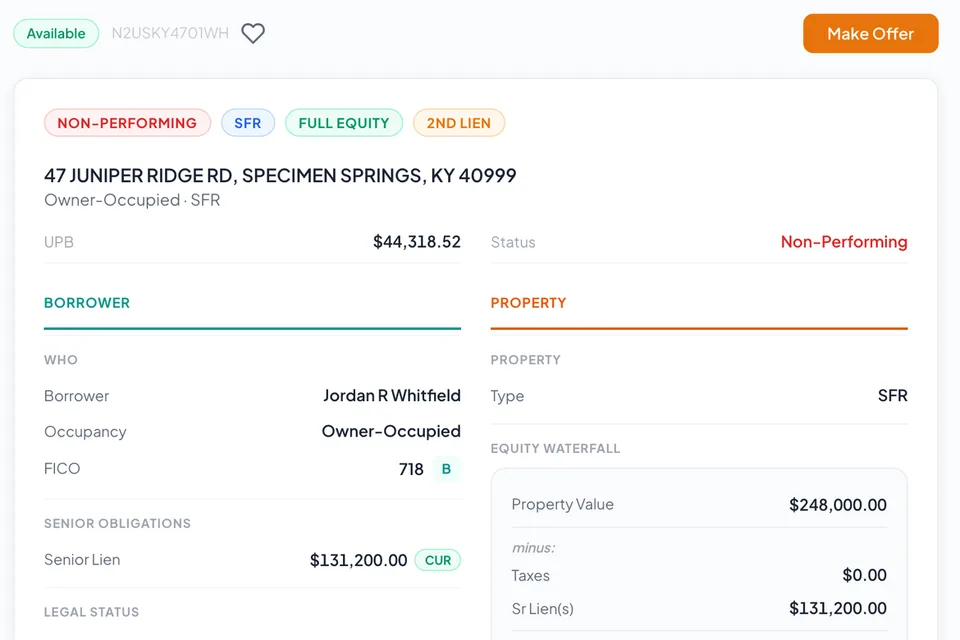
When you buy a mortgage note, your investment is secured by real property. The borrower owes you money, and their home is the collateral for that obligation. If the borrower stops paying, you have legal remedies -- workout negotiations, loan modifications, or foreclosure -- and the underlying property provides a recovery floor. Even in a worst-case scenario, you are not starting from zero. You own a claim on a physical asset with measurable value.
This distinction matters enormously in stressed market conditions. During the 2008 crisis, many stocks went to zero. Entire companies ceased to exist. But the homes securing mortgage notes did not vanish. Their values declined, sometimes substantially, but the land and structures remained. An investor holding notes backed by properties with reasonable equity had a fundamentally different loss profile than an investor holding shares in Lehman Brothers.
Collateral does not eliminate risk. A note secured by a property worth less than the loan balance offers thin protection. Junior liens carry more collateral risk than senior liens. But the presence of a tangible, recoverable asset beneath the investment is a structural safety feature that equity markets simply do not provide.
Speculation vs. Value-Add: The Core Distinction
There is a useful framework for thinking about the difference between stock investing and real estate investing: speculation versus value-add.
A stock investor is, in most cases, a speculator. They buy a position and hope that future events -- earnings growth, market sentiment, macroeconomic conditions -- push the price higher. They do not control those events. They cannot create value through their own effort. They are betting on outcomes driven by other people's decisions.
A real estate investor -- whether they own property directly or hold mortgage notes -- is a value-add operator. They can improve a property to increase its value. They can negotiate better terms on a loan. They can work with a non-performing loan borrower to create a resolution that benefits both parties. They can clean up a distressed asset, literally or figuratively, and create value that did not exist before they got involved.
This is not an abstract distinction. It changes everything about the return profile. A speculator's return depends on market conditions they cannot influence. A value-add investor's return depends, at least in part, on their own skill, effort, and decision-making. That additional control translates directly into reduced risk for the investor who knows what they are doing.
In mortgage note investing, the value-add dynamic is particularly pronounced. Buying a non-performing note at a discount, getting the borrower into a payment plan, and converting it into a performing loan is a process the investor controls from start to finish. The ROI is driven by the investor's ability to resolve the situation -- not by what the Federal Reserve does next Tuesday.
Does Current Interest Rate Policy Help Real Estate Investors?
When stock markets sell off due to tariff fears or recessionary signals, there is often a corresponding flight to safety that pushes bond yields down. Lower bond yields tend to translate into lower mortgage interest rates. For real estate investors, that dynamic creates opportunities.
Lower interest rates benefit real estate investors in several concrete ways:
- Refinancing existing debt. An investor carrying higher-rate debt on rental properties can refinance at lower rates, immediately improving cash flow without changing anything about the property itself.
- Cheaper acquisition financing. Lower rates reduce the cost of borrowing to acquire new properties, widening the spread between the cost of capital and the return on the investment.
- Resolving non-performing notes. For note investors holding NPLs, lower rates make it easier to offer borrowers affordable modification terms. A borrower who could not sustain payments at 7% might succeed at 5%, turning a non-performing asset into a performing one.
- Increased property values. Lower rates tend to support or increase property values by making mortgages more affordable for buyers. That appreciation builds equity in existing holdings and strengthens collateral coverage on note investments.
The key insight is that the same macroeconomic forces that make stock investors anxious -- recession fears, trade uncertainty, deflationary pressure -- can actively benefit real estate investors by driving down the cost of capital. While the stock investor watches their portfolio shrink, the real estate investor may be locking in lower rates and expanding their portfolio at favorable terms.
This is not guaranteed, and it does not happen in every cycle. But the inverse relationship between stock market fear and interest rate opportunity is a real structural advantage for investors who hold assets financed by debt. Carrying debt is a choice too, and the same trade-off decides whether to pay off your mortgage or invest.
What Makes Mortgage Notes Unique in This Comparison?
Mortgage notes occupy an unusual position in the investment landscape. They share characteristics with both stocks and real property, but they have features that neither can match.
Like stocks, notes are paper assets. You are not maintaining a physical property. You are not dealing with tenants, toilets, or roofing contractors. The asset exists as a document -- a promissory note and a security instrument -- that entitles you to a stream of payments. This makes notes more scalable and less operationally demanding than direct property ownership.
Like real property, notes are backed by collateral. Unlike stocks, your investment is not floating in the abstract space of market expectations. There is a house. It has an address. It has a fair market value. If things go wrong, that house provides a recovery floor.
Unlike either, notes give you legal remedies. A stock investor who disagrees with management can sell their shares. A landlord who has a problematic tenant can begin an eviction. A note investor who has a non-performing borrower has a wider toolkit: loan modification, forbearance agreement, repayment plan, short sale, deed in lieu, or foreclosure. Each resolution path offers different economics, and the investor chooses which path to pursue based on the specifics of the situation.
This combination -- paper-asset efficiency, real-property collateral, and a deep resolution toolkit -- is what makes notes a compelling option for investors who want real estate exposure without the operational overhead of property ownership.
How Should You Think About Allocation Between Asset Classes?
Framing the question as "real estate vs. stocks" implies a binary choice. In practice, most well-constructed portfolios include both. The question is not which asset class is safer in absolute terms, but how each asset class contributes to the overall risk profile of your portfolio.
Here is a framework for thinking through allocation:
| Consideration | Favors Stocks | Favors Real Estate / Notes |
|---|---|---|
| Need for liquidity | High -- may need capital quickly | Low -- can lock capital for years |
| Desired income predictability | Low -- comfortable with variable returns | High -- need reliable monthly cash flow |
| Time available for management | None -- want complete passivity | Some -- willing to oversee investments |
| Risk tolerance for loss | High -- can stomach 30%+ drawdowns | Low -- prefer collateral-backed positions |
| Capital available | Limited -- starting with small amounts | Sufficient -- can deploy meaningful sums |
| Investment horizon | Very long -- 20+ years, no withdrawals | Medium -- 5-15 years, income-oriented |
An investor who is 30, earning a strong salary, and does not need investment income for decades might reasonably allocate heavily to index funds. The volatility is a feature in that context -- it creates the opportunity for long-term compounding.
An investor who is 50, approaching retirement, and needs predictable monthly income might reasonably shift toward performing notes and cash-flowing real estate. The lower volatility and contractual income streams provide the stability that matters more as the investment horizon shortens.
Neither allocation is wrong. They are optimized for different situations.
Real Risks That Real Estate Investors Cannot Ignore
Any honest comparison must acknowledge that real estate carries real risks that stocks do not.
Illiquidity. You cannot sell a property or a note in seconds. Exit timelines are measured in weeks or months. If you need cash urgently, real estate assets cannot provide it the way a stock liquidation can.
Concentration risk. A single property or note represents a large, undiversified bet. A $50,000 note secured by one house in one city is far more concentrated than $50,000 in an S&P 500 index fund that holds 500 companies.
Operational complexity. Real estate investing is not passive in the way that owning an index fund is passive. Notes require servicer oversight, borrower communication, and resolution management. Properties require maintenance, tenant management, and regulatory compliance.
Local market exposure. A property's value is tied to a specific location. Economic shifts, population decline, environmental risk, or regulatory changes in that location can impair the investment in ways that have no analog in a diversified stock portfolio.
Legal and regulatory risk. Foreclosure timelines vary by state. Borrower protection laws can change. Compliance requirements for note investors are real and carry penalties for violations.
These risks are manageable, but they are not trivial. The investor who understands them and builds systems to mitigate them will earn the safety premium that real estate offers. The investor who ignores them will discover that real estate is only safer than stocks when it is managed competently.
Practical Considerations for Your Portfolio
Rather than asking whether real estate is safer than stocks as a blanket proposition, ask these questions about your own situation:
What percentage of your net worth can you afford to lock up in illiquid assets? Real estate and notes tie up capital for extended periods. Make sure your liquid reserves -- including stock holdings -- are sufficient to handle unexpected expenses and opportunities before committing heavily to illiquid positions.
Do you have the knowledge to evaluate collateral? The safety advantage of real estate depends entirely on buying assets with adequate collateral coverage. A note purchased at a price above the property's fair market value is not safer than a stock -- it is riskier. The collateral advantage only exists when the investor has the skill to assess it accurately.
Can you tolerate operational involvement? If the answer is no, a performing note portfolio serviced by a competent third party is the closest you will get to passive real estate income. But even that requires periodic attention. If you want zero involvement, index funds remain the better fit.
What is your income need? If you need monthly cash flow now, performing notes and rental properties deliver it. If you are building wealth for a distant future, the compounding power of reinvested stock returns may serve you better over a multi-decade horizon.
The strongest portfolios match asset allocation to the investor's actual life -- their timeline, their income needs, their skill set, and their tolerance for complexity. Real estate offers meaningful safety advantages over stocks in the dimensions that matter most: collateral protection, income predictability, and investor control. But those advantages only materialize when the investor brings competence and discipline to the asset class. Allocate accordingly, and build from what you know.
 Free Note Investor Workshop
Learn notes by pricing one.
Analyze a training loan modeled on a real deal, then submit practice offers on loans that actually sold.
- No credit card
- No email needed to start
- 7 steps · about 70 min