Mortgage Note Investing for Beginners: The Roadmap
A roadmap to mortgage note investing for beginners: which notes to buy first, where to find sellers, how notes are priced, and the mistakes to avoid.
Mortgage note investing for beginners is a sequence: choose the kind of note you will buy, put a servicer and sellers in place, learn how each kind is priced, and screen the seller before the asset. Each step depends on the decisions you made at the one before it. The beginner who understands this sequence and builds real seller relationships will close deals. The one who jumps to sourcing without infrastructure will spin their wheels indefinitely. If you want the whole business on one page first, start with how to invest in mortgage notes.
What Is a Mortgage Note, and Which Type Should You Start With?
A mortgage note is a legally enforceable promise to repay a real estate debt. Two main categories exist in the market.
Seller-finance notes are created when a property seller carries the financing directly with the buyer. The seller does not lend cash — they create a note secured by the property itself. The buyer, who cannot qualify for traditional financing or prefers creative terms, becomes the borrower. If payments stop, the seller has the legal right to foreclose.
Institutional notes are originated by banks lending money to homeowners. The bank's security instrument is the mortgage (in many states, a deed of trust) on the property. These are the loans banks sell off when they go delinquent.
Within those two categories, there are three performance statuses:
- Performing — the borrower is current on payments
- Non-performing — the loan is 90 or more days past due (bank regulators also count loans on nonaccrual status as noncurrent)
- Re-performing — the loan was seriously delinquent in the past but is current again, often after a loan modification, so it is performing with a troubled payment history
And two lien positions: first mortgage (senior lien, recorded first in county records) and second mortgage (junior lien, recorded second). First mortgages are the primary debt. Second mortgages are subordinate to the first — if the property goes to foreclosure sale, the first lien gets paid before the second sees a dollar.
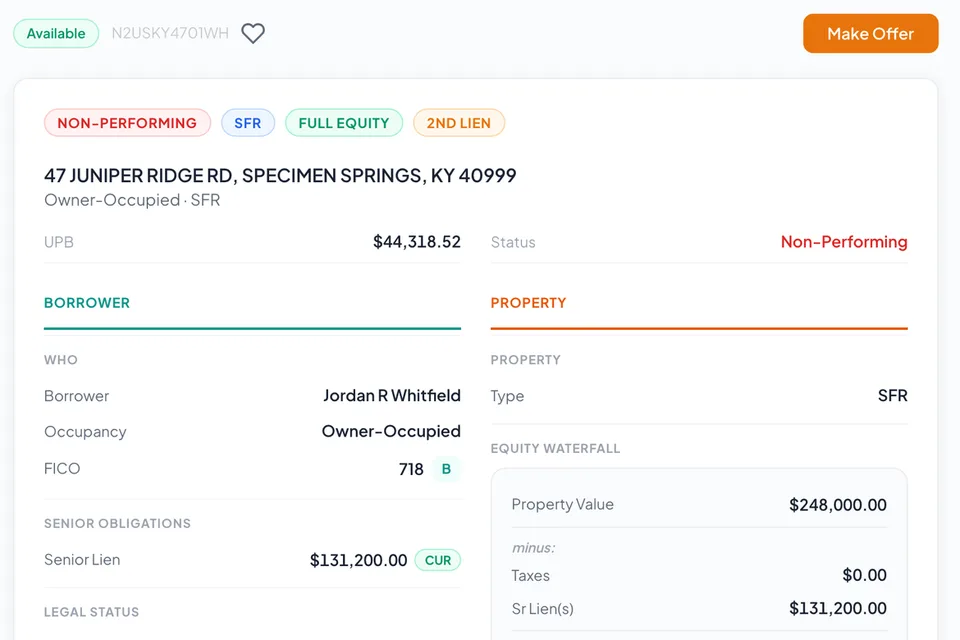
Most beginners start with non-performing second liens. The entry price is lower, and when you buy a delinquent second behind a performing first, the homeowner is still invested in keeping the property — there is someone maintaining it and paying the senior mortgage. That is a meaningful structural advantage, and it is why many experienced investors concentrate here.
Why Do Banks Sell Their Delinquent Loans?
This is one of the most common questions from new investors, and it has a clear answer: a seriously delinquent loan costs a bank more to keep than it is worth to them.
Banks are not in the business of chasing delinquent borrowers or running foreclosures, and a bad loan costs them in four ways:
- Loss allowance. Banks carry an allowance for the credit losses they expect over a loan's life, and interagency guidance tells them to weigh "the volume and severity of past due financial assets" when they set it. A delinquent loan pushes the allowance up, and building it comes out of earnings.
- Capital. Under the federal bank capital rules, a first-lien home loan that is 90 days or more past due, on nonaccrual, or modified carries a 100% risk weight instead of 50% (12 CFR 324.32(g), the FDIC's version of the rule), so the bank must hold more capital against it.
- Exam ratings. Examiners rate a bank's asset quality partly on "the level, distribution, severity, and trend of classified assets, nonaccrual and restructured loans, delinquent loans, and nonperforming assets" (Uniform Financial Institutions Rating System). A pile of bad loans drags that rating down.
- Workout cost. Federal servicing rules generally bar a servicer from starting a foreclosure until the borrower is more than 120 days delinquent (12 CFR 1024.41(f)), and the foreclosure that follows adds legal cost and months or years of carrying time.
None of this is about deposit reserve requirements, which the Federal Reserve cut to zero in March 2020. Selling the loan — even at a steep discount — takes the problem off the balance sheet and frees capital and staff for new lending. It is a rational business decision, not necessarily a sign the bank is in distress.
Banks typically sell these loans in bulk to large hedge funds. Those hedge funds resell individual notes and smaller pools downstream to smaller funds, which eventually sell them to individual investors. This trickle-down effect is how most note investors access institutional product — not by calling a bank directly.
Where Do Beginners Find Mortgage Notes to Buy?
Sourcing is the core of the note business. Without consistent deal flow, you have no business. Much of the non-performing side of the secondary mortgage market trades privately — tapes emailed to known buyers, broker relationships, fund-to-fund sales — rather than through public listings.
Here are the primary sourcing channels:
Reputable note sellers. Established sellers are the easiest starting point. They are known in the market, easy to find, and provide a reliable supply of product. The discounts may not always be the deepest, but the process is clear and the counterparty risk is lower. Do your due diligence on the seller — not just the note. Google them, ask other investors, and check their reputation before putting capital to work.
Hedge funds, large and small. Larger funds buy directly from banks in bulk and resell portions of their portfolios when they need to rebalance or liquidate. The more relationships you build at conferences and in the investor community, the more likely you are to find out when a fund is closing or has excess product.
Note brokers. Real brokers typically sell in bulk, do their own diligence on the product they represent, and collect a percentage from the seller. Joker brokers are a different story — they are third parties passing around a tape that has already circulated through multiple hands without knowing what they are actually selling. Stick to established brokers and avoid anyone who cannot answer basic questions about the loans they are marketing.
Industry conferences and events. Note-industry conferences are where investors meet the funds, brokers, and servicers who control product — the Diversified Mortgage Expo, a note-investing conference in Nashville, is one. Event calendars change from year to year, so confirm dates on the organizer's site before you plan a trip. A single conference can generate deal flow for years. Do not overlook local real estate meetups either — seller-finance note originators often appear in those rooms.
Your network. Other note investors sell. Attorneys who work with investors know who is selling. Servicers have clients with loans to move. The deeper your relationships in this business, the more product finds you rather than the other way around.
Assignment chains. When you buy a note, the collateral file includes the chain of assignments showing the loan's prior holders of record. Google those prior owners. Find out whether they are still active and whether they have product. Assignment chains are an underused sourcing tool that becomes more valuable as you build a portfolio.
The businesses that generate the most consistent deal flow treat sourcing as a daily discipline — not an occasional task. Communicate clearly, follow through on commitments, and respect sellers' time. Reputation in this market travels fast. For more on working each channel, see how to find and buy mortgage notes for sale.
How Does Pricing Work for Non-Performing Notes?
There is a foundational principle in note investing: there are no bad notes. It is all about purchase price and how you work the asset. A note with ugly characteristics can still produce an excellent return if you buy it at the right number.
Always price off the unpaid principal balance (UPB), not the payoff. The payoff includes accrued interest, late fees, and recoverable legal costs advanced by the lender. That additional amount — sometimes tens of thousands of dollars — is a bonus if you can collect it, not a baseline you should pay for. Statute of limitations issues, bankruptcy discharges, and other complications can wipe out the accrued portion during resolution. If you base your purchase price on the payoff number, you are paying for something you may never collect.
Where does the market sit? On the FIXnotes Market, the 90-day weighted average price of closed note sales was 33.7% of UPB as of October 4, 2026, down from 41.9% a year earlier. Individual notes trade well above and below that average, depending on the factors below. Prices used to be far lower: most rounds in the FIXnotes round archive from 2012 through 2014 cleared below 20% of UPB. Those days are gone — but there is still significant money to be made buying at today's prices, provided you understand what drives the price.
The biggest pricing factors, in rough order of importance:
1. Seller credibility and reputation. This one surprises beginners. A note from a trusted, reputable seller is worth paying more for because when a problem surfaces — and problems always surface — that seller will help fix it. A seller who disappears after closing leaves you holding the full cost of whatever the tape did not disclose. Quality counterparties are worth a premium.
2. Lien position. A non-performing first mortgage carries different risk than a non-performing second. With a first lien, there is no senior lien in front of you — but that also means property taxes, HOA fees, and mechanic's liens may be delinquent and need to be addressed. With a second lien, you must verify the status of the first mortgage. A current first is a strong signal that the borrower is still invested in the property.
3. Property value and equity coverage. The LTV (loan-to-value ratio) tells you how much protection your lien position has. If you are buying a $30,000 second mortgage on a property with a $50,000 first and the property is worth $100,000, your position is fully covered in equity. If the property is worth $70,000 with an $80,000 first, your second is completely underwater — and that fundamentally changes what you should pay for it. Ordering a BPO (broker price opinion) is how you independently verify the property's fair market value.
4. Property condition and insurance. When buying non-performing seconds, the property is often in better condition than you expect — the homeowner is still living there, maintaining it, and paying the first mortgage. When buying non-performing firsts, there is a meaningful chance the property lacks homeowner's insurance, and you may need your servicer to arrange force-placed (lender-placed) coverage soon after closing.
5. State foreclosure laws. The cost and timeline to foreclose vary dramatically by jurisdiction. In ATTOM's midyear 2026 foreclosure report, homes foreclosed in Q2 2026 had spent an average of 2,007 days in the process in New York, where foreclosure runs through the courts, against 155 days in Texas, where most foreclosures are non-judicial trustee sales. Timelines vary within each group too, so check the state's actual numbers. Every extra month adds legal and carrying cost, and that difference needs to be reflected in your purchase price.
6. Taxes and other senior liens. When buying non-performing firsts, verify whether property taxes are current. A property tax lien "almost always has first priority over all other liens, including mortgages," per the National Consumer Law Center — even a first mortgage recorded before the taxes came due. HOA liens, utility liens, and mechanic's liens also need to be investigated.
How Are Re-Performing Notes Priced Differently?
Re-performing loans are not priced as a percentage of UPB. They are priced on a yield basis — the purchase price that delivers your target annual return given the loan's remaining payment stream.
The tool for this calculation is the HP 10bII financial calculator, a common instrument in this business; inexpensive phone apps that replicate it work the same way. Five inputs drive the calculation: number of remaining payments, monthly payment amount, future value (any deferred balance due at payoff), present value (purchase price), and yield. Know four of those five numbers, and the calculator produces the fifth.
Yields on re-performing notes move with seasoning, the borrower's credit, equity, and lien position. Set your target yield before you open a tape, and check it against the trades sellers are actually closing. A few important nuances:
- Build your servicing cost into the calculation. If the monthly payment is $300 and your loan servicer charges $20 per month, run your yield calculation on $280 rather than $300. Some investors reduce the payment count slightly (e.g., model 290 payments instead of 300) to create a cushion for costs.
- Account for recording fees, IRA custodian fees if applicable, and any other carrying costs.
- If there is a deferred balance on the back of the loan, that amount enters as the future value in the calculation.
The key pricing factors for re-performing notes differ from non-performing:
Borrower's ability to repay. Pull a credit report. You are buying a loan that was once delinquent and has been modified — understanding the borrower's current financial profile tells you whether the re-performance is durable.
Loan modification package quality. A complete, well-documented modification package — one that includes homeowners insurance information, first mortgage authorization letters if applicable, and clear incentive terms — is worth paying a tighter yield for. An incomplete package creates legal and operational problems.
Seasoning and payment history. Some investors will only buy a re-performing note after a long record of on-time payments since the modification. Others buy soon after modification if the package is strong. The longer and cleaner the payment history, the more the note is worth. The servicer can provide full payment history on request.
Equity position. Even on a re-performing loan, know your LTV. If the property goes non-performing again, your equity position determines what your options are.
State. Know the foreclosure laws and regulatory requirements for the jurisdiction. If this loan re-defaults, you need to know what it will cost to rework it again.
What Does Responsible Seller Due Diligence Look Like?
Before you spend money on property-level due diligence, screen the seller.
Do not skip this step. Not every note seller operates with the same standards. Search the seller's name and company online. Ask other investors who have done business with them. Ask questions about the product they are selling — a knowledgeable seller will have specific, direct answers. A seller who cannot answer basic questions about the loans they are marketing, or whose tape has been circulated through multiple hands without clear ownership documentation, is a red flag.
When issues arise during due diligence — and they will — a reputable seller will engage constructively. They will help you understand the discrepancy, consider a price adjustment, or agree to unwind the transaction if necessary. A seller with no reputation to protect will be much harder to work with after the wire has cleared.
Good communication with sellers is also how you build the relationships that produce better deal flow and better pricing over time. If your due diligence reveals a problem, communicate it clearly and early. Share what you found. If the seller will not work with you, walk away. If they engage constructively, you have a counterparty worth doing business with again.
What Are the Most Common Mistakes Beginners Make?
Pricing off the payoff, not the UPB. The payoff figure includes accrued interest, fees, and legal costs that may not be fully collectible. Always anchor your price to the unpaid principal balance.
Ignoring the status of the first mortgage when buying seconds. A delinquent first ahead of your second is a potentially fatal problem. If the first forecloses, the sale wipes out your lien, and you are paid only from whatever surplus is left after the first is satisfied. Verify the first mortgage's status through the credit report, title search, and available foreclosure records.
Skipping the assignment recording. Once you fund a trade, the assignment of mortgage needs to go to the county recorder's office immediately. Without a recorded assignment, you may not receive notice of a tax foreclosure, senior lien foreclosure, or other action that threatens your position. This is one of the most costly mistakes in the business.
Working with joker brokers. If someone is marketing a tape they clearly know nothing about — cannot identify the loan owner, cannot answer due diligence questions, is passing along a spreadsheet that has already been circulated widely — walk away. The product is either already sold, encumbered with undisclosed issues, or misrepresented.
Not having a servicer in place before closing. Whoever services a home loan is subject to the federal mortgage servicing rules — Regulation X under RESPA and Regulation Z under TILA cover transfer notices, periodic statements, error resolution, force-placed insurance, and loss mitigation — and many states also require mortgage servicers to be licensed (North Carolina, for one). That is why note investors hire a licensed loan servicer instead of collecting payments themselves. Have the servicing contract signed before you fund your first trade, so the loan boards with a compliant servicer from day one.
Letting relationships atrophy. Word of mouth travels fast in this market. The investors who receive the best product at the best discounts are the ones who have built a reputation for following through, communicating clearly, and executing when they say they will. Reputation is currency.
For a complete walkthrough of the acquisition process from tape to boarding, see How to Buy Your First Mortgage Note. For a 90-day operational roadmap covering entity setup, vendor relationships, and your first bid, see Your First 90 Days as a Note Investor.
Frequently asked questions
- What types of mortgage notes can beginners buy?
- Beginners can buy seller-finance notes or institutional notes, in first or second lien position, and in performing, non-performing, or re-performing status. New investors most commonly start with non-performing second liens because the entry price is lower.
- How are non-performing mortgage notes priced?
- Non-performing notes are priced as a percentage of the loan's unpaid principal balance (UPB), never the payoff. Where a note lands depends on lien position, property equity, borrower status, and state foreclosure timelines. For a current benchmark, the FIXnotes Market (fixnotes.com/market) publishes the weighted average price-to-UPB of recently closed note sales.
- What is the difference between a performing, non-performing, and re-performing loan?
- A performing loan is current on payments. A non-performing loan is 90 or more days past due; bank regulators also count loans on nonaccrual status as noncurrent. A re-performing loan was seriously delinquent in the past but is current again, often after a loan modification, so it is performing with a troubled payment history.
- Where do mortgage notes come from?
- Banks originate institutional mortgage notes when lending to homeowners. When those loans go delinquent, banks often sell them to hedge funds and investors to remove them from their books. Larger funds resell individual notes downstream to smaller investors through what is often called the trickle-down effect.
 Free Note Investor Workshop
Learn notes by pricing one.
Analyze a training loan modeled on a real deal, then submit practice offers on loans that actually sold.
- No credit card
- No email needed to start
- 7 steps · about 70 min