Scaling Note Sourcing: From One-Off Deals to Relationships
Scaling note sourcing means moving from one-off cold outreach to repeat seller relationships built on credibility, a vetting package and follow-up.
Why Does Note Sourcing Stall After the First Few Deals?
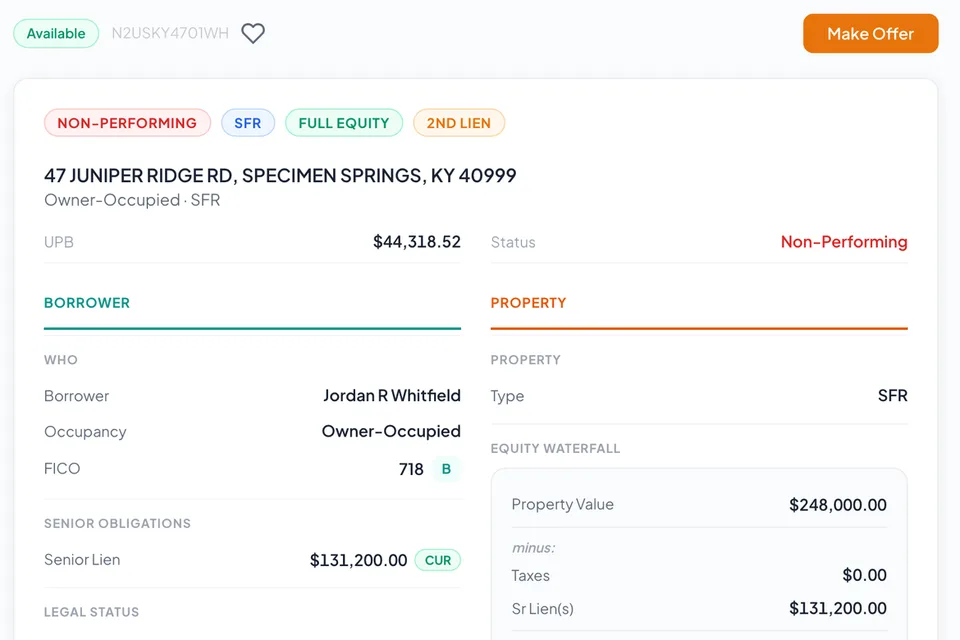
Most note investors experience the same plateau. Early transactions come through a broker, a loan exchange such as the mortgage notes for sale on a marketplace, or a lucky introduction. The first few deals close, confidence builds, and the investor assumes the pipeline will keep producing. Then silence. Weeks pass without a new tape on the desk. The broker who sent that first portfolio has moved on to other buyers. The loan exchange has not posted anything that fits the buying criteria. The investor realizes that each completed deal was a standalone event — a transaction, not a relationship.
This is the conduit problem. A conduit is a one-directional channel that delivers something once and requires constant effort to refill. Cold emails, generic outreach blasts, and passive browsing on loan exchanges are all conduits. They can produce deal flow, but they produce it unpredictably and without compounding. Every new deal requires starting the prospecting cycle from scratch.
The alternative is relationship-based sourcing — building durable connections with sellers who bring you repeat deal flow over months and years. The shift from conduit to relationship is the single most important transition a note investor can make to scale acquisitions without scaling effort proportionally. This guide breaks down how to prepare for that transition, how to move through the levels of seller engagement, and how to systematize the follow-up process that makes it all work.
The Professional Debt Buyer Checklist Sellers Expect
Before contacting any institutional seller, you need to pass a basic credibility test. Banks, credit unions, and hedge funds (the main sellers of non-performing notes) are not going to send portfolio data to someone who looks like they started the business yesterday. Their compliance and legal teams will research you before approving any interaction. The preparation you do before your first outreach determines whether doors open or stay shut.
The foundation is a polished web presence. Benchmark your digital footprint against investment firms you respect — not just in the mortgage note space but across financial services. A professional logo, consistent brand guidelines, a clean website, a Google Business profile, a LinkedIn company page, and regular content publishing all contribute to the image of a firm that is active in the secondary mortgage market.
When a bank officer receives your email and searches your company name, the results need to confirm that you are a serious counterparty. If the search returns nothing — or worse, an incomplete LinkedIn profile and no website — the conversation ends before it starts.
Do Professional Affiliations Actually Generate Leads?
Professional affiliations and credentials serve a dual purpose. Memberships in organizations like the Receivables Management Association International (RMAI) or the Mortgage Bankers Association signal your commitment to operating with integrity and within industry standards. They reassure institutional sellers that you understand compliance requirements and ethical business practices.
But affiliations can also produce inbound leads directly. Consider a community bank that has never sold loans before. The bank's management team decides to explore their options and searches the RMAI database for local debt buyers. If your firm appears in that directory, you can receive an inbound inquiry from a motivated seller without having done any outreach at all. That possibility is one of the reasons that investing in your professional infrastructure pays dividends long before you have a large portfolio of closed deals.
Having a proper business entity — an LLC or corporation — is non-negotiable when approaching institutional sellers. It is the minimum threshold for being taken seriously in any secondary market transaction.
How Do You Build a Track Record Before Closing Deals?
New investors face a circular problem: sellers want to see a track record, but building a track record requires sellers. The way through this is to redefine what counts as a track record.
A track record does not have to mean closed transactions. It can mean volume of assets reviewed. If you have evaluated fifty tapes and run due diligence on hundreds of loans — even if none of those reviews resulted in a purchase — that experience is meaningful to a seller. It demonstrates that you understand the asset class, can move quickly through data, and know how to price a portfolio. Frame your experience in terms of unpaid balance reviewed, number of individual loans analyzed, and turnaround time from tape receipt to bid submission.
A pitch page or pitch book formalizes this narrative. It defines your target asset class, your management process, your team's experience, and your investment criteria. The pitch book serves double duty: it helps you raise capital from investors, and it shows sellers that you have systems and processes in place. A seller's primary concern when moving a portfolio is liability — they need confidence that the buyer will handle the assets responsibly and that the transaction will not create regulatory or reputational risk. A professional pitch book addresses that concern directly.
The Connection Conversion Hierarchy: Five Levels of Seller Engagement
Not all outreach methods produce the same results. There is a hierarchy of effectiveness in how you connect with potential sellers, and understanding it allows you to allocate your time toward the highest-converting approaches.
Level 1: Cold Contact
Cold outreach — unsolicited emails or phone calls to people who have never heard of you — sits at the bottom of the hierarchy. The response rate is low, and most contacts go nowhere. That said, cold outreach is where every sourcing operation begins, and it can be effective when executed with discipline.
One approach that has worked well in the note space is calling bank branches after regular business hours. The front desk staff has gone home, but the executives — the people who actually make decisions about loan sales — are often still working. Reaching a decision maker directly, without going through a gatekeeper, dramatically improves your odds of having a real conversation.
A better cold contact approach combines email and phone. Lead with a brief, professional email that establishes who you are and what you do. Then follow up with a phone call that references the email. This gives the prospect something to look back at, and it creates two touchpoints instead of one. When writing cold emails, avoid low-status messaging: no long-winded paragraphs, no attachments on first contact, no unrealistic calls to action, no fake social connections, and no trace of neediness. Keep the email short, establish credibility through your signature and links, and make it easy for the recipient to respond.
Level 2: Outbound with Reference
Including a real social connection in your outreach elevates the conversation immediately. If you can reference a mutual contact — someone the prospect knows and trusts — your credibility jumps before you have said anything about yourself. The response rate increases significantly compared to pure cold contact.
Level 3: Mutual Connector Introduction
Better still is having a mutual connector make the introduction directly. Instead of you sending an email that mentions a shared contact, the shared contact sends the email with you copied. This is the equivalent of arriving at a party with someone who already knows everyone in the room. The ice is broken before you speak. This approach works especially well at in-person events, which is one of the reasons industry conferences are so valuable for note sourcing. You never know which contact at a conference is one degree of separation from the seller you have been trying to reach.
Level 4: In-Person Meeting
Face-to-face interaction shortcuts the trust-building process in a way that email and phone cannot replicate. Conversations that would take weeks of back-and-forth digitally can happen in a single coffee meeting or conference dinner. The soft skills discussed earlier — communication, adaptability, likability — matter most at this level. Dale Carnegie's advice from How to Win Friends and Influence People applies directly: be genuinely interested in the other person, remember their name, and make them feel important.
Level 5: Inbound with Interest
The top of the hierarchy is having sellers come to you. This is the endgame of all the preparation work — the web presence, the content, the affiliations, the reputation. When your professional image is strong enough that sellers proactively reach out because they want to do business with you, the sourcing dynamic inverts entirely. You are no longer chasing deal flow. Deal flow is chasing you.
Reaching this level takes time and sustained effort. But even while you are working through the lower levels of the hierarchy, every investment in your credibility and visibility moves you closer to inbound interest. The content you publish, the relationships you build, and the deals you close all contribute to a reputation that eventually does the prospecting for you.
How Does a Vetting Package Unlock Institutional Sellers?
When a bank or credit union agrees to explore a loan sale with you, the first thing they will request is a vetting package. This is the collection of documents that proves you are a legitimate, compliant debt buyer capable of handling their assets responsibly.
The requirements vary by institution, but a comprehensive vetting package typically includes:
- Business documentation. Entity formation documents, operating agreements, and evidence of any required debt buyer licensing.
- Compliance materials. Consumer privacy policies, anti-money laundering procedures, cybersecurity programs, and disaster recovery plans.
- Operational documentation. Collection processes and procedures, servicer information, and loss mitigation protocols.
- Financial verification. Proof of funds, errors and omissions insurance, and possibly financial statements.
- References. Letters of reference from other sellers, attorneys, or industry contacts.
Some banks are more stringent than others. Community banks that have never sold loans before can actually be more demanding than larger institutions, because they lack the experience to know which requirements are standard and which are excessive. They err on the side of caution, requesting everything they can think of.
Start assembling your vetting package before you need it. Consolidate every document that supports your legitimacy as a professional buyer. When the request comes — and it will — you want to be able to respond within days, not weeks. The speed with which you produce a complete vetting package is itself a signal of professionalism.
Why Is Your CRM the Most Underrated Sourcing Tool?
None of the outreach methods discussed above work without a follow-up system. And the follow-up system lives in your CRM.
A customer relationship management tool — whether it is Podio, HubSpot, a simple spreadsheet, or even the notes app on your phone — is where you track every interaction with every prospect. Who you contacted, when, what you discussed, whether they responded, and what the next step is (the stages in the note investor funnel from lead to close are a good starting map). Without this tracking, your sourcing efforts dissolve into a blur of half-remembered conversations and missed follow-ups.
But the CRM is more than a task manager. It is a relationship-building tool. The small details you record about each contact — their kids' names, where they are traveling, a project they mentioned being excited about — become the building blocks of genuine rapport. When you call a prospect six months after your first conversation and ask how their daughter's soccer season went, you are demonstrating something that cannot be faked: that you paid attention and cared enough to remember.
Most prospects don't answer the first email or the first call, and many sellers won't have a portfolio ready the first time you reach them. If you are tracking your numbers, you know how many touches it actually takes in your pipeline, and you can make informed decisions about whether to persist or redirect your effort.
How Many Follow-Ups Does It Actually Take?
The follow-up numbers deserve emphasis because they are counterintuitive to most new investors. The instinct is to interpret silence as rejection. You send an email, get no response, and assume the prospect is not interested. In reality, the prospect may be busy, may have missed the email, or may not yet have a portfolio ready to sell. Your job is to stay present without being annoying — and the only way to do that consistently is to track the cadence in your CRM.
A practical follow-up cadence for note sourcing might look like this:
| Touchpoint | Timing | Method |
|---|---|---|
| Initial outreach | Day 1 | Email or LinkedIn message |
| First follow-up | Day 4-5 | Phone call referencing the email |
| Second follow-up | Day 10-14 | Email with a piece of relevant content |
| Third follow-up | Day 30 | Brief check-in email |
| Ongoing nurture | Monthly | Share market insight or industry news |
The key is consistency, not volume. You are maintaining a steady, professional presence that keeps you top of mind without creating pressure. Every touchpoint is tracked in your CRM so that when the prospect finally responds, you have full context for the conversation.
The Soft Skill That Matters Most in Note Sourcing
The technical side of note sourcing — identifying targets, writing emails, analyzing tapes — can be learned from a guide or a course. The soft skills that make the difference between average and exceptional sourcing are harder to teach but equally important.
Communication, adaptability, dependability, and problem-solving are the foundation. But the single most important soft skill in relationship-based sourcing is follow-through. Doing what you say you are going to do, every time, without exception.
The worst scenario in note sourcing is not failing to land a new seller. It is landing a new seller, receiving a portfolio, and then failing to respond with a bid or meaningful feedback. That single failure damages your reputation in a way that is difficult to recover from. The note industry is small. Word travels. If a bank sends you a portfolio and you ghost them, that story reaches other potential sellers — and your pipeline contracts instead of expanding.
The flip side is equally true. When you execute efficiently — reviewing a tape quickly, submitting a thoughtful LOI, closing on schedule — that reputation spreads as well. Over time, your execution record becomes your best marketing asset. Sellers refer other sellers to you. Brokers prioritize your bids. The compounding effect of reliable execution is the most powerful scaling mechanism in note sourcing.
How Do You Turn a Single Transaction Into Recurring Deal Flow?
The transition from conduit to relationship happens at the moment a one-time transaction becomes a recurring arrangement. Here is what makes that transition possible:
Deliver value beyond the purchase price. The seller cares about more than the dollar amount on your indicative bid. They care about speed of execution, professionalism during due diligence, clean communication, and certainty of close. When you consistently deliver on all four dimensions, the seller has no reason to shop the next portfolio to other buyers. You become the default counterparty.
Request feedback and referrals. After a successful transaction, ask the seller for a LinkedIn recommendation or a Google review. Ask whether they know other institutions considering loan sales. These requests are organic when the relationship is genuine, and the social proof they generate feeds your credibility for future outreach.
Stay in touch between transactions. A seller who sold you a portfolio six months ago should still hear from you periodically — not with a pitch, but with relevant market intelligence or a genuine check-in. A two-minute email every quarter keeps the relationship warm and ensures that when the next portfolio is ready, your name is the first one the seller thinks of.
Build toward forward flow. The ultimate expression of a relationship-based sourcing model is a forward flow arrangement — a standing agreement where the seller sends you new assets on a regular cadence without a competitive bid process. Forward flow is earned, not negotiated. It is the natural result of executing reliably over multiple transactions until the seller trusts you enough to formalize the arrangement.
Five Steps to Start the Transition Today
Shifting from conduit-based to relationship-based sourcing does not require overhauling your entire operation. It requires adding structure and intentionality to what you are already doing.
-
Audit your digital presence. Google yourself and your company. What do the results communicate to a bank officer evaluating whether to send you a portfolio? Fill any gaps — update LinkedIn, publish a piece of content, complete your Google Business profile.
-
Start assembling your vetting package. Gather every document you currently have that supports your credibility as a debt buyer. Identify the gaps and begin filling them. Having a vetting package ready before it is requested puts you ahead of most buyers in the market.
-
Attend one networking event. Industry conferences, local real estate investor meetups, and even online forums offer opportunities to build the mutual connections that power Level 3 and Level 4 of the conversion hierarchy. Put the next relevant event on your calendar.
-
Set up your CRM and use it. Choose a tool, create a contact record for every prospect you have interacted with, and log the details. Start recording the personal notes — travel plans, family details, professional interests — that transform transactional follow-ups into relationship-building conversations.
-
Commit to a follow-up cadence. Define how frequently you will touch base with prospects at each stage of the pipeline and hold yourself to it. The discipline of consistent follow-up, tracked in your CRM, is what separates investors who build lasting seller relationships from those who are perpetually restarting their prospecting cycle.
The note industry rewards patience, professionalism, and persistence. The investors who treat sourcing as a relationship-building discipline — rather than a series of disconnected transactions — are the ones who build pipelines that produce deal flow year after year without starting from zero each time.
 Free Note Investor Workshop
Learn notes by pricing one.
Analyze a training loan modeled on a real deal, then submit practice offers on loans that actually sold.
- No credit card
- No email needed to start
- 7 steps · about 70 min