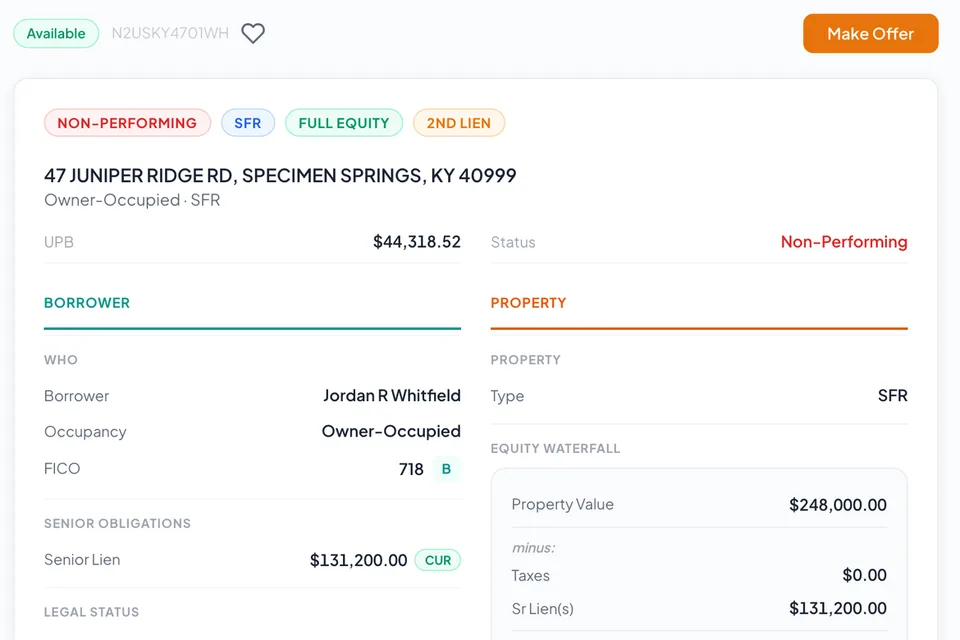
Case Study: Selling a Non-Performing Second Lien for $10,500
NPL case study: an $18,607 non-performing second lien sold for $10,500 as part of a 21-loan portfolio — offering the buyer up to 77% IRR.
The Setup
Not every non-performing note resolution involves working directly with the borrower. Sometimes the best exit is selling the loan to another investor in the secondary mortgage market — especially when you can move multiple assets at once and redeploy capital into fresh opportunities.
In this case, an investor held a non-performing loan in the second lien position on a single-family residential property. The borrower had stopped paying on the junior mortgage but was still current on the senior lien and living in the home. That combination — owner-occupied, senior lien current, full equity coverage — made this an attractive asset for a downstream buyer looking for a deal with strong resolution potential.
The Deal Metrics
| Metric | Value |
|---|---|
| Property Type | Single Family Residential |
| Fair Market Value (FMV) | $140,000 |
| Senior Lien UPB | $98,000 |
| Equity Above Senior | $41,327 |
| Second Lien UPB | $18,607 |
| Equity Coverage Ratio | >2x |
| CLTV | <100% |
| Occupancy | Owner-Occupied |
| Senior Lien Status | Current |
| Sale Price | $10,500 (56.43% of UPB) |
The unpaid principal balance on the second lien was $18,607. After subtracting the $98,000 senior lien balance from the $140,000 fair market value, $41,327 of equity remained to cover the junior position. Dividing that equity by the UPB produces a coverage ratio greater than 2x — meaning the borrower's equity was more than double the outstanding second lien balance. From the borrower's perspective, the combined loan-to-value was below 100%, confirming skin in the game on both sides of the equation.
The Resolution
Rather than pursuing a borrower workout, the seller packaged this loan into a portfolio of 21 non-performing loans and marketed it to their network of downstream note investors. The portfolio sold for a total of $367,000.
The sale process followed a standard LOI structure. Multiple investors submitted indicative offers as letters of intent. The seller analyzed all bids and awarded each loan to the highest bidder. Once an LOI was signed, the winning buyer moved into full due diligence — ordering title searches, credit reports, and broker price opinions to verify property values before closing.
This particular loan sold for $10,500, representing 56.43% of the $18,607 UPB. For the buyer, the upside was clear. If they could get the borrower back on their original monthly payment of $155.67 through a loan modification with no down payment, they would earn a 17.79% annualized return on their $10,500 cost basis. That back-of-the-envelope calculation is straightforward: $155.67 monthly payment multiplied by 12 months, divided by $10,500 — with the caveat that loan servicing fees of $15 to $25 per month should be netted out unless the investor is self-servicing.
But the bigger prize was a full payoff. If the borrower refinanced the loan and paid off the full UPB of $18,607, the buyer's return jumps significantly.
The Numbers
| Scenario | Value |
|---|---|
| Purchase Price | $10,500 |
| Original Monthly Payment | $155.67 |
| Scenario 1: Modification at Original Payment | 17.79% annualized yield |
| Full UPB (if refinanced) | $18,607 |
| Gross Profit (full payoff) | $8,107 |
| Scenario 2: Full Payoff Within 12 Months | 77% IRR |
In the full-payoff scenario, the math works out to an ROI of 77%: the $18,607 UPB minus the $10,500 purchase price, divided by $10,500. Assuming the borrower refinances within 12 months, that ROI equals the annualized internal rate of return. And these are conservative projections — they do not account for any arrears or accrued interest the buyer might also collect, nor any monthly payments received before the payoff event.
The reason the buyer had confidence in either scenario was the deal profile itself. The borrower was living in the home and paying the first mortgage, which demonstrated both income and motivation to keep the property. A borrower who is current on their senior lien and occupying the home is far more likely to engage in a resolution — whether that is a modification, a reinstatement, or a refinance — than one who has walked away.
The Takeaway
This case study highlights two strategies that note investors often overlook: selling loans as a resolution exit, and buying in bulk for better pricing.
Selling into the secondary market is a legitimate resolution strategy. Not every loan in your portfolio needs to be worked to completion. If you have capital tied up in a deal that requires patience you cannot afford — or if you simply want to recycle capital into higher-priority assets — selling the note to another investor who has the time and appetite for that deal is a rational move. The seller in this case moved 21 loans at once, freeing up $367,000 in capital to redeploy.
Buying in bulk delivers better pricing. The buyer acquired this loan at just 56 cents on the dollar. That discount was partly a function of purchasing as part of a portfolio. Bulk buyers consistently get better pricing than one-off purchasers because sellers value the efficiency of moving multiple assets in a single transaction. Beyond pricing, portfolio diversification is critical when working non-performing junior liens. These deals often involve a "hurry up and wait" cycle — you send a letter, engage an attorney, and then wait for a response. Investors who hold only a single loan tend to get impatient and make suboptimal decisions. A portfolio of loans gives you the patience to let each deal resolve on its own timeline without forcing premature action.
Finally, this deal underscores the importance of conservative pricing. The buyer did not assume a three-month payoff at full UPB. They priced the loan based on lower-expectation scenarios — collecting 50% of the monthly payment, or recovering only 75% of the balance — and worked backward to a purchase price that made the deal profitable under any reasonable outcome. When you price with the worst case in mind and the best case materializes, the returns take care of themselves.
 Free Note Investor Workshop
Learn notes by pricing one.
Analyze a training loan modeled on a real deal, then submit practice offers on loans that actually sold.
- No credit card
- No email needed to start
- 7 steps · about 70 min