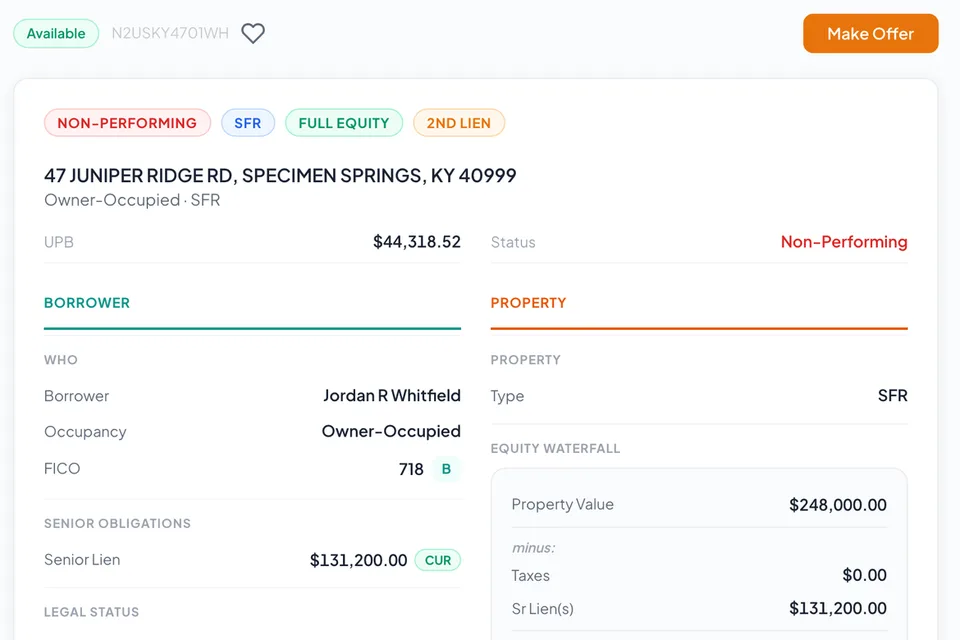
Case Study: 142% IRR on an NPL Junior Lien Modification-to-Payoff
NPL case study: a $19,900 junior lien on a $433K property was modified at $362/month, then paid off in full within 8 months — generating a 142% IRR.
The Setup
An investor acquired a non-performing loan in a junior lien position — a second mortgage on a single-family residential property where the borrower had stopped making payments. The senior lien was current, which meant the borrower was still servicing the first mortgage and had both income and motivation to keep the home. The property had a fair market value of $433,000 against a first lien balance of $315,000, leaving $118,000 of equity to protect the junior position.
The borrower was a small business owner who had gone through a rough stretch financially but appeared to be coming out the other side. That combination — a current senior lien, strong equity coverage, and a borrower showing signs of recovery — made this an attractive candidate for a loan modification.
The Deal Metrics
| Metric | Value |
|---|---|
| Property Value (FMV) | $433,000 |
| First Lien Balance | $315,000 |
| Equity Above Senior | $118,000 |
| Second Lien UPB | $37,219 |
| Equity Coverage Ratio | 3.19x |
| CLTV | 81.21% |
| Purchase Price | $19,900 (53.47% of UPB) |
The combined loan-to-value of 81.21% confirmed full equity coverage from the borrower's perspective — total debt across both liens was well below the property's value. The equity coverage ratio of 3.19x meant the available equity was more than three times the junior lien's unpaid principal balance. This borrower had significant skin in the game.
The Resolution
The investor's first contact with the borrower came during what sounded like a busy day — the borrower was at the grocery store with his daughter. But he was receptive. He called back the next day, and the two began discussing the account. The borrower explained that his small business had been through difficult times, but the situation had stabilized and he was ready to get back on track.
They negotiated a modification agreement: $1,000 down payment plus $362 per month at an 8.75% interest rate. On a back-of-the-envelope basis, annualizing the $362 monthly payment against the $19,900 cost basis suggested roughly a 21.83% annual return — a solid outcome even before accounting for the down payment or servicing costs.
The borrower did miss the initial deadline to sign the modification documents and submit the down payment. The investor used this as an opportunity to show the borrower a per diem rate — the daily amount by which the payoff balance was increasing. Rather than pulling the offer entirely, the investor extended the original terms, starting the relationship on a foundation of good faith. The borrower signed, made the down payment, and began the monthly payments.
Four to five months into the modification, the borrower refinanced the loan and paid it off in full. The total collected across the down payment, monthly payments, and the lump-sum payoff was $38,711.
The Numbers
| Metric | Value |
|---|---|
| Purchase Price | $19,900 |
| Total Collected | $38,711 |
| Gross Profit | $18,811 |
| Hold Time | 8 months |
| ROI | 94.5% |
| Annualized IRR | 142% |
The math: $38,711 collected minus the $19,900 cost basis equals $18,811 in gross profit — a 94.5% return on investment. Because the deal resolved in 8 months rather than a full year, we annualize by dividing by 0.667 (8 months / 12 months), which brings the internal rate of return to 142%.
IRR = (Total Collected - Cost Basis) / Cost Basis / (Months to Exit / 12)
($38,711 - $19,900) / $19,900 / (8 / 12) = 142%
The Takeaway
Three deliberate decisions made this outcome possible, and each one applies to any junior lien modification.
First, show the borrower the per diem rate. When the borrower missed the initial modification deadline, the investor ran a payoff quote through the loan servicer showing the per diem — the daily amount the balance was increasing. This accomplished two things: it demonstrated urgency without hostility, and it gave the investor leverage to extend the original terms as a goodwill gesture. Starting a modification on the right foot with good faith can make a measurable difference in payment consistency.
Second, set the interest rate to encourage refinancing. The modification was written at 8.75%. When institutional rates dropped well below that level in early 2021, the borrower had a clear financial incentive to refinance — saving money on both the monthly payment and the total interest over the life of the loan. That refinance produced the full payoff that drove the 142% IRR. Structuring a modification rate above prevailing market rates aligns the investor's interest in a fast exit with the borrower's interest in reducing their cost of debt.
Third, do not charge a prepayment penalty. The borrower was free to pay off the loan at any time without additional cost. Combined with the above-market interest rate, this created a natural incentive for the borrower to refinance as soon as better terms became available. The investor wanted the capital back quickly to reinvest in additional mortgage notes — and the borrower wanted a lower rate. No prepayment penalty meant both parties got what they wanted.
The broader lesson is one of interest alignment. A well-structured modification does not trap the borrower — it gives them a path to resolve the debt in a way that benefits both sides. In this case, the borrower stabilized his finances, rebuilt his payment history, and refinanced into better terms. The investor turned $19,900 into $38,711 in eight months. That is what a win-win resolution looks like in practice.
 Free Note Investor Workshop
Learn notes by pricing one.
Analyze a training loan modeled on a real deal, then submit practice offers on loans that actually sold.
- No credit card
- No email needed to start
- 7 steps · about 70 min