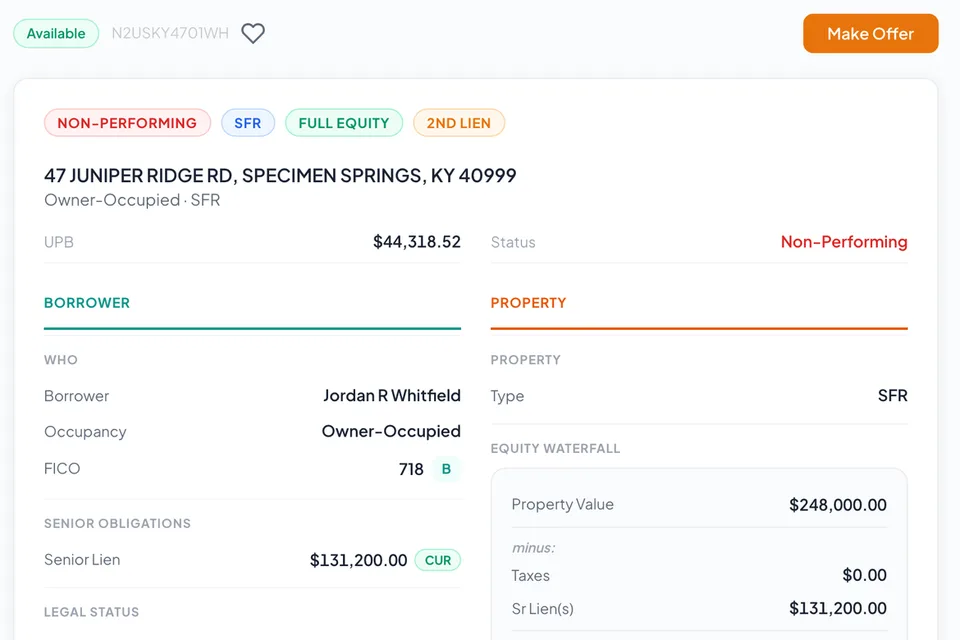
How to Research and Analyze Mortgage Notes: The Complete Due Diligence Waterfall
The non-performing note due diligence waterfall — from secured status to equity coverage — is a step-by-step system for analyzing mortgage notes.
What Is the Non-Performing Waterfall Evaluation?
The waterfall evaluation is a systematic, top-to-bottom framework for analyzing non-performing mortgage notes before you commit capital. Each step narrows the field, eliminates unacceptable risk, and refines your pricing. Skip a step and you are guessing. Follow every step and you have a defensible bid backed by real data.
The waterfall covers six stages: secured status, collateral value, bankruptcy, occupancy, title, and equity. For junior lien investors, it adds two more checkpoints: first lien status and property taxes as they relate to your equity position. This post walks through each stage so you can apply it to your own due diligence process.
How Do You Determine If a Loan Is Secured or Unsecured?
This is the single biggest driver of pricing. A secured loan -- one backed by real property as collateral -- can trade near par value. An unsecured loan might be worth half of one percent of the unpaid principal balance, sometimes even less. The difference between those two outcomes is enormous, and it is the first thing you need to establish.
The process is straightforward. Look up the property in public records and check whether the property owner matches the borrower on the data tape. If the names match, you can be reasonably confident the loan is secured by that collateral property. The lien you are evaluating is protected by real estate.
A loan becomes unsecured when a senior lien forecloses and wipes out the junior position. If the senior lender has already completed foreclosure, the property has transferred to a new owner, and your junior lien is no longer attached to anything tangible. It becomes an unsecured personal obligation of the borrower -- which is worth a fraction of what a secured note commands.
For senior lien investors, this determination is simpler: if the borrower still owns the property, you are secured. For junior lien investors, you must confirm that no senior lien foreclosure has already occurred. The secured versus unsecured determination should be your first filter on every loan you evaluate.
How Should You Approach Collateral Valuation?
Determining the property value is one of the most consequential steps in your analysis. There is a spectrum of methods available, ranging from free but less precise to expensive but highly accurate. The right approach depends on the deal size, lien position, and your stage in the evaluation process.
Free Automated Valuation Models (AVMs)
On the free end of the spectrum, automated valuation models from platforms like Zillow, Trulia, and other online estimators give you a starting point. These are useful for quick screening on large tapes, but they carry meaningful error margins.
Paid AVMs
Paid AVM products from vendors like CoreLogic, HouseCanary, and others provide tighter estimates with comparable sales data baked in. They are a step up in accuracy without requiring significant time investment.
Manual Comparable Sales Analysis
The best balance of cost and accuracy for most note investors is doing your own manual comparable sales review. Pull recently sold properties in the same area with similar characteristics -- square footage, lot size, bed and bath count, construction date -- and use those to triangulate a value. This costs nothing but your time, and with practice, you can produce valuations that rival what a desktop appraiser would deliver.
Here is a practical workflow for running your own desktop appraisal:
- Search the subject property on Zillow and use the seller landing pricing tool, which displays side-by-side comparisons of beds, baths, square footage, year built, lot size, and recent sale prices
- Scroll to recently sold homes at the bottom of the listing to find comparable properties that match your subject
- Switch to the map view and toggle the "sold" filter to see yellow dots representing recent sales near your subject property -- this gives you geographic proximity context
- Check Google Street View for the subject property and surrounding homes, but confirm the image capture date in the bottom corner. An image from 10+ years ago should be taken with a grain of salt
- Look for condition red flags: tarps on roofs, overgrown lawns, boarded windows, or visible deterioration compared to neighboring properties
BPOs and Professional Appraisals
A broker price opinion puts boots on the ground -- a local realtor visits the property, takes photos, and provides a valuation informed by firsthand observation and local market knowledge. A paid one is worth ordering on higher-value deals, particularly senior liens. For most junior lien acquisitions, your own manual research is sufficient. A local agent may also prepare one for free in exchange for the future listing; here is how to get a broker price opinion that way.
The key takeaway on collateral valuation: the method should match the stakes. Screen large tapes with free AVMs. Narrow your shortlist with manual comps. Reserve paid BPOs and appraisals for the deals where you are ready to commit capital.
What Do You Need to Know About Bankruptcy?
Bankruptcy adds layers of complexity to note analysis, particularly for junior lien holders. The two chapters that matter most are Chapter 7 and Chapter 13, and each creates different risks.
Chapter 7: Liquidation
In a Chapter 7 bankruptcy, the trustee liquidates the borrower's non-exempt assets to pay creditors. There is an equity exemption of approximately $23,000 on homestead property. The borrower must pass a means test based on income, and discharge typically occurs within three to five months. For note investors, Chapter 7 is generally less threatening to junior liens because lien stripping requires a more involved process.
Chapter 13: Reorganization
Chapter 13 is a reorganization of debt where the borrower makes plan payments to creditors over several years. It accommodates up to $394,000 of unsecured debt or $1.18 million of secured debt. The critical risk for junior lien holders: if the senior lien balance exceeds the property's fair market value, a Chapter 13 plan can strip or cram down the junior lien entirely.
How to Analyze a Bankruptcy Filing
The tactical approach to bankruptcy analysis follows a clear sequence:
- Search PACER.gov using the borrower's Social Security number to locate any active or discharged bankruptcy cases
- Review the docket for schedules and motions -- specifically Schedule D (secured claims) and any motion for relief from stay or motion to cram down
- On the voluntary petition, locate Schedule D and note the collateral value and senior lien balance the borrower has reported. If the senior lien balance exceeds the stated collateral value, your junior lien is at risk of being stripped
- If the collateral value is understated, have an attorney file a motion to re-value the collateral to protect your lien position
- Check the borrower's stated intentions regarding the property -- retaining and continuing payments versus surrendering or selling
- Look for a motion for relief from stay filed by the senior lien holder. If granted, the senior lender can proceed with foreclosure despite the active bankruptcy, which directly threatens your junior position
Why Does Occupancy Matter So Much?
Occupancy status -- whether the property is owner-occupied, tenant-occupied, or vacant -- is one of the strongest predictors of resolution outcomes. Owner-occupied properties carry the highest likelihood of a successful workout because the borrower has emotional equity in the home and a personal motivation to resolve the default.
Vacant properties present the opposite risk profile: deferred maintenance, potential municipal violations, and the absence of a motivated borrower who wants to keep the property. Tenant-occupied falls somewhere in between.
How to Determine Occupancy
You establish occupancy by triangulating multiple data sources:
- County tax records: If the mailing address for the tax bill matches the collateral address, the property is likely owner-occupied
- Bankruptcy petition: The borrower's listed address on the filing indicates where they live
- Google search: A simple name and address search can surface public records and directory listings
- Social media: The borrower's listed location on social profiles can confirm or contradict other data points
- Credit report: Most reports list three addresses with dates -- the most recent address is likely current
- Skip trace: The strongest single data point. Skip trace services show where the borrower receives mail and pays utility bills. You can also search the property address to determine if someone other than the borrower resides there
The more data points you compare, the more confident your occupancy determination. Even with multiple sources, some properties will remain uncertain -- but most can be classified with reasonable confidence using this approach.
How Do You Evaluate Title and Liens?
The title search confirms what liens, judgments, and encumbrances exist on the property and whether the assignment chain is intact. There are two primary approaches depending on the deal size and lien position.
Ownership and Encumbrance Reports
An O&E report reviews public records through the last property transfer rather than the full 30-year history of a comprehensive title search. At approximately $90, it is significantly cheaper than a full title search that can cost several hundred dollars. O&E reports from vendors like Pro Title USA often include property tax data and HOA details, and some provide Excel output that can be merged directly into your data tape -- a major time saver for bulk analysis.
Manual Public Records Research
For most junior lien acquisitions, you can perform a cursory title review by searching public records manually. This works well for lower-value deals where the cost of a formal report is not justified by the deal economics.
When to Order a Full Title Search
Full title searches are most appropriate for senior lien purchases or high-value junior liens where the stakes warrant the expense. The advantage of a full search through a title insurance company is the ability to actually insure the title -- providing protection against undiscovered defects.
How Do You Assess First Lien Status on Junior Notes?
If you are investing in junior liens, understanding the status of the senior lien in front of you is critical. A credit report provides this information through the senior lien's trade line.
The trade line shows:
- Origination date: The senior lien will have an earlier origination date than the junior
- Balance and monthly payment: What the borrower owes and what they are expected to pay each month
- Payment string: A series of 12 numbers representing the last 12 months of payment history
Reading the payment string is straightforward. A 1 means current (paying as agreed). A 2 means 30 days late. A 3 is 60 days late. 4 is 90 days late. 5 indicates 120+ days late or foreclosure initiated. Read the string from right to left -- the rightmost number is the most recent month.
A borrower showing all 1s on the senior is current and likely motivated to keep the home. A string that deteriorates from 1s to 5s over recent months suggests the borrower is sliding toward foreclosure on the senior -- which directly threatens your junior position.
One critical detail: check the reported date on the trade line. If the data was last reported two years ago, everything you are reading is stale. The reported date should be within 60 days of your review to be reliable.
Beyond senior lien status, credit reports reveal FICO scores, employment details, other outstanding debts, and lifestyle indicators like vehicle financing or medical debt. All of this informs your assessment of the borrower's capacity and willingness to resolve the default on your note.
What Role Do Property Taxes Play in Your Analysis?
Property tax research is especially important for senior lien investors because you are often resolving through the property itself. Unpaid taxes directly reduce your equity position and, if far enough along, can threaten the secured status of your lien entirely.
The best case scenario is finding complete county tax records online showing all taxes current or only the current year outstanding before the deadline. The worst case is discovering a sheriff's sale already in progress -- meaning tax lien certificates have been sold and the foreclosure clock is ticking.
When property taxes are delinquent:
- If you are still in due diligence: Subtract the delinquent tax balance from the fair market value to recalculate your equity position, then reassess your bid accordingly
- If the seller represented taxes as current: Present the evidence and negotiate for the seller to bring taxes current before closing
- If you already own the loan: Understand the county's specific redemption period and process. You or the borrower can redeem the property by paying the delinquent taxes before the deadline. Your servicer can advance the tax payment as a recoverable corporate advance that gets added to the borrower's loan balance
Three vendor options for property tax research: Pro Title USA (included in O&E reports for many counties), CoreLogic Residential Tax Solutions (best for bulk volume), and First American Tax Source through DataTree (accessible for one-off research).
How Do You Calculate Equity Coverage?
The final step in the waterfall is determining the equity position, which is the foundation of your pricing decision. For junior lien investors, the equity coverage formula is:
Equity Coverage = (Fair Market Value - Senior Lien Payoff) / Junior UPB
This ratio tells you how much equity protects your junior lien position:
| Equity Coverage | Classification | What It Means |
|---|---|---|
| Greater than 1.0 | Full Equity | The property value fully covers both the senior and junior balances |
| 0.25 to 1.0 | Partial Equity | Some equity exists but does not fully cover the junior balance |
| 0 to 0.25 | No Equity | Negligible equity protecting the junior position |
| Less than 0 | Underwater | The senior lien alone exceeds the property value |
Consider an example: a property with a fair market value of $200,000, a senior lien balance of $100,000, and a junior UPB of $50,000. The equity coverage is ($200,000 - $100,000) / $50,000 = 2.0. That is a full equity position with strong coverage.
Now change the numbers: fair market value of $100,000, senior lien of $50,000, junior UPB of $50,000. Equity coverage equals 1.0 -- technically covered, but conservatively classified as partial equity because there is no margin of safety.
This formula is essential for screening large tapes efficiently. Rather than evaluating each loan qualitatively, you can calculate equity coverage across hundreds of loans and immediately stratify them into pricing tiers.
Putting the Waterfall Together
The non-performing waterfall evaluation is not a checklist you run through once and forget. It is a repeatable system that produces consistent, data-driven acquisition decisions. Each step builds on the previous one:
- Secured status eliminates loans where the collateral is gone
- Collateral value establishes what the underlying property is worth
- Bankruptcy identifies legal risks that could strip or cram down your lien
- Occupancy predicts the likelihood of a cooperative borrower resolution
- Title confirms your lien position and reveals competing claims
- First lien status (juniors only) assesses whether the senior is threatening your position
- Taxes adjusts your equity position for outstanding obligations
- Equity coverage produces the final number that drives your pricing
By the time you reach the equity coverage calculation, you have a complete picture of the asset. You know whether it is secured, what the collateral is worth, whether bankruptcy creates risk, who lives in the property, what liens exist on title, what the senior lien is doing, how much is owed in taxes, and how much equity protects your position. That is the foundation of a defensible bid.
The investors who build this process into a repeatable system -- running every loan through every step before committing capital -- are the ones who consistently make money in this business. The ones who skip steps are the ones who learn expensive lessons.
 Free Note Investor Workshop
Learn notes by pricing one.
Analyze a training loan modeled on a real deal, then submit practice offers on loans that actually sold.
- No credit card
- No email needed to start
- 7 steps · about 70 min