How to Price Performing and Non-Performing Notes: Yield vs. Collateral Value
Pricing frameworks for performing and non-performing notes. Yield-based pricing for PLs vs. collateral-value pricing for NPLs, with examples.
The Fundamental Pricing Split: Cash Flow vs. Collateral
Compare alternatives: Wholesaling vs note investing →
Every note investor needs to internalize one core principle before pricing a single asset: the method you use to price a note depends entirely on whether it is performing or non-performing.
Performing loans and re-performing loans generate predictable monthly cash flow. That cash flow is the basis of their value. You price them by working backward from the payment stream to a maximum purchase price using a target cash-on-cash return.
Non-performing loans produce no cash flow. There is no payment stream to discount. Instead, their value is anchored to the underlying collateral — either the fair market value of the property for first liens or the unpaid principal balance (UPB) for second liens.
This distinction is not just academic. It determines which spreadsheet formulas you build, which data points matter most in your due diligence, and where your bid ultimately lands. Get it wrong and you will either overpay for risk you have not accounted for or submit bids so far off-market that sellers stop returning your calls.
Pricing Performing and Re-Performing Notes
Cash-flowing notes — whether they are seasoned performers or recently modified re-performers — are priced on yield. The formula is the same one used across the cash-flow investment world, from rental properties to dividend stocks:
Maximum Purchase Price = ((Monthly Payment - Servicing Fee) x 12) / Target Cash-on-Cash Return
You set your desired annual return, subtract the monthly servicing fee from the borrower's payment to get net cash flow, annualize it, and divide by your target yield. The result is the most you should pay.
Yield Ranges by Asset Class
Different performing note types trade at different yield expectations based on risk:
| Asset Class | Typical Cash-on-Cash Range | Risk Drivers |
|---|---|---|
| Performing senior liens (firsts) | 7.5% - 12.5% | Lowest risk; consistent payment history; strong collateral coverage |
| Performing junior liens (seconds) | 12% - 22% | Higher risk due to subordinate lien position; compensated with higher yield |
| Re-performing first liens | 10% - 16% | Borrower was previously delinquent; modification in place but shorter payment track record |
| Re-performing second liens | 14% - 24% | Combines subordination risk with reperformance uncertainty |
These ranges shift with market conditions, but they provide the framework for anchoring your target return before you start pricing a tape. A common mistake among newer investors is setting a target return that is too aggressive for the asset class. If you price every performing first lien at a 20% cash-on-cash target, your bids will fall below market consistently and you will never win an allocation. Conversely, pricing risky re-performing seconds at 8% means you are not being compensated for the additional risk.
Why Yield-Based Pricing Works
The logic behind yield-based pricing is straightforward: you are buying a stream of future payments. The value of that stream depends on how much income it generates relative to your invested capital. This is no different from how an investor evaluates a rental property — the purchase price must be justified by the rent it produces, not by speculation about future appreciation.
When you buy a note that is already cash-flowing, you know the monthly payment, you know the servicing cost, and you can calculate exactly what return you will earn at any given price. That certainty is what makes performing notes more expensive than non-performing notes, and it is what justifies the yield-based approach.
Pricing Non-Performing First Liens
When a note is not producing cash flow, you cannot price it on yield. There is no income stream to work with. Instead, non-performing first liens are priced as a percentage of the property's fair market value. To test that percentage against what the loan's realistic outcomes are worth to you, run the modification and foreclosure scenarios in our step-by-step guide to NPL valuation.
This makes intuitive sense. As the senior lien holder, your ultimate backstop is the property itself. If the borrower does not pay, does not modify, and does not cooperate, your resolution path leads through foreclosure — and the property is what you recover. The value of that property determines how much you can afford to pay for the note.
Value Bands for First Lien Pricing
Not all properties are created equal. A $90,000 home in a stable neighborhood represents a fundamentally different risk than a $8,000 vacant lot in a declining market. That is why experienced note investors stratify non-performing first liens into value bands:
| Property Value Band | Typical Price (% of FMV) | Why |
|---|---|---|
| Under $10,000 | 5% - 15% | Often vacant land, condemned, or potential demolitions; may be more liability than asset |
| $10,000 - $25,000 | 20% - 40% | Lower-value homes; higher risk of vacancy, poor condition, and weak borrower attachment |
| $25,000 - $50,000 | 30% - 50% | Mid-range; improving borrower commitment to the property |
| $50,000 - $100,000 | 40% - 65% | Stronger collateral; typically owner-occupied with borrower motivated to resolve |
| $100,000+ | 50% - 85% | Highest-value band; strong borrower attachment; most resolution options available |
The pricing increases as property value increases because higher-value properties tend to have borrowers who are more committed to the home, are more likely to be owner-occupying, and present more resolution options — from loan modifications to discounted payoffs to property sales. Lower-value properties carry more risk of vacancy, deterioration, and costly foreclosure processes that may not be worth pursuing.
The UPB Cap on First Liens
Even when pricing based on property value, you must keep the unpaid principal balance in mind. The UPB represents what you are actually buying — the right to collect a specific amount of debt. If a property is worth $50,000 but the UPB is only $6,000, you would not pay 60% of value ($30,000) for a $6,000 debt. Your bid should be capped at a reasonable percentage of UPB — typically no more than 80-90% for non-performing first liens.
The best first lien opportunities often feature a large spread between property value and UPB. When a borrower owes $6,000 on a home worth $90,000, both parties have a strong incentive to resolve the debt. The borrower wants to protect substantial equity; the lender wants to facilitate a resolution that recovers the full balance. These high-equity first liens can produce full payoffs relatively quickly, dramatically increasing the internal rate of return beyond what the static pricing percentage would suggest.
Pricing Non-Performing Second Liens
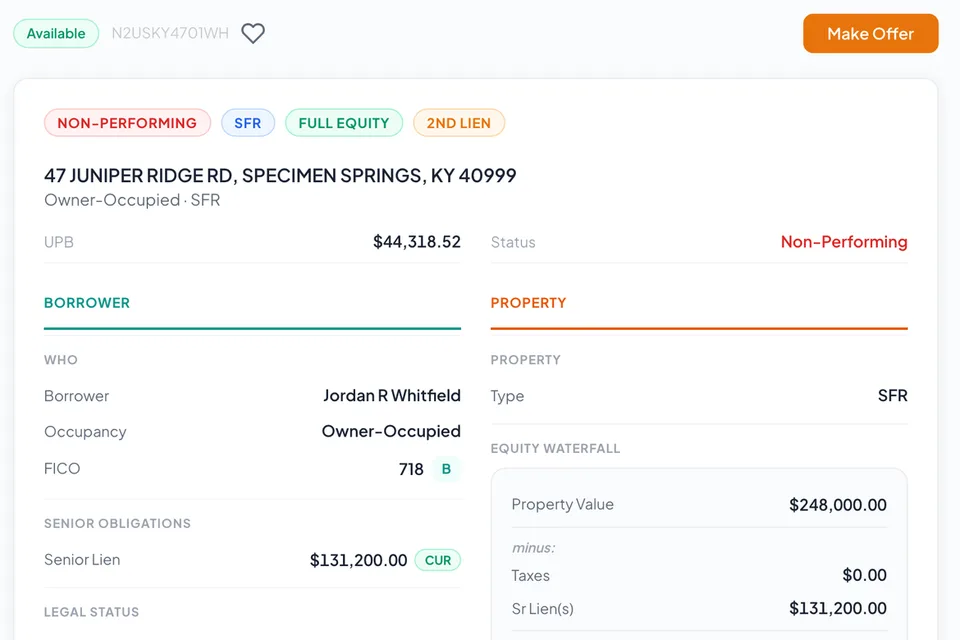
Non-performing second liens are priced as a percentage of the unpaid principal balance, not the property value. This is the key distinction from first liens, and it reflects a fundamentally different resolution path.
First liens typically resolve through the property — foreclosure, property sale, or deed-in-lieu. Second liens resolve more often through the borrower — negotiated modifications, discounted payoffs, or payment plans. You are addressing the debt obligation, not the collateral directly. That is why UPB, not property value, drives second lien pricing.
How Equity and Senior Lien Status Affect Pricing
The pricing range for non-performing second liens is wide — from as low as 2% of UPB to as high as 60% — and where a specific loan falls in that range depends primarily on two factors:
1. Equity position. How much value sits above the first lien balance? If the first lien is $100,000 and the property is worth $200,000, there is $100,000 of equity protecting your second lien. That is a strong position. If the first lien is $190,000 and the property is worth $200,000, there is minimal equity and your second lien is effectively underwater.
When investors say a second lien is "unsecured" — even though it is technically still secured by the property — what they mean is that there is no equity above the first lien to protect the second position. In those situations, second liens can price down to 2-5% of UPB, approaching the range of genuinely unsecured debt.
2. Senior lien status. Is the first lien current, delinquent, or in foreclosure? A performing first lien is the best-case scenario for a second lien investor because the senior lender is escrowing taxes and insurance, protecting the collateral, and demonstrating that the borrower has some capacity to pay. If the senior lien is in foreclosure, the clock is ticking — your second lien could be wiped out if the foreclosure completes.
| Second Lien Scenario | Typical Price Range (% of UPB) |
|---|---|
| Current senior, positive equity | 40% - 60% |
| Current senior, minimal equity | 15% - 30% |
| Delinquent senior, positive equity | 20% - 40% |
| Delinquent senior, minimal equity | 5% - 15% |
| Foreclosure initiated on senior | 2% - 10% |
Invested Capital to Value: The Right Way to Measure Equity
A common mistake is using combined loan-to-value (CLTV) to evaluate second lien equity. CLTV combines the first and second lien balances and divides by property value — that is the borrower's perspective. But as a second lien investor, you are not paying the full UPB for the note. You are paying a fraction of it.
The more useful metric is invested capital to value (ICTV): your purchase price for the second lien plus the balance of the first lien, divided by the property value. This gives you the investor's perspective on how much equity protects your actual capital at risk — not the notional face value of the debt.
The Due Diligence Waterfall That Drives Pricing
Pricing does not happen in a vacuum. Every pricing decision is the output of a due diligence process that moves through a structured waterfall. Understanding this waterfall helps you identify which data points matter most at each stage.
Step 1: Secured vs. Unsecured
Before anything else, confirm the debt is secured. The borrower on the data tape must match the owner on the county records. If the borrower lost the property to a tax foreclosure or a senior lien foreclosure, the debt is now unsecured — enforceable only through the promissory note, not through the collateral. Unsecured mortgage debt trades at roughly 0.5% to 5% of UPB.
Step 2: First vs. Second Lien
This determines your entire pricing framework. First liens price on property value. Second liens price on UPB. This also determines your due diligence priorities — first liens focus heavily on property condition, taxes, and title; second liens focus on senior lien status and equity.
Step 3: Equity and Property Value
For both lien positions, you need a reliable property valuation. Use BPOs (broker price opinions), AVMs (automated valuation models), and comparable sales analysis. Then calculate the equity available to your lien position.
Step 4: Bankruptcy Status
Research the borrower through PACER (Public Access to Court Electronic Records) at pacer.gov. A bankruptcy filing is not necessarily bad news — it opens the borrower's financial records and can lead to structured repayment through the courts. Review the voluntary petition's Schedule D (secured claims) to understand the borrower's stated property value and the debts secured against it.
Be aware of the motion for relief from stay. If a senior lien holder has filed this motion, they are seeking permission to foreclose despite the bankruptcy, which means the clock is running on your second lien position.
Step 5: Occupancy
Determine whether the property is owner-occupied, tenant-occupied, or vacant. Triangulate using multiple data sources:
- Property tax records — compare the owner's mailing address to the property address
- Credit reports — check the borrower's current address against the collateral address
- Skip traces — use utility and creditor records for deeper confirmation
Owner-occupied properties generally command higher prices because the borrower has a personal attachment to the home and stronger motivation to resolve the debt.
Step 6: Title and Taxes (First Liens) / Senior Status and Equity (Second Liens)
For first liens, order a title report to identify any liens, judgments, or encumbrances that could affect your position. Monitor property taxes closely — a tax foreclosure can wipe out your first lien position entirely. Current property taxes signal that the borrower intends to keep the home.
For second liens, the equivalent priority is understanding the first lien status and the equity available above it. If the first lien is current and escrowing taxes, you are in a strong position. Title reports on second liens are less critical when the senior is performing — the first lien holder is already protecting the collateral from tax and title issues.
Bulk vs. One-Off Acquisitions: How Purchase Size Affects Price
The price you pay for a note is also influenced by how you are buying — one asset at a time or an entire portfolio.
One-Off Purchases (Under $100K Total Spend)
One-off buying means cherry-picking individual assets that fit your investment criteria. The advantages are clear:
- Intentional diversification — you choose exactly which assets to buy
- Targeted due diligence — you can go deep on every loan
- Selective risk management — you skip anything that does not meet your standards
The tradeoff is retail pricing. You are competing against other investors who are similarly cherry-picking the best assets, which drives prices higher. One-off deals are for end users — investors who plan to resolve the loan themselves through modification, payoff, or foreclosure. If you are buying one-off at retail pricing and trying to flip, the margins are too thin.
Standard representations and warranties protect one-off buyers. Sellers warrant the documentation, enforceability, and status of the debt as of the cutoff date. If any of those representations are false — for example, if a foreclosure wiped out the lien the day before funding — you have a repurchase claim.
Bulk Acquisitions ($1M+)
Bulk buying means taking down an entire portfolio, often on an all-or-nothing basis. The pricing is wholesale — significantly better than one-off — but the trade comes with caveats:
- No cherry-picking — you take the good, the bad, and the ugly
- Professional competition — your competing bidders are institutional and sophisticated
- Loan-level pricing required — you must price every asset individually, then aggregate into a portfolio bid
- Reduced reps and warranties — bulk trades often sell as-is, where-is, especially tail-end fund liquidations
The upside of bulk is optionality. At wholesale pricing, you can resolve the strongest assets yourself and redistribute the rest to investors in your network who have specific geographic or asset-class expertise. This consortium approach — one buyer takes down the portfolio, then splits it among specialists — gives the seller a clean, single-counterparty transaction while giving the buyer access to deal flow that would otherwise be out of reach.
Bulk buying also forces you to expand your preferences. If you only pursue second liens behind performing firsts with positive equity, you will miss a large portion of the market. Lower-probability assets — those with weaker equity, delinquent seniors, or uncertain occupancy — are priced much more attractively and sometimes contain upside surprises that only reveal themselves after acquisition. A satisfaction of mortgage on the first lien that was not identified in due diligence. A foreclosure that was dismissed. A borrower with strong emotional equity who fully intends to resolve the debt despite what the numbers on paper suggest.
From the Non-Performing Purchase to the Re-Performing Exit
One of the most powerful strategies in note investing is buying a non-performing note at distressed pricing, resolving it into a re-performing loan through a modification, and then either holding it for cash flow or selling it to a re-performing loan buyer at a yield-based price.
The key question is whether the re-performing value exceeds the non-performing purchase price. This is where a modification viability calculation becomes essential.
Modification Viability: Will the RPL Be Worth More Than the NPL?
Consider a second lien with a $31,000 UPB purchased at 30% — a $9,500 acquisition cost. If you modify the loan to a $350 monthly payment, the re-performing value at a 20% cash-on-cash target is:
(($350 - $15 servicing) x 12) / 0.20 = $20,100
That re-performing value of $20,100 far exceeds the $9,500 purchase price. The math works. But if the borrower can only afford $250 per month:
(($250 - $15) x 12) / 0.20 = $14,100
Still viable. Now consider $150 per month:
(($150 - $15) x 12) / 0.20 = $8,100
At $8,100, the re-performing loan is worth less than the $9,500 you paid for it as a non-performing note. The modification is not viable at that payment level — you would be better off pursuing a different resolution.
Run this calculation before you buy. If the borrower's likely payment capacity does not produce a re-performing value above your purchase price, the modification path may not work, and you need confidence in an alternative resolution — payoff, property sale, or foreclosure — to justify the acquisition.
The Velocity of Money
When a borrower pays off early — through a property sale, refinance, or lump-sum settlement — your internal rate of return increases dramatically compared to holding through a full modification term. A $9,500 investment that returns $25,000 over 15 months through a modification and RPL sale delivers a fundamentally different return than one that generates $350 per month for 10 years.
This is why experienced note investors track IRR alongside cash-on-cash return. Cash-on-cash tells you what you earn annually at a given price. IRR tells you what you actually earn when you factor in the timing of all cash flows — purchase, monthly payments, and eventual payoff or sale.
Putting It All Together
Pricing notes is not guesswork. It is a structured process built on a clear framework:
- Determine the note's performance status. Is it paying or not paying?
- Identify the lien position. First or second?
- Apply the correct pricing method. Yield for performing; FMV percentage for non-performing firsts; UPB percentage for non-performing seconds.
- Run the due diligence waterfall. Confirm security, calculate equity, check bankruptcy, verify occupancy, assess title/taxes or senior status.
- Adjust for acquisition type. Retail pricing for one-offs; wholesale pricing for bulk.
- Model the exit. Will the resolution produce a return that justifies the purchase price?
The discipline of pricing anchored to fundamentals — not speculation, not hope, not what someone on a forum said they paid — is what protects your capital over the long term. You know exactly what return you will earn at any given price, and you can walk away from any deal where the numbers do not work. That discipline, applied consistently across every tape you review, is what separates investors who build sustainable portfolios from those who overpay on their first deal and never recover.
 Free Note Investor Workshop
Learn notes by pricing one.
Analyze a training loan modeled on a real deal, then submit practice offers on loans that actually sold.
- No credit card
- No email needed to start
- 7 steps · about 70 min