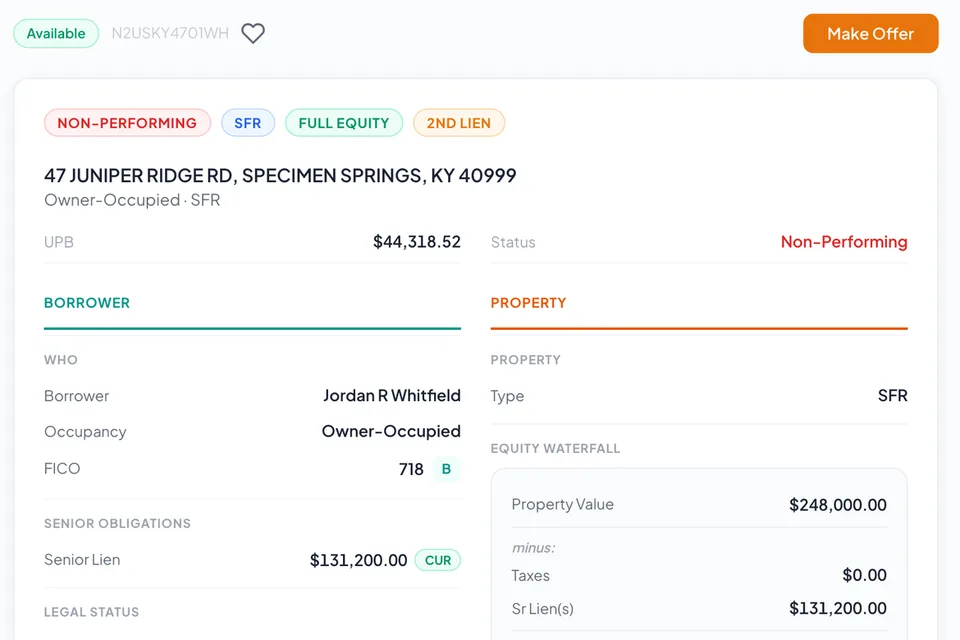
Democratizing the Secondary Mortgage Market: How Independent Investors Are Changing the Game
Secondary mortgage market access is expanding to independent investors. How technology and transparency create better outcomes for borrowers and buyers.

The Market That Was Never Meant for You
For decades, the secondary mortgage market operated behind closed doors. When banks charged off non-performing loans and packaged them for sale, the buyers were hedge funds, private equity firms, and institutional debt collectors with nine-figure balance sheets. Individual investors -- the people with the time, motivation, and local knowledge to actually help distressed borrowers -- were not invited to the table.
That is changing. And the shift is not just a matter of access. It is fundamentally altering how defaulted mortgage debt gets resolved, who profits from it, and whether borrowers end up in a better position when the process is over.
The democratization of the secondary mortgage market is not a marketing slogan. It is a structural transformation driven by technology, education, and a growing ecosystem of independent investors who are proving that smaller operators can outperform institutional buyers on both returns and borrower outcomes.
Compare alternatives: Real estate crowdfunding vs note investing →
Why the Market Was Closed in the First Place
To understand why the secondary mortgage market is opening up, you need to understand why it was closed.
The Institutional Monopoly
Banks sell non-performing loans (NPLs) in bulk. A typical institutional trade involves hundreds or thousands of loans bundled into a single loan pool. The minimum purchase price on these trades often starts in the tens of millions of dollars. Even if an individual investor had the knowledge to evaluate these assets, the capital requirements alone made participation impossible.
The buyers at these institutional auctions were large debt purchasing firms. Their business model was straightforward: acquire massive pools at steep discounts, apply standardized resolution playbooks across the entire portfolio, and extract maximum value through volume. The approach worked financially, but it left significant value on the table -- both for the investors who could have done more granular work on individual loans, and for the borrowers who received form letters instead of genuine resolution conversations.
The Information Gap
Beyond capital barriers, there was an information gap. The mechanics of buying mortgage debt -- how to read a tape, conduct due diligence, navigate the Loan Purchase and Sale Agreement (LPSA), onboard with a servicer, and execute loss mitigation strategies -- were not taught anywhere accessible. There were no courses, no publicly available case studies, and no transparent pricing benchmarks. Knowledge lived inside institutional trading desks and was passed between professionals who had no incentive to share it.
This opacity was self-reinforcing. Without accessible education, independent investors could not enter the market. Without independent investors in the market, there was no demand for accessible education.
What Changed: The Three Pillars of Democratization
Three forces converged to break the institutional monopoly on secondary mortgage market participation.
1. Aggregation and Smaller Trade Sizes
The most important structural change is the emergence of aggregated trade desks and loan sale advisories that break large institutional pools into smaller, investor-friendly packages. Instead of requiring a $10 million minimum purchase, these platforms allow individual investors to participate in curated pools with investment minimums as low as $25,000 to $50,000 per loan.
Here is how the model works:
| Traditional Institutional Trade | Aggregated / Democratized Trade |
|---|---|
| 500+ loans per pool | 5-20 loans per pool |
| $10M-$100M+ minimum | $25K-$200K per investor |
| Standardized resolution playbook | Individualized borrower workouts |
| Limited borrower contact | Direct borrower engagement |
| Bulk pricing, take-it-or-leave-it | Collaborative pricing with due diligence |
This aggregation model does not just lower the capital barrier. It changes the nature of the work. When an investor owns five loans instead of five hundred, they can dedicate real attention to each borrower situation. They can ask the three questions that matter: What happened? Where are you now? What do you want to do? And they can craft solutions that actually fit.
2. Education and Transparency
The second pillar is the explosion of publicly available education about secondary market mechanics. A decade ago, the only way to learn this business was through an expensive mentorship program or by working inside an institutional shop. Today, investors can access detailed breakdowns of every step in the process -- from reading a data tape to recording an assignment of mortgage -- through online courses, video libraries, and community forums.
This matters because knowledge is the real barrier to entry. Capital can be raised through partnerships and joint ventures. Legal and servicing infrastructure can be outsourced. But understanding how to evaluate a non-performing loan, price it correctly, and execute a workout strategy requires genuine education. When that education becomes accessible, the talent pool of capable investors expands dramatically.
Key knowledge areas that are now openly taught include:
- Tape analysis -- How to filter a data tape for loans that match your investment criteria, including state, lien position, unpaid principal balance (UPB), and property type
- Valuation methods -- Using BPOs, AVMs, and fair market value analysis to determine what a loan is actually worth
- Borrower resolution -- The full menu of exit strategies from loan modification to discounted payoff to foreclosure, and when each one makes sense
- Legal compliance -- State-specific requirements for servicing, collections, and foreclosure that protect both the investor and the borrower
- Servicer management -- How to onboard loans, direct resolution strategy, and monitor performance through your servicer
3. Technology and Infrastructure
The third pillar is technology. Modern loan servicing platforms, cloud-based document management, automated valuation tools, and digital title search services have dramatically reduced the operational overhead of managing a small note portfolio.
A decade ago, an independent investor buying five non-performing loans would have needed a full-time assistant just to track the paperwork, manage servicer communications, and monitor borrower outreach timelines. Today, a single investor with the right technology stack can manage a portfolio of 20-50 loans part-time.
Technology has also improved transparency on the buy side. Online marketplaces and broker networks now distribute tapes digitally, allowing investors to evaluate opportunities from anywhere. Due diligence vendors offer standardized packages that deliver title searches, property valuations, and credit reports in days rather than weeks.
The Ethical Case: Why Democratization Helps Borrowers
This is where the story gets important -- not just for investors, but for the families behind the loan numbers on a data tape.
The Problem with Institutional Resolution
When a large institutional buyer acquires a pool of 500 non-performing loans, the economics dictate a standardized approach. The firm applies the same resolution template across the entire portfolio because individualized attention does not scale at that volume. Loans that do not respond to the first or second outreach attempt get pushed toward foreclosure because it is operationally simpler to liquidate the collateral than to invest time in understanding a borrower's specific circumstances.
This is not malice. It is math. At institutional scale, the marginal return on spending an extra 10 hours understanding one borrower's situation does not justify the cost. So borrowers who could have been helped -- who had viable income, who wanted to stay in their homes, who simply needed a modified payment structure -- end up losing their properties because no one took the time to ask what happened.
The Independent Investor Advantage
Independent note investors operate at a fundamentally different scale, and that scale changes everything about borrower outcomes.
When you own a small portfolio of non-performing loans, every single resolution matters to your bottom line. You have the economic incentive and the operational capacity to dig into each borrower's situation individually. You can:
- Spend real time understanding the borrower's circumstances. Job loss, medical emergency, death of a co-borrower, divorce -- the reasons people stop paying their mortgages are specific and human. Understanding the cause of default is the first step toward crafting a solution.
- Design flexible resolution options. An interest-only modification with a step-rate increase. A discounted payoff that lets the borrower settle for less than the full balance. A forbearance period that gives them time to sell the property on their terms. These structures require creativity and individual attention that institutional buyers rarely provide.
- Align incentives with the borrower. The best resolution strategies create genuine win-win outcomes. The borrower gets a manageable payment or a clean exit from a debt they cannot carry. The investor earns a strong return on the capital they deployed. Neither party succeeds at the expense of the other.
A Real-World Example
Consider a common scenario: a borrower whose co-borrower passed away, leaving the surviving family member overwhelmed and unable to keep up with payments. The loan goes non-performing. The bank charges it off and sells it into the secondary market.
An institutional buyer might send a few collection letters and, when those go unanswered, begin foreclosure proceedings. The surviving borrower -- already grieving and financially stressed -- now faces losing their home.
An independent investor takes a different approach. They reach out through their servicer, make contact, and learn the full story. The borrower wants to sell the property but needs time to work with a realtor. They cannot afford the full amortized payment, but they can manage a reduced amount while the property is marketed.
The investor structures an interest-only loan modification at a payment the borrower can actually afford, with a step-rate provision that incentivizes timely payoff. The borrower stays in the home while marketing it for sale. The property sells, the loan gets paid off in full, and the investor earns a triple-digit return on their investment.
This is not a theoretical exercise. This is how the business actually works when investors have the knowledge, the motivation, and the scale to treat borrowers as people rather than line items on a spreadsheet.
Building an Ethical Investment Practice
Democratizing the secondary mortgage market is not just about opening access. It is about establishing standards for how independent investors operate once they are in. Here are the principles that separate ethical note investors from opportunistic ones.
Borrower-First Resolution
Every workout should start with the borrower's situation, not the investor's preferred exit. The three-question framework -- What happened? Where are you now? What do you want to do? -- is not just good practice. It is the foundation of every successful resolution. Borrowers who feel heard and respected are dramatically more likely to engage constructively, which leads to faster and more profitable outcomes for the investor.
Transparent Modification Terms
When structuring a loan modification, the terms should be genuinely achievable for the borrower. Setting a payment amount the borrower cannot sustain just to create the appearance of a re-performing loan is short-sighted and unethical. A well-structured modification considers:
- Current income and expenses -- What can the borrower actually afford on a monthly basis?
- Reasonable timelines -- Is the borrower working toward a payoff event (property sale, refinance) that needs adequate runway?
- No prepayment penalties -- Waiving prepayment penalties encourages faster payoffs, which accelerates capital velocity for the investor and reduces total interest cost for the borrower. There is no good reason to penalize a borrower for paying off their debt early.
- Step-rate provisions -- Gradually increasing the interest rate over the modification term aligns incentives. The borrower is motivated to pay off sooner to avoid rate increases, and the investor is compensated for the extended timeline if payoff takes longer.
Compliance as a Non-Negotiable
Operating in the secondary mortgage market comes with real regulatory obligations. Federal and state consumer protection laws govern how you communicate with borrowers, what disclosures you must provide, and what resolution options you must offer before pursuing foreclosure. These requirements exist to protect borrowers, and compliant investors should welcome them.
Working with a licensed servicer is not optional -- it is the mechanism through which you maintain compliance. Your servicer handles borrower communications, payment processing, escrow management, and loss mitigation outreach according to established regulatory frameworks. Investors who try to cut corners on servicing to save a few dollars per month are taking on enormous legal and reputational risk.
The Market Opportunity
The practical case for independent investors in the secondary mortgage market is compelling even without the ethical dimension.
Pricing Advantages at Smaller Scale
Individual loans and small pools often price more favorably for buyers than large institutional trades. This seems counterintuitive, but it reflects a structural reality: institutional buyers set floor pricing on large trades, while smaller deals fly under the radar. A five-loan package from a regional bank or credit union may price at 40-50% of UPB for non-performing second liens, compared to 55-65% on a competitive institutional auction for similar collateral.
Resolution Rates
Independent investors who invest in education and borrower outreach consistently report higher resolution rates than institutional portfolios. When you actually reach borrowers and offer viable solutions, a significant percentage of non-performing loans can be converted to re-performing status or resolved through payoff. Higher resolution rates mean faster capital recovery and better returns.
Portfolio Diversification
Mortgage notes are fundamentally different from equities, bonds, or rental real estate. Returns are driven by individual borrower behavior and property-level collateral values, not by broad market movements. For investors with existing stock or rental portfolios, adding mortgage notes introduces genuine non-correlation -- one of the most valuable and hardest-to-find attributes in portfolio construction.
Scalable Without Property Management
Unlike rental real estate, scaling a note portfolio does not require proportionally more operational infrastructure. You do not need local property managers, maintenance crews, or tenant screening processes in every market. Your servicer handles the operational layer regardless of where the underlying properties are located. An investor in one state can efficiently manage loans secured by properties in a dozen states.
Getting Started: A Practical Roadmap
If you are an investor interested in participating in the secondary mortgage market, here is a realistic path from education to first acquisition.
Phase 1: Education (1-3 Months)
- Study the fundamentals of mortgage note investing, including loan types, lien positions, and the lifecycle of a note from origination through secondary market sale
- Learn how to read and analyze a data tape
- Understand due diligence requirements: title search, property valuation, borrower credit analysis, and collateral file review
- Study state-specific foreclosure timelines and borrower protection laws for your target markets
Phase 2: Infrastructure (1-2 Months)
- Establish your purchasing entity (LLC or similar structure)
- Identify and onboard with a licensed loan servicer
- Set up relationships with due diligence vendors (title, valuation, credit)
- Arrange document custody for original loan files
- Secure your capital -- whether personal funds, IRA/SDIRA, or a joint venture partnership
Phase 3: Deal Flow (Ongoing)
- Build relationships with brokers, loan sale advisors, and aggregated trade desks
- Join investor networks and mastermind groups where deals are shared among vetted participants
- Review tapes regularly, even before you are ready to buy, to develop pattern recognition and pricing intuition
Phase 4: First Acquisition
- Start with a single loan or a small package (2-5 loans) where the total capital at risk is a manageable portion of your investment budget
- Conduct thorough due diligence on every loan before committing
- Execute the acquisition through a proper LPSA
- Board the loans with your servicer and begin borrower outreach immediately
Phase 5: Resolution and Reinvestment
- Work each loan toward the best possible resolution for both borrower and investor
- Track your results meticulously -- purchase price, expenses, resolution timeline, total recovery, and internal rate of return
- Reinvest recovered capital into new acquisitions, compounding your portfolio and your experience
The Bigger Picture
The democratization of the secondary mortgage market is part of a larger trend in alternative investing: the dismantling of artificial barriers that kept individual investors out of asset classes that were historically reserved for institutions. We have seen it in real estate crowdfunding, in fractional share investing, and now in mortgage debt.
But the secondary mortgage market is different from those other examples in one critical respect. When you buy a share of stock or a fraction of a rental property, your participation does not change the outcome for anyone else. When you buy a non-performing mortgage note and work it out ethically, you directly change the trajectory of a family's financial life.
That is the real opportunity in democratizing this market. Not just access to attractive returns -- though the returns are genuinely compelling. The opportunity is to build a business where doing the right thing for borrowers and generating strong investment returns are not competing objectives. They are the same objective.
Every non-performing loan that gets resolved through a fair modification instead of an unnecessary foreclosure is a win for the borrower, a win for the investor, and a win for the community where that property sits. The more capable, educated, ethical investors participate in this market, the more of those outcomes we get.
That is what democratization looks like in practice. Not just opening the door. Building something better on the other side of it.
 Free Note Investor Workshop
Learn notes by pricing one.
Analyze a training loan modeled on a real deal, then submit practice offers on loans that actually sold.
- No credit card
- No email needed to start
- 7 steps · about 70 min