How to Fund the Best Mortgage Note Deals
Fund or flip? How to evaluate mortgage note deals using capital, time, skill, and interest — plus the pricing and LOI process to close.
You have a data tape on your desk. A seller has sent you a portfolio of assets, and now you need to make a decision: are you going to fund this deal yourself, or flip the loans to a counterparty? This is the central question every note investor faces on every opportunity, and the answer depends on a framework that goes well beyond the numbers on the spreadsheet.
Funding the best deals is not just about having enough capital. It is about understanding your own capacity across four dimensions -- capital, time, skill, and interest -- and making an honest assessment before you commit. The investors who build sustainable portfolios are the ones who apply this framework consistently, deal after deal, and resist the temptation to overextend on any single axis.
Why Should You Under-Promise on Pricing?
The first step after receiving a data tape is to provide preemptive conservative pricing guidance to the seller. This is one of the most important habits you can develop as a note investor, and it is counterintuitive for people who come from sales backgrounds where the instinct is to impress and win the deal.
The principle is straightforward: under-promise on price from the very first conversation. If the seller scoffs at your initial number because it is too low, that is a far better outcome than quoting a number you cannot deliver. The worst position you can put yourself in is reaching the end of a lengthy due diligence process -- after weeks of work, multiple phone calls, and significant research -- only to tell the seller you cannot pay what you initially suggested. You have wasted their time, damaged the relationship, and likely killed any future deal flow from that source.
Non-performing charged-off loans trade at pennies on the dollar. Communicate that reality early. If your deeper analysis reveals that you can pay more than your initial estimate, you get to deliver good news. That builds trust. That generates repeat deal flow. The seller remembers the buyer who came in conservatively and then exceeded expectations -- not the one who promised the moon and then faded at closing.
How Do You Conduct Rapid Research Before Spending a Dollar?
Speed matters. The first hour after you receive a portfolio is critical. Your goal is to provide immediate feedback based on research you can conduct quickly using free resources and the seller's provided data. You are not ordering title reports or pulling credit at this stage. You are building a preliminary picture of the portfolio using publicly available information.
Here is what you can accomplish in that first hour without spending a dime:
Verify secured status. Confirm that the borrower of record still owns the property listed on the spreadsheet. If ownership has transferred, the collateral picture changes dramatically.
Check property values. Compare the seller's values against desktop estimates using recently sold comparable sales or automated valuation tools. Discount those estimates conservatively to build in a margin of safety.
Review occupancy. Determine whether the property is owner-occupied, tenant-occupied, or vacant. Occupancy status directly affects your resolution strategy and timeline.
Examine property taxes. Pull public records from the county to check for delinquent taxes. Unpaid property taxes erode equity and, in worst-case scenarios, can result in a tax foreclosure that wipes your lien entirely.
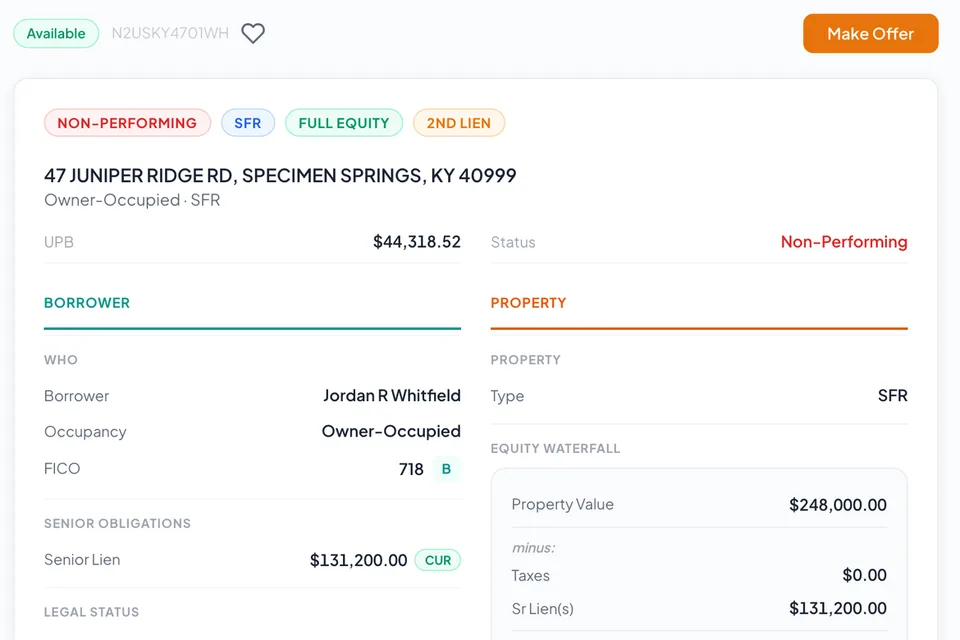
Calculate equity position. For second mortgages, determine the senior lien balance and status. For first liens, calculate equity after accounting for delinquent taxes and any other encumbrances.
Once you have reviewed these factors, you can refine your pricing conversation with the seller using three core variables:
| Factor | First Liens | Second Liens |
|---|---|---|
| Tax / Senior Status | Property tax delinquency | Senior lien balance and payment status |
| Occupancy | Owner-occupied, rented, or vacant | Owner-occupied, rented, or vacant |
| Equity | Value minus taxes and encumbrances | Value minus senior liens, taxes, and encumbrances |
These three factors alone will get you 75 percent of the way to a refined price. You do not need expensive vendor reports to have an informed second conversation with the seller. You need public records, free online tools, and the willingness to spend an hour doing the work before you spend a dollar on paid reports.
Should You Fund or Flip? The Four-Level Decision Matrix
After completing your initial review, you should have a clear picture of the asset types in the portfolio. Now comes the decision that defines your business model on each deal: fund it or flip it?
This decision is not a single question. It is a four-level framework, and you need to pass each level before committing capital.
Level 1: Do You Have the Capital?
This is the threshold question. If you cannot fund the deal, the answer is simple -- flip the assets to a buyer who can.
But capital is not just the purchase price. You need to account for working capital reserves beyond the acquisition cost. For non-performing loans, plan on approximately $10,000 per asset in reserve capital. For performing loans, you may be able to reduce that to under $5,000 per asset. These reserves cover contingencies that are not optional:
- Property taxes that go delinquent and need to be paid to protect your lien position
- Servicing fees of approximately $25 per month per loan
- Legal costs if the resolution path requires attorney involvement
- Corporate advances for property preservation on vacant or distressed properties
The rule is clear: do not commit all of your available capital to a single opportunity. If the deal consumes your reserves, a single unexpected expense can put you in a position where you cannot protect your investment.
Level 2: Do You Have the Time?
Time horizon varies dramatically based on geography and the seller's prior collection activity.
States with judicial foreclosure processes -- like New York and New Jersey -- can take several years to resolve through litigation. If the seller has already initiated foreclosure and you are inheriting an active legal case, you may not see a return on your investment for a long time. You need to be honest about whether your capital can stay deployed that long.
By contrast, non-judicial states like Texas and Arizona can complete the foreclosure process and move through to REO disposition in just a couple of months. Same asset class, entirely different time commitment.
The seller's prior activity is equally important. Institutional sellers often have charged-off loans that have not been touched in years. Those borrowers may just need to know where to make their payments -- there could be significant low-hanging fruit in that portfolio. But if the previous holder was a hedge fund or private lender that exhausted every collection strategy before deciding to sell, foreclosure may be the only remaining path. That is a different time commitment and a different deal.
Even with a portfolio of 100 loans, the day-to-day management of non-performing resolutions can often be handled by a single person, and not even on a full-time basis. The process is largely a pattern of outreach, then waiting -- send a letter, wait a week or two, get your attorney involved, check in monthly for status updates. It is more of a hurry-up-and-wait rhythm than a daily grind. Above 100 loans, the time commitment starts to scale more meaningfully.
Level 3: Do You Have the Skill?
A skill deficiency is surmountable -- but not if you are already stretched thin on capital and time. If you are near your limits on the first two levels, jumping into the deep end on complexity is a recipe for trouble.
The biggest skill challenge for newer investors is active litigation. Loans that have already been through exhaustive collection efforts and are now in an active legal process create significant complexity. You need to understand:
- Why the previous seller did not finish the legal process themselves
- Whether there are red flags in the case that could delay resolution
- The specific foreclosure procedures in the relevant jurisdiction
- How to communicate effectively with attorneys about case status and strategy
If you are buying your first loans, target portfolios where the win-win resolution window is still open -- loans where the borrower has not been contacted, where a welcome package and options letter might be all it takes to start a productive conversation. Save the litigation-heavy deals for when you have the experience and the legal relationships to manage them effectively.
Level 4: Do You Have the Interest?
This may sound obvious, but it is worth a hard look. Even if you have the capital, time, and skill, you need to honestly assess whether the specific resolution scenarios in this portfolio are ones you want to handle.
Are you prepared to take back a property through the REO process, potentially in a state where you have never operated? Are you ready to manage a situation with a serial bankruptcy filer who may be hostile or litigious? Do you have a team -- a door knocker, an attorney, a servicer, property preservation vendors -- in place to handle the contingencies that these loans might produce?
Consider the rules of thumb:
- First liens secured by vacant properties are likely heading to REO through either a deed in lieu or foreclosure
- Borrowers with multiple bankruptcies on their credit history may require proactive field outreach because they are unlikely to engage voluntarily
- Loans in states you have never worked in will require building new vendor and attorney relationships from scratch
Move forward with cautious optimism, but plan for worst-case scenarios. If the worst case on a particular pool is something you are not equipped to handle, flip those assets and focus your capital where your interest and infrastructure align.
How Do You Structure the Letter of Intent?
Once you have passed all four levels and decided to fund the deal, the next step is preparing a letter of intent -- the formal document that communicates your pricing and terms to the seller.
An LOI can take different forms. It can be as informal as an email with terms, conditions, contingencies, price, and timing. Or it can be a polished PDF with a cover letter, a proof of funds attachment, and a detailed pricing schedule. For your first transaction, err on the side of overly professional. Include everything.
Your LOI should cover:
Loan-level pricing. Do not submit a single bulk price for the portfolio. Define individual prices for individual assets. This precision demonstrates that you have done your homework, and it protects you if specific loans need to be removed from the pool during due diligence.
Contingencies. Spell out what conditions must be met for the deal to close -- complete documentation, delivery of collateral files, satisfactory title review, and any other requirements specific to the portfolio.
Timing. Define the timeline for contract execution, the due diligence period, and the funding date.
Exclusivity. This is critical. Once the seller signs your LOI, you should be the exclusive buyer through the remainder of your due diligence. You are about to spend real money -- title reports at roughly $100 per asset, credit reports at approximately $10 per asset, and potentially BPOs at another $100 per asset. For a large portfolio, these costs add up fast. You cannot afford to have the seller shopping your diligence to another buyer while you are investing in the research.
Escrow. Consider whether a third-party escrow agent should handle the closing. Document this in the LOI so there are no surprises later.
What Does the Closing Checklist Look Like?
With the LOI signed and exclusivity secured, you move into the final phase of the acquisition. Here is the sequence:
- Order vendor reports. Title, BPO, credit -- get all vendors working immediately so you can meet your timeline
- Tighten property values. Dig into county public records, check PACER for bankruptcy filings, review all vendor reports as they come in
- Append your research spreadsheet. Update the data tape with every new finding -- values, tax status, title issues, bankruptcy flags, occupancy verification
- Document misrepresentations. Note any material discrepancies between the seller's data and your findings. Delinquent taxes that erode equity, properties that have been demolished, satellite imagery showing structural damage -- anything that justifies a price adjustment
- Present your final offer. If your diligence revealed issues, present a revised price with supporting evidence. The seller needs to see why the price changed, not just that it changed
- Execute the LPSA. The loan purchase sale agreement is the binding contract that governs the transaction
- Fund and transfer servicing. Wire the funds and coordinate the boarding of loans to your loan servicer
The key principle through this entire process is that the only legitimate basis for reducing your price below the LOI amount is documented evidence of misrepresentation or material new information. You committed to a price. Honor it unless the facts changed. That discipline is what earns repeat business from sellers who have the best inventory.
What If the Deal Does Not Pass Your Framework?
Not every portfolio is a buy. In fact, the discipline to walk away -- or more precisely, to flip what you should not fund -- is one of the most valuable skills in the note business. If the deal does not pass your four-level test, you have options:
- Flip the entire portfolio to a buyer whose parameters better fit the assets
- Cherry-pick the loans that fit your criteria and flip the remainder
- Broker the deal to a counterparty and earn a fee without deploying capital
The critical point is timing. Do not lead a seller on. If you know within the first hour of your initial review that these loans are not for you, communicate that immediately. Offer to connect the seller with a buyer who is a better fit. That honesty preserves the relationship and positions you for future deal flow when the right portfolio comes along.
Actionable Takeaways
-
Under-promise on pricing from the first conversation. Delivering better-than-expected numbers builds trust and generates repeat deal flow. Overpromising and fading at closing destroys relationships.
-
Spend an hour before you spend a dollar. Free resources -- county records, online valuation tools, public tax data -- can get you 75% of the way to a refined price before you order a single paid report.
-
Apply the four-level framework on every deal. Capital, time, skill, interest. If you cannot pass all four, flip the assets rather than overextending on any single dimension.
-
Secure exclusivity before spending on due diligence. Title reports, BPOs, and credit pulls cost real money. Protect that investment with a signed LOI that grants you exclusive diligence rights.
-
Document everything during your closing process. Misrepresentations and material findings are your only legitimate basis for adjusting price below your LOI commitment. Build the evidence file as you go, not after the fact.
-
Decide early, communicate honestly. If the deal is not for you, say so immediately. The seller will remember your integrity long after they have forgotten the deal that did not close.
 Free Note Investor Workshop
Learn notes by pricing one.
Analyze a training loan modeled on a real deal, then submit practice offers on loans that actually sold.
- No credit card
- No email needed to start
- 7 steps · about 70 min