Passive Income
What is passive income from mortgage notes?
A performing mortgage note pays the holder monthly principal and interest on a schedule defined in the original promissory note. After acquisition, the note investor's day-to-day involvement is limited to reviewing servicer reports and confirming payments are received — the cash flow itself is generated by the borrower's contractual obligation, not by ongoing operational work.
How is it different from rental real estate?
Rental property generates income through tenants, but landlords carry ongoing operational responsibilities — maintenance, vacancies, turnovers, evictions, capital expenditures. Note investors hold the debt rather than the property, which means they collect cash flow on the loan without managing the asset. The trade-off is the absence of property-level appreciation and the dependence on a single counterparty (the borrower) for income.
Tax treatment
Interest income from a mortgage note is generally taxed as ordinary income at the holder's marginal rate, unlike rental real estate where depreciation can shelter cash flow. Many note investors hold notes inside self-directed IRAs (SDIRAs) to defer or eliminate that ordinary-income tax exposure. Consult a CPA before structuring a portfolio for tax-driven goals.
Risks to "passive"
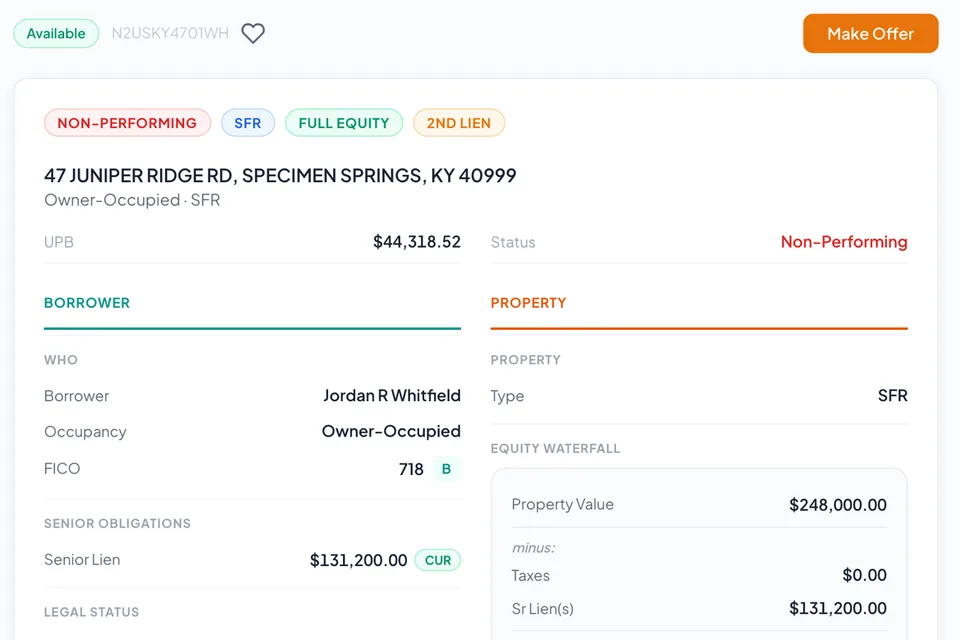
Even a performing note can become non-performing. The income stream is only as reliable as the borrower, the collateral, and the loan servicer. Due diligence at acquisition — borrower credit, property value, lien position, payment history — is what determines whether income is durable or fragile.
 Free Note Investor Workshop
Learn notes by pricing one.
Analyze a training loan modeled on a real deal, then submit practice offers on loans that actually sold.
- No credit card
- No email needed to start
- 7 steps · about 70 min