How to Flip Mortgage Notes for Transaction Fees
How to flip mortgage notes for transaction fees: get seller approval, build a buyer network, structure deals, and earn spreads or broker fees.
What Does It Mean to Flip a Mortgage Note?
Flipping mortgage notes is the practice of earning transaction fees by connecting sellers who have loans they need to unload with buyers who want to acquire them. You are not buying the note yourself. You are acting as a conduit in the secondary mortgage market -- identifying deals that do not fit your own portfolio, finding the right buyer, and earning compensation for making that match happen.
This is one of the most accessible entry points in note investing because it does not require capital to fund a purchase. What it does require is deal flow, a network of buyers, the discipline to add genuine value at every step, and the integrity to operate transparently with all counterparties.
Done poorly, note flipping is just forwarding emails. Done well, it is a professional loan sale advisory service that sellers rely on and buyers pay premiums to access.
Why Does the Seller's Permission Come First?
Before you market a single loan, you need the seller's explicit blessing. This is non-negotiable. If you attempt to flip loans without the seller's knowledge, you risk being blacklisted from future deal flow -- and word travels fast in this industry.
Here is how quickly things can go sideways: a broker once sent back a portfolio that was already being marketed by the original seller, thinking the seller would be an end buyer. The seller recognized their own loans. That broker's reputation took a hit that no amount of future deal flow could repair.
The conversation itself is straightforward. For institutional sellers who have no existing connections to the secondary market for non-performing loans, you may be their first and only introduction to a broader buyer pool. That makes the pitch easy -- you are opening a door they did not know existed. But if the seller already operates in the secondary market and has established buyer relationships, they are unlikely to let you earn a fee marketing loans they can sell themselves. Reading the seller correctly takes experience, but the underlying principle never changes: transparency first, always.
How Do You Approach the Seller Conversation?
There are two scripts that work depending on how much pricing information you already have.
When you know the seller's pricing expectations: After reviewing the assets and determining they do not fit your own investment criteria, you pivot with a simple statement: "This trade does not fit our wheelhouse, but we have a few buyers in mind who would be a great fit. Do you mind if we share the opportunity and get the ball rolling?" This works because you already know the seller's target price and can identify a buyer willing to pay above it -- allowing you to earn a spread or fee.
When you do not have pricing guidance yet: You need to establish the seller's floor before you can match them with a buyer. The approach is to anchor low: "We are seeing some issues with the deal that put our pricing at the high end around 25% of UPB. Does that fit your expectations?" If they accept that number, the deal needs to be good enough that you would fund it yourself -- not just flip it. If they push back and give you a realistic target, you now have the pricing intelligence to find the right buyer.
The goal of both approaches is the same: establish a price the seller will accept, then find a buyer willing to pay more. The difference between these two numbers is where your compensation lives.
Where Do You Find Buyers?
Finding great buyers is significantly easier than finding great deals. Capital is a commodity in this market. Deal flow is not. Buyers are actively searching for product, and they make themselves visible if you know where to look.
Google and Paid Advertising
Many note buyers run paid ads specifically to attract deal flow. A simple search for "we buy mortgage notes" will surface dozens of sponsored results from active buyers looking for product. These are buyers who are spending money to tell you they want to close deals.
Organic Content Marketing
Other buyers use content marketing -- blogs, podcasts, social media, educational content -- to position themselves as active participants in the market. The same strategies used to generate seller leads are being deployed by buyers to attract deal flow. Open your eyes to the marketing around you and you will spot them everywhere.
Industry Conferences
The single best source for building buyer relationships is attending note investor conferences. Events like the Diversified Mortgage Expo, the Note Expo, Paper Source, and MBA and IMN events are filled with buyers who are actively seeking product. These conferences may not be the most efficient place to find deals for sale, but they are exceptional for meeting buyers who want to close deals. These buyers are not hiding. They are there specifically to be found.
How Do You Build a Buyer Rolodex?
Once you start identifying buyers, you need a system for organizing what you know about them. Whether you use a spreadsheet or a CRM platform, the goal is to build a searchable database of buyer preferences so that when a deal lands on your desk, you immediately know who to call first.
The key data points to capture for every buyer:
- Asset types -- Do they buy firsts, seconds, performing, non-performing?
- Geographies -- Which states or regions do they target?
- Target trade size -- Are they buying single assets or loan pools?
- Buy box details -- Price range, collateral requirements, occupancy preferences
- Pricing expectations -- What are they paying per dollar of UPB for various asset types?
Some buyers publish their buy box on their website or distribute it via email to potential sellers. Others will share it in a phone conversation if you explain that you are seeing deal flow and want to understand whether they would be a good fit. Either way, get that information into your Rolodex so you can match deals to buyers without hesitation.
How Do You Set Yourself Apart From "Joker Brokers"?
The lowest-effort approach to note flipping is forwarding an email you received from a seller to your entire buyer list. This is the "joker broker" approach, and it does not close deals. It annoys buyers, creates confusion when multiple people respond simultaneously, and demonstrates zero value.
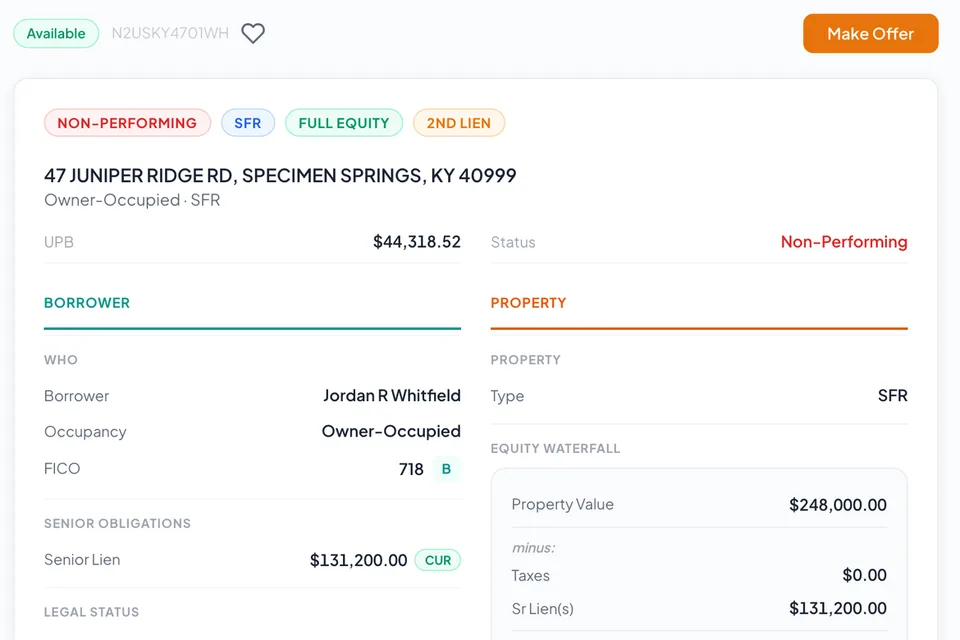
The way to differentiate yourself is through a consistent deal summary format. Because you have already completed your due diligence at the indicative level, you can prepare a one-page summary -- either a spreadsheet or a PDF -- that gives potential buyers everything they need to make a quick decision:
- Loan characteristics and key metrics
- Property details and collateral observations
- Pricing guidance
- Timeline expectations
When buyers become accustomed to your format, they know exactly where to look every time you send them an opportunity. They can say yes or no in minutes instead of days. That speed benefits everyone: the seller gets faster execution, the buyer gets efficiently packaged deal flow, and you get a quicker path to closing.
This is the core principle: you are not a trader scalping a spread between two parties. You are a value-add intermediary. The more value you add -- through research, organization, and professional presentation -- the more you can charge and the more repeat business you will earn.
What Is the Right Way to Manage the Buyer Pipeline?
The best note flippers do not blast opportunities to their entire buyer list. They identify the top-pick buyer -- the one whose buy box most closely matches the deal, or the one who compensates them for first-look access -- and reach out individually.
Here is why: if you send the deal to four buyers simultaneously and all four respond, you now have a prioritization problem. Who gets it? How do you manage competing interests without damaging relationships? The cleaner approach is sequential outreach -- start with your best-fit buyer, get a definitive yes or no, and move to the next one if needed.
When a buyer passes on a deal, ask why. That feedback updates your Rolodex and sharpens your matching ability for future opportunities.
How Do You Vet a Buyer's Letter of Intent?
When a buyer says yes to your deal summary, signs a non-disclosure agreement, reviews the full loan file, and submits an indicative bid or letter of intent, your job is to vet that LOI before presenting it to the seller. You are a conduit, and the smoother the transaction runs, the better your chances of getting paid and earning repeat business.
Evaluate the LOI on three dimensions:
| Priority | What to Check | Why It Matters |
|---|---|---|
| 1. Price | Is the offer in the seller's ballpark? | If pricing is off, nothing else matters |
| 2. Contingencies | Are the buyer's conditions reasonable? | Burdensome contingencies frustrate sellers and kill deals |
| 3. Timing | Does the buyer's timeline match the seller's? | Misaligned closing expectations create friction |
Do not waste the seller's time with a poorly constructed offer. Pre-vetting the LOI protects your relationship with the seller and demonstrates the kind of professional oversight that justifies your fee.
What Are the Three Fee Structures for Note Flipping?
Structure 1: Seller-Paid Percentage Fee
This is the simplest and most recommended starting point. The buyer wires funds directly to the seller. After the seller receives the proceeds, you invoice them for a percentage of the transaction.
The fee range depends on the scope of your involvement:
- 1% for a simple introduction where the buyer and seller handle the rest
- 3% as a typical minimum fee that includes some facilitation
- 7% or more when you are preparing the contract, drafting assignments and allonges, facilitating the servicing transfer, and managing the entire closing process
The more services you bundle into your role, the more you can charge. Position yourself as a loan sale advisor -- not just a matchmaker -- and back it up with real work. Prepare the purchase agreement. Coordinate the collateral delivery. Manage the tape distribution and buyer communications. When the seller sees the volume of work you are handling, the fee is easy to justify.
You can also run competitive loan sale offerings with multiple buyers bidding on the same pool. This approach tends to work better with secondary market sellers who are accustomed to the process, rather than institutional sellers who prioritize execution simplicity over price optimization. An institutional lender does not want to execute 10 different contracts to 10 different buyers with 10 different collateral delivery addresses. They want one clean transaction with one buyer. Know your seller.
Structure 2: The Deal Spread
This is the wholesaling model adapted for mortgage notes. You lock in a price with the seller, find a buyer willing to pay more, and pocket the difference.
This structure is more lucrative but carries a significant relationship risk. In traditional real estate wholesaling, the seller is typically a one-time transaction partner -- a motivated homeowner who, once they unload a troubled property, you will never work with again. If they discover you earned $10,000 flipping their property at settlement, it stings, but there is no ongoing relationship to damage.
Note flipping is different. Your sellers are repeat counterparties. If they see that you could have gotten them a significantly better price and instead kept the spread, they will stop sending you deal flow. The math might work once, but the relationship math fails every time if the seller feels taken advantage of.
Use the spread structure cautiously and transparently. On larger transactions, $10,000 might represent only 1% of the deal -- a reasonable and defensible margin. The key is making sure all counterparties feel the arrangement is fair.
Structure 3: Advanced Double-Dip (Buyer and Seller Fees)
In the ideal scenario, you earn a fee from both sides of the transaction. The seller pays you a percentage when they receive funds, and the buyer pays you a sourcing fee for delivering deal flow that matches their criteria.
The buyer-side fee is structured as a preferred buyer arrangement. The pitch: "I have priority buyers who get first-look access to my deal flow. I charge a 1% fee or a flat per-asset cost -- only a success fee if we close a deal. Do you want preferred buyer status?"
Buyers who say yes sign a finder's fee agreement. They get first access to your pipeline. Buyers who decline can still participate, but they are not first in line. This creates a tiered system where your best buyer relationships are also your most lucrative ones.
This is an advanced structure. Do not attempt it before you have established credibility and a track record of closing deals. Start with the simple seller-paid percentage model and evolve from there.
What Mistakes Kill Note Flipping Deals?
The most common failures in note flipping come down to three recurring errors:
Flipping without permission. Marketing a seller's loans without their knowledge is the fastest way to destroy your reputation. One incident can blacklist you from entire networks of deal flow.
Blasting deals to your entire list. Mass distribution creates chaos. Multiple interested buyers responding simultaneously forces you into uncomfortable prioritization decisions and signals to everyone involved that you are not operating with intentionality.
Failing to add value. Forwarding an email with a tape attached is not a service. If you are not conducting indicative-level due diligence, preparing professional deal summaries, pre-vetting buyer LOIs, and facilitating a smooth closing process, you are not earning your fee. Buyers and sellers will figure that out quickly.
What Does Long-Term Success Look Like?
You do not need dozens of sellers and hundreds of buyers to build a profitable note flipping operation. A handful of trusted sellers who know you, like you, and want to work with you on a regular basis -- combined with a curated group of reliable buyers whose preferences you know inside and out -- is enough to generate consistent transaction fees.
The business runs on relationships. Over-deliver for your sellers by bringing qualified buyers who close. Over-deliver for your buyers by sending them well-packaged opportunities that match their criteria. The sellers keep sending you deal flow because you make their lives easier. The buyers keep taking your calls because you save them sourcing time and deliver real product.
At the end of the day, this is a people business. The note flippers who thrive are the ones who treat every counterparty as a long-term relationship, not a one-time transaction. Add value at every step. Communicate honestly. Execute cleanly. The fees follow.
Key Takeaways
- Always get the seller's explicit permission before marketing their loans. No exceptions.
- Build your buyer Rolodex with detailed preference data so you can match deals to buyers instantly.
- Create professional deal summaries that differentiate you from low-effort brokers and accelerate buyer decisions.
- Start with the seller-paid percentage fee structure -- it is the simplest, most transparent, and easiest to scale.
- Pre-vet every LOI before presenting it to the seller. You are protecting the relationship, not just passing paper.
- Treat every counterparty as a long-term relationship. The one-time spread is never worth more than the ongoing deal flow.
- Add value or get out of the way. The market does not reward intermediaries who do not earn their position in the transaction.
 Free Note Investor Workshop
Learn notes by pricing one.
Analyze a training loan modeled on a real deal, then submit practice offers on loans that actually sold.
- No credit card
- No email needed to start
- 7 steps · about 70 min