Above the API, Five Years Later: Grading My 2021 Calls
In 2021 I said you'd either tell the robots what to do or vice versa. Five years later, I graded every call against primary sources, misses included.
What did I say on the 2021 livestream?
On April 28, 2021, I went live with episode 32 of Be the Bank, my weekly show about the secondary mortgage market. It was a Wednesday at 1 p.m. with a small audience, and a bird cam and a koi-pond cam running for company. The feature segment was called "Break Through the API" (21:22).
Partway through, I put up a slide with one sentence on it and read it out:
"In the not so distant future, you will either tell the robots what to do or vice versa." (25:18)
That was nineteen months before OpenAI released ChatGPT on November 30, 2022. I wasn't talking about chatbots. I was talking about Uber, Instacart and Amazon warehouses, and about which side of the software people would end up on.
I closed the segment with a promise: "I'm by no means an expert on this, but it's definitely something that I've considered and continue to monitor. So I'll keep you guys posted on things that I see." (34:09)
This is the update. The film at the top of this page is the short version. Software made almost all of it, which turns out to be one of the results.
What does "above the API" mean?
An API, or application programming interface, is how one piece of software gives instructions to another. "Above the API" describes which side of that software your work sits on. Above it, you design the system or decide what it should do. Below it, the system tells you what to do.
Here's how I explained it on the stream:
"Uber, for example, is a dispatching service that is created algorithmically. It's drivers and passengers with no middle management. The middle management's been replaced entirely by the API." (23:05)
A cab driver's job used to include finding customers, taking calls and building repeat business. Uber's software took over that part. What was left was an address on a phone. That's a job below the API.
Who coined "above the API"?
Not me. The term comes from software founder Peter Reinhardt's essay "Replacing Middle Management with APIs", published February 2, 2015. His key line: "As the software layer gets thicker, the gap between Below the API jobs and Above the API jobs widens." Two days later, on February 4, 2015, Anthony Kosner covered it in Forbes.
On the stream I said the term was "coined, I think, in 2005 in a Forbes article" (22:31). Wrong decade, and it was Reinhardt's idea before it was Forbes' story.
I didn't coin it. I acted on it. That's the only credit I'm claiming here.
How did my 2021 calls hold up?
I went back through the segment, pulled every concrete claim, and checked each one against a primary source: the company or the researchers themselves, not a news summary.
| The call | What I said in 2021 | What's true in 2026 | Grade |
|---|---|---|---|
| Robot drivers | "Instead of a driver, it's going to be a robot driver." | Waymo: more than 400,000 rides a week (Feb 2026) | Called it |
| Warehouse robots | "The robots are going to do that work." | Amazon: its 1 millionth robot, plus an AI model that coordinates robot movement (Jun 2025) | Called it |
| AI that writes its own code | "As soon as artificial intelligence is able to code themselves…" | Anthropic: more than 80% of the code it merges is authored by Claude (May 2026) | Underway |
| The jobs split | Jobs below the API get taken over by robots | Stanford: employment of 22- to 25-year-olds in AI-exposed jobs is 19% behind their less-exposed peers; no economy-wide displacement (Aug 2026) | Early signs |
| Robot-proof skills | "Creativity, imagination, content creation…" | This film: script, voice, score and animation all made by software (Sep 2026) | Wrong |
| Universal basic income | "I'm not advocating one way or the other" | No UBI in the U.S. (Sep 2026) | Open question |
Did robot drivers happen?
In 2021 I traced a cab driver who becomes an Uber driver taking orders from an app, then gets replaced: "once self-driving cars are more prevalent and safer, instead of a driver, it's going to be a robot driver" (27:28).
In February 2026, Waymo reported "more than 400,000 rides provided every week across six major U.S. metropolitan areas" (Waymo, Feb. 2, 2026). Waymo has also said it's on a path to 1 million rides a week by the end of 2026 (Waymo, Dec. 2025). That's a target, not a result.
Two caveats. Most ride-hail trips in the U.S. still have a human driver. And this was never a bold call: Reinhardt's 2015 essay already said "self-driving cars and drone delivery are certainly on the way." I repeated a good idea. But the robot driver is no longer hypothetical.
Are robots doing the warehouse work?
On the stream: "Instead of Amazon warehouse workers listening to the robots on, you know, where to pull a package and then where to put that package, the robots are going to do that work" (27:37). The chart behind me had three bands. The third was labeled "Below the API Robots."
On June 30, 2025, Amazon announced: "We've just deployed our 1 millionth robot." In the same post it introduced DeepFleet, "a new generative AI foundation model" that "will coordinate the movement of robots across our fulfillment network," which Amazon says improves its robot fleet's travel time by 10% (Amazon, June 30, 2025).
Plenty of people still work in those buildings, so the human job hasn't vanished. But the layer I drew, software directing robots instead of people, now has a product name.
Is AI writing its own code?
This is the line I'd most like to have said more carefully: "advocate for AI safety, because it's going to proceed very, very quickly. And as soon as artificial intelligence is able to code themselves, then it's going to be completely exponential" (31:25).
Anthropic, the company that makes Claude, now publishes this: "As of May 2026, more than 80% of the code we merge into Anthropic's codebase was authored by Claude" (Anthropic, "When AI builds itself"). An AI lab's own model writes most of the lab's code. That's the first half of what I described.
The second half, "completely exponential," is not proven. Anthropic's own page cautions that the exponential trends it describes "may actually turn out to be S-curves." So this one is underway, not called.
The safety half aged better than I expected. The same page says: "If it were possible to effectively slow the development of this technology to give ourselves more time to deal with its immense implications, we think that would likely be a good thing." The company building the technology says slowing down would likely be a good thing. That's the safety half of my 2021 line, in their words.
Is AI taking jobs yet?
My 2021 version was blunt. I called jobs below the API "worse than dead-end" and said "these jobs are going to no longer exist as the API robots take over" (28:03).
The best data I've found is from the Stanford Digital Economy Lab: Erik Brynjolfsson, Bharat Chandar and Ruyu Chen, "Canaries in the Coal Mine?", revised August 12, 2026, using ADP payroll data through June 2026. What they found:
- "We find no evidence of widespread, economy-wide job displacement."
- Employment of workers aged 22 to 25 in AI-exposed occupations is 19% below where it would be had it kept pace with their less-exposed peers. Experienced workers show no comparable gap.
- The gap comes mainly from reduced hiring of young workers, not from layoffs.
- Declines are concentrated in occupations where AI substitutes for human tasks. Where AI complements workers, employment is flat or rising.
The authors call these "early, descriptive indicators… rather than causal estimates." So this isn't proof, and it isn't a test of my framework. But substitute versus complement is the above-and-below line in an economist's vocabulary. And it's showing up as fewer entry-level hires, not mass layoffs, which is quieter than the collapse I described in 2021. Early signs, not a verdict.
Which skills did I think robots couldn't replace?
Here's the list from my slide, titled "Below the API? Lean into your humanity": "Communication, sales, public speaking, leadership… Creativity, imagination, content creation, creating original ideas, emotional intelligence, empathy and compassion, critical thinking, strategy and going with your gut" (29:00).
The film at the top of this page is the counter-evidence: software wrote it, voiced it, scored it and animated it (the film's credits list who did what). Creativity, imagination and content creation were all on my list.
I was wrong about this one.
The line right after that list still holds: "Robots don't have guts" (29:22). A model will write you ten versions of a script. It has nothing riding on which one you pick.
Did universal basic income happen?
I raised it as a question ("I'm not advocating one way or the other," 32:41), and five years later the U.S. has no universal basic income, so it stays an open question.
What's left above the line?
If creativity as output now sits below the API, what's above it? Four things.
- Taste. Knowing what good looks like before it exists. I made the full case in Taste and Resourcefulness: AI can generate unlimited output, but it can't originate the standard that output is measured against.
- Judgment. Deciding what's worth doing, and what to walk away from.
- Ownership. The robots always work for somebody. Whoever owns the asset decides what the software is for.
- Trust. People still want someone on the other side who is accountable for the outcome.
That's the lesson of the miss: creativity as output got automated. The standard it's measured against did not.
How do you get your capital above the API?
A job can sit below the API. Capital doesn't have to.
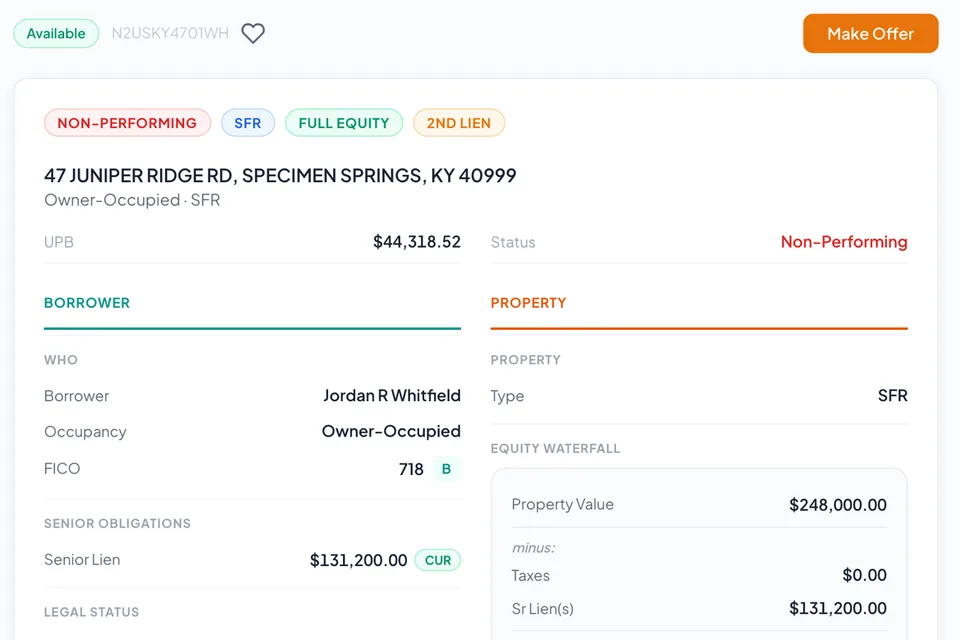
The show was called Be the Bank for a reason. I've spent 15 years in mortgage notes, with more than $299M in career face value of notes sold (face value meaning the loans' unpaid balances, not what they sold for). Most of that has been non-performing notes: loans where the borrower has stopped paying. New to the asset class? Start with what note investing is.
Owning a non-performing note is an above-the-API position for five reasons:
- You own the debt. When you buy the note, you step into the lender's position, subject to the loan documents and state law.
- A licensed servicer runs the day-to-day. A loan servicing company handles statements, payments, required notices and compliance.
- Software speeds up the research. Property values, title, liens and payment history get pulled and cross-checked in a fraction of the time it takes by hand (my workflow is here). Software speeds up due diligence; it doesn't sign off on it.
- You make the decisions. What to buy, what to pay, and what workout to offer.
- The most important part stays human. A fair resolution for a family that fell behind.
What does a fair workout look like?
Later in the same 2021 episode, I walked through two case studies. The first turns on three questions we asked the borrower: "What happened? Where are you now? And what do you want to do?" (36:25).
In practice the servicer usually makes that contact, since collection rules govern who can say what. The questions are the framework; the decision about what to offer is yours.
The second case study was a loan modification on a second mortgage: a lower interest rate and a longer term. Afterward, the family's first and second mortgage payments combined came to less than 28% of their gross income (42:26). Before the modification, that ratio was above 35%. By the time I presented it, they had made 11 months of payments on autopay.
Software can find a loan like that and speed up the diligence. A person decides what fair looks like.
What are the risks of non-performing notes?
You're not the landlord. You're the bank. That means no tenants and no toilets. It doesn't mean no work.
Workouts are still work. Borrowers don't answer. Paperwork stalls. Some loans end in foreclosure, and some end with you taking back the property, at which point you do own a house for a while. A second lien can lose its security if the first mortgage forecloses (more on that in understanding lien position). Resolutions take time and cost money, and you can lose principal. The full range of outcomes is in the beginner's guide to resolutions for non-performing notes.
The risk is real. What puts the position above the line is that the decisions are yours.
How was this film made?
I directed it. Software made it.
My part: I set the angle, a scorecard with honest grades. I picked the narrator's voice and the music by ear from short previews. My own last name took ten tries before the narrator said it right. And I approved the final cut.
Software did the rest:
- Claude (Anthropic) drafted the script and wrote the code that animates it.
- Gemini TTS (Google) voiced the narrator.
- Lyria (Google) composed the score.
- GPT (OpenAI), an independent model from a different vendor, reviewed the script for compliance, and it made the film more honest. It caught an early line saying Amazon had "an AI telling them where to go" (Amazon claims coordination, not command) and a line that oversold the Stanford data as "Above and below the API, measured." Those became "an AI to coordinate their traffic" and "Early data, not proof." The same pass is why the scorecard carries graded stamps instead of a clean sweep.
My 2021 footage was processed on my own machine and never sent to an AI service. Total API spend for the film: USD 0.69 (voice, music, transcription and the script review), on top of my Claude subscription. Total time from brief to final render: about four hours.
That's the 2021 split in miniature. I made the decisions; software did the work. It's how I built the FIXnotes platform, too, and it's how this post was drafted: Claude wrote the first version, and I edited it.
Want to build a note portfolio the same way?
Build a note portfolio the way this film was made: you make the decisions, the tools do the grunt work. The robots made the video. The call is with a human.
Tell us what you want your capital doing. It's an application call with our team, and we'll talk through whether note investing fits your goals.
This post is educational content, not investment advice. Mortgage notes involve risk, including delays, costs and loss of principal.
 Free Note Investor Workshop
Learn notes by pricing one.
Analyze a training loan modeled on a real deal, then submit practice offers on loans that actually sold.
- No credit card
- No email needed to start
- 7 steps · about 70 min