The VIP Pass
How certification unlocks institutional deal flow
Banks won't sell notes to small investors. That's not a myth — it's a fact. Here's how certification solves the access problem.
 New to notes? The free workshop walks you through one loan, start to finish.Start free →
Let Me Save You Some Time
If you call a bank and ask if they have non-performing notes for sale, they'll tell you no. It's not that they don't have them — they just don't want to sell them to you.
That's not cynicism. It's how the market works. And if you've already tried reaching out to banks, hedge funds, or institutional sellers and gotten the cold shoulder, I want you to know something before we go any further: you weren't doing it wrong. The system isn't set up for individual buyers. It never was.
Most courses would gloss over that. They'd tell you to just "build relationships" or "be persistent." I'm going to tell you the truth instead — and then show you what actually works.
The Objection (In Their Own Words)
I hear the same concern from nearly every person who considers getting into this business. The words change slightly, but the objection is the same.
Creed L. put it this way: "Are most banks not messing with you unless you've got, you know, a ton of capital and you're gonna buy everything?"
Joe R. was more blunt: "For a new guy in the note business to walk into a bank and try to get them to talk to me... I'm not digging that so much."
Rahim D. described the feeling that stops most people before they even start — the intimidation of "walking into rooms where they don't know if they're even supposed to be in."
Bill R. looked at the available retail options and came to a logical conclusion: "There's not a whole lot of deal flow on PaperStack. There's not much there."
And Dan G. captured the institutional reality: "Most banks don't want you to know they have non-performing notes."
If any of that sounds familiar, you're not wrong. Let me explain why.
Why They're (Partially) Right
Here's what no one in the "note investing education" space wants to admit: the barriers to entry are real.
Banks sell their non-performing loans at best execution. That means they package hundreds or thousands of loans into massive tapes — $100M or more in unpaid principal balance — and sell them to hedge funds and private equity firms that can wire nine figures with a phone call. That is the primary market for distressed debt. It always has been.
Individual investors calling bank asset departments get stonewalled. Not because they're unqualified or unprofessional — because the bank has no infrastructure to sell one loan at a time to someone they've never heard of. The compliance burden alone makes it not worth their time.
Public retail note marketplaces — the ones you find with a Google search — are picked over by the time most buyers see them. The best assets are gone within hours. What remains are the loans that experienced buyers already passed on.
The system isn't built for individual buyers. It's built for institutions.
So if you've tried and been shut out, it's not because you did something wrong. It's because you were trying to play a game with rules designed to exclude you.
How I Solved It
I spent years getting stonewalled by the same banks. Early in my career at US Mortgage Resolution, I made the same calls, sent the same emails, and got the same results as everyone else. Silence. Polite rejections. The occasional "we'll add you to our buyer list" that never led anywhere.
The pivot came when I stopped trying to force my way through the front door and started asking a different question. Instead of "how do I get banks to sell to me," I asked: "what if I stopped trying to squeeze through the door as a small buyer and became the door instead?"
That question changed everything.
USMR started positioning itself to take down the same institutional tapes the hedge funds were buying — $100M or more in UPB. Not cherry-picking individual loans off public marketplaces, but acquiring the full portfolios that regular investors never see because they never hit the open market.
Then we did something those hedge funds don't do: we broke those portfolios apart into individual deals — single loans that an individual investor could evaluate, bid on, and close. One at a time.
We became the bridge between Wall Street and Main Street. The institutional sellers got the best execution they needed. Individual investors got access to inventory they'd never see otherwise. And the quality of that inventory was categorically different from what shows up on retail platforms — because it was never meant for retail in the first place.
The VIP Pass
But we can't sell to just anyone.
The banks and hedge funds we buy from have requirements. They need to know that whoever ends up holding their former loans is vetted, trained, and capable of handling the due diligence, servicing, and resolution process responsibly. If we sell to unqualified buyers who default on their obligations or mishandle borrower communications, we lose the institutional relationships that make the whole model work.
That's where CNP™ certification comes in — and it's important you understand what it actually is.
CNP™ certification is not a diploma. It's not a piece of paper you hang on the wall. It's a vetting package — access credentials that prove to institutional sellers you've been trained, evaluated, and qualified to participate in this market.
When you're certified, you skip the line. You don't need to spend years cold-calling banks to build credibility one conversation at a time. The credential does that work for you, because it was designed to satisfy the exact requirements institutional sellers impose on downstream buyers.
Your Credential Is Portable
The vetting package is portable. It doesn't just work on the FIXnotes marketplace — you can take it to any institutional seller. Banks, credit unions, hedge funds, and private equity firms all need the same proof: that the person buying their loans understands the asset class, can close reliably, and will handle the borrower relationship professionally.
This isn't platform lock-in. It's a universal credential. You earn it once and carry it everywhere.
The Virtuous Cycle
There's a second layer to this that most people don't see until I explain it.
We can only bring exclusive institutional deals to our marketplace if we can prove to sellers that our buyer base is vetted, qualified, and capable of closing. Every certified buyer strengthens that proof. The more qualified buyers we have, the bigger and better the exclusive tapes we can negotiate. Your certification isn't just for you — it's what allows us to bring better deals to everyone.
This is a cooperative network, not a one-way transaction. Every qualified buyer who joins makes the deal flow better for the entire community. Sellers see a deeper, more reliable buyer pool. They send bigger tapes. We break those into better individual deals. The cycle reinforces itself.
Proof: What Access Actually Looks Like
Remember Mario from the previous lesson? He had no capital and no connections. He got certified, used the sourcing training to build a credit union relationship from scratch, and acquired over $1M in principal balance with no money down.
That's what access looks like in practice. Not a theory about "building relationships someday." A defined process that produced a seven-figure pipeline for someone starting from zero.
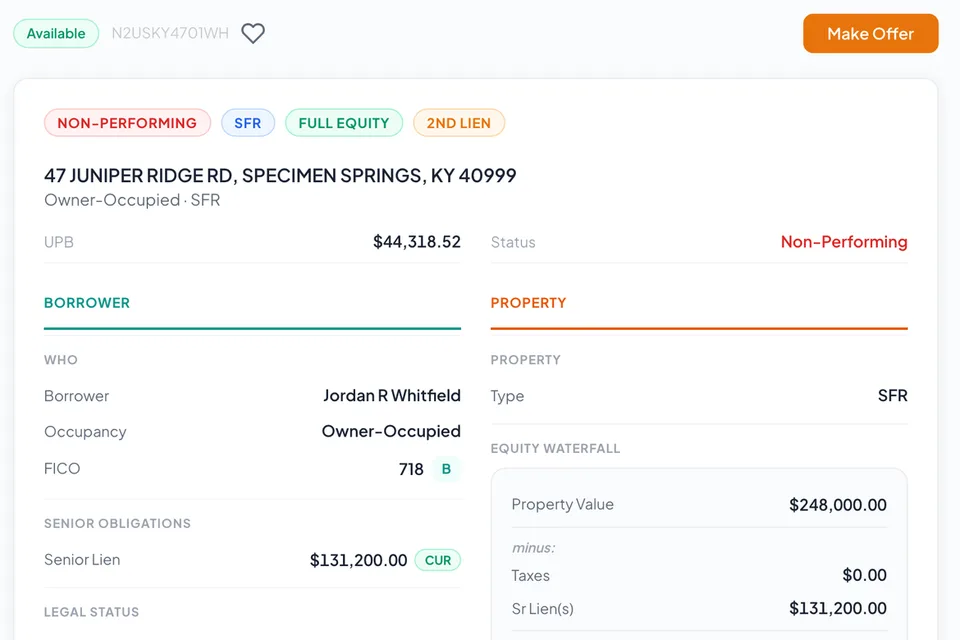
Here's what the FIXnotes infrastructure looks like today for certified buyers:
- $5B per month in UPB flowing through the FIXnotes Trade Desk — institutional inventory that never touches a public marketplace
- Curated exclusive deals on the fixnotes.com marketplace, selected from the best assets in those institutional tapes
- Waived minimums for qualified buyers — no requirement to purchase entire pools or meet six-figure thresholds
- Fast-tracked KYC and provisional offer status — certified buyers move to the front of the line when new inventory drops
This is not a hypothetical future state. This is the current infrastructure, operating today.
The Alternative
Without certification, the path looks like this:
- Years of cold calling bank asset departments that hang up on you or add you to a list that goes nowhere
- Overpaying for picked-over deals on public retail marketplaces where the best inventory is already gone
- Spending money on courses that teach theory but don't give you access to a single deal
- Building relationships from scratch in an industry where trust takes years to establish and a single misstep can set you back to zero
You can spend three years trying to build these relationships yourself. Or you can be qualified in 90 days.
Both paths lead to the same destination. One of them costs you three years and an unknowable amount in missed opportunities. The other costs you 90 days and a structured curriculum.
What's Next
So the access problem is solved. But there's one more thing you need to know — and it's the reason I'm releasing this course right now instead of a year from now.
Something happened in April 2025 that changed everything.
Free Note Investor WorkshopLearn notes by pricing one.
Analyze a training loan modeled on a real deal, then submit practice offers on loans that actually sold.
- No credit card
- No email needed to start
- 7 steps · about 70 min