First-Lien vs. Second-Lien Mortgage
Also known as: first vs second lien, lien priority comparison, junior vs senior lien
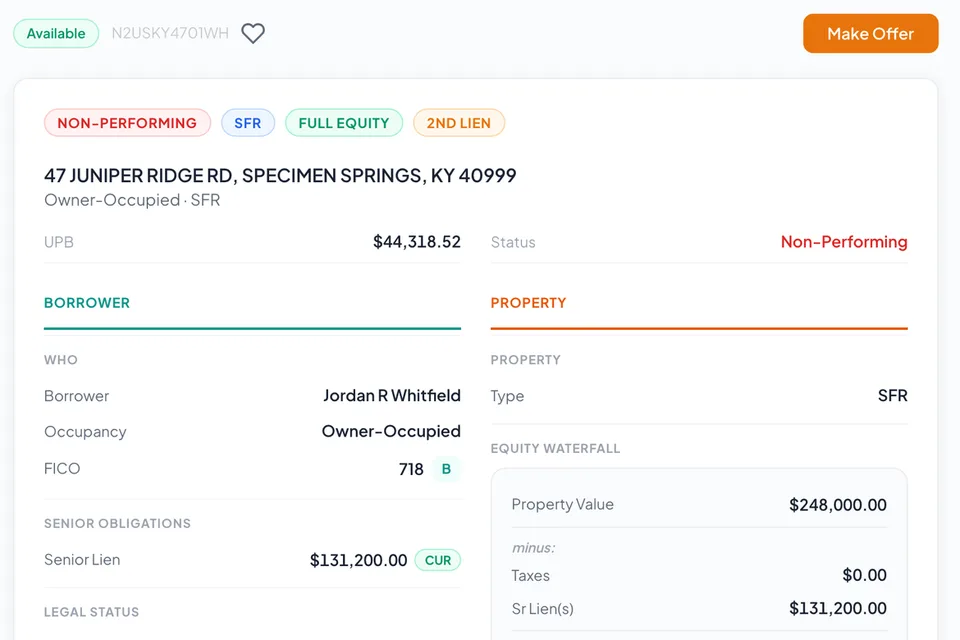
A first-lien mortgage holds senior priority for proceeds from a foreclosure sale; a second-lien mortgage is junior to the first and paid only after the first lien is fully satisfied. The distinction is foundational to mortgage-note pricing because it determines what each lien holder can expect to recover when the borrower defaults and the property goes to foreclosure auction. First liens recover most of unpaid principal balance in most scenarios; second liens are equity-sensitive and recover little or nothing when the property's value falls short.
For the per-loan mechanics of each, see the first mortgage and second mortgage entries. This entry covers the comparison and the secondary-market pricing implications.
What Determines Lien Priority?
The general rule is "first in time, first in right" — the lien that was recorded first at the county recorder's office holds senior priority over subsequently recorded liens. Several exceptions apply:
| Lien Type | Priority Rule |
|---|---|
| Property tax liens | Senior to all mortgage liens, regardless of recording date |
| Federal tax liens | Recording-date rule, with statutory carve-outs |
| Mechanic's liens | Vary by state; some relate back to commencement of work |
| Purchase-money mortgages | Some states give super-priority to purchase-money liens |
| Subordination agreements | Voluntary written agreement can re-order liens |
For a typical residential property with a first mortgage and a HELOC or home equity loan as a second, the first mortgage was recorded first and holds senior priority. The second mortgage holder consented to the junior position when underwriting the loan.
Recovery at Foreclosure
The economic difference between first and second liens shows up at the foreclosure auction. Two worked examples:
Equity-Rich Scenario
A property worth $400,000 with a $250,000 first mortgage and an $80,000 second mortgage. Total liens: $330,000. The property forecloses at a $350,000 gross sale price, with $20,000 of foreclosure costs (legal, marketing, taxes) deducted to leave $330,000 of net proceeds:
- First lien: receives $250,000 → 100% recovery
- Second lien: receives $80,000 → 100% recovery
- Borrower: receives $0 (no excess equity)
In equity-rich scenarios, both lien holders recover fully. The borrower loses any equity they had built up but does not face deficiency liability if the sale covers all liens.
Underwater Scenario
The same loan stack — $250,000 first, $80,000 second — but the property has depreciated to $250,000. Gross sale: $250,000; foreclosure costs: $20,000; net proceeds: $230,000:
- First lien: receives $230,000 → 92% recovery
- Second lien: receives $0 → 0% recovery
- Borrower: still owes deficiency (state law dependent)
In underwater scenarios, the second lien holder absorbs the full collateral shortfall. The first lien recovers most of its UPB; the second lien recovers nothing from the sale. The second lien holder's only post-foreclosure remedy is pursuing the borrower personally for the deficiency, which is uneconomic in most cases.
Pricing Implications for Note Investors
The recovery asymmetry drives the secondary-market pricing structure:
| Lien Type | Typical NPL Price Range | Drivers |
|---|---|---|
| Non-performing first lien | 30-70% of UPB | Property value, state foreclosure timeline, borrower responsiveness |
| Non-performing second lien | 1-30% of UPB | Equity behind the second, first-lien performance status |
| Performing first lien (re-performing) | 70-95% of UPB | Seasoning, payment history, equity |
| Performing second lien | 35-75% of UPB | Equity, first-lien status, borrower credit |
Second liens trade at deep discounts because the equity protecting them can evaporate in a property-value decline. A second lien with significant equity behind it can produce excellent returns through DPO or short-sale negotiation; a second lien underwater is often worth only its nuisance value to the first lien holder.
Junior-Lien Workout Mechanics
Second-lien NPLs are often workout-favored over foreclosure because:
- First-lien foreclosure extinguishes the second. If the first lien forecloses and the property doesn't sell for enough to cover both, the second lien is wiped out at the foreclosure sale.
- DPO economics favor the borrower-and-second-lien deal. A borrower facing a defaulted second can often refinance the first lien if the second is willing to take a discount, producing cash recovery that beats foreclosure-wipeout zero.
- Borrowers stay engaged to protect equity in the property. When property value exceeds the first lien but not both, the borrower has economic incentive to settle the second to preserve their position.
Experienced second-lien investors model both the equity-rich and underwater outcomes when pricing, with the expected weighted recovery driving the bid. See the FDIC Bankers Resource Center for the supervisory framework around junior-lien classification (and the FDIC Quarterly Banking Profile for systemwide trends in residential lien performance), plus the non-performing loan entry for general secondary-market pricing dynamics.
For commercial property junior liens — including multifamily and CRE — the same priority framework applies, though recovery percentages skew differently because commercial property valuations are more cap-rate-sensitive than residential.
See current top 50 banks by rising 1-4 family NPL trends, where first-lien residential dominates the inventory pipeline → Rising 1-4 Family NPLs.
 Free Note Investor Workshop
Learn notes by pricing one.
Analyze a training loan modeled on a real deal, then submit practice offers on loans that actually sold.
- No credit card
- No email needed to start
- 7 steps · about 70 min